
A doctor's bone health advice puts strength training alongside daily movement. Here's how it relates to golfers over 40 and where the evidence stops.




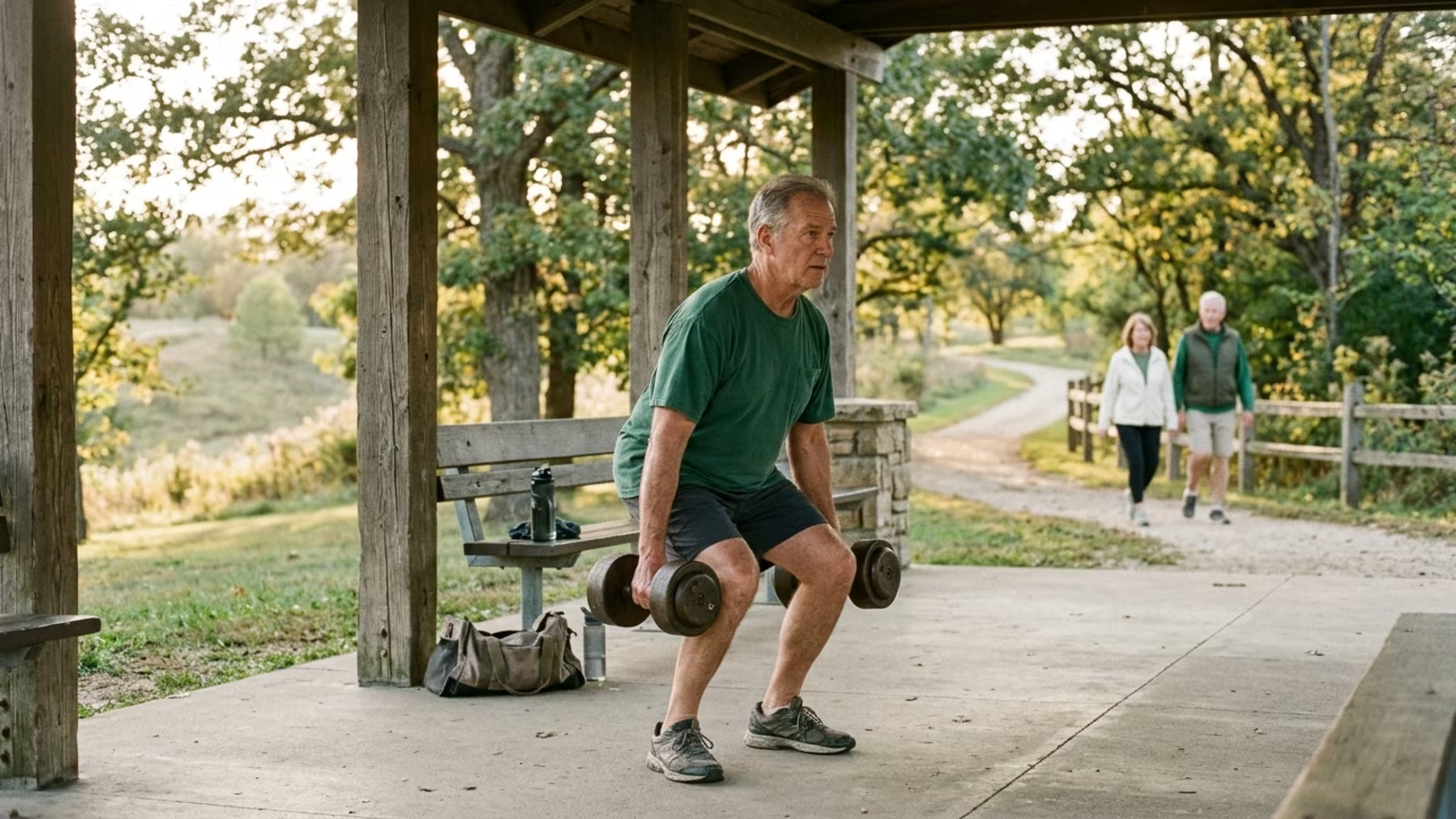
A TODAY.com report republished by NBC Bay Area on October 21, 2026, covered physician Ian Smith's recommendation for bone health: a dumbbell squat followed by a biceps curl and overhead press. Smith presents the combination as one of his favorite compound exercises.
The report places that movement within a broader approach. Its introductory guidance highlights strength training twice weekly and daily movement such as walking. It also calls attention to core stability and glute strength.
For recreational golfers over 40, the useful angle is broader than finding another exercise for the swing. The report offers a reason to think about strength work as part of healthy ageing. Bone health deserves attention alongside the familiar goals of moving comfortably and playing well.
Smith's explanation centers on loading. He says weight-bearing activity can place pressure and tension on bones. His advice favors a manageable weight and consistent exercise rather than treating the amount lifted as the main goal.
The recommended combination brings together a squat, a biceps curl and an overhead press. Those are separate movements joined into one sequence. The report's advice is to learn the parts before putting them together.
Smith also draws a distinction between exercise types:
> “Cardio protects the heart. Strength training supports your bones.”
That is a useful way to read the report's wider message. Walking appears in its daily-movement guidance. Strength training receives separate attention for bone health.
For golfers, the editorial lesson is to avoid treating every form of activity as interchangeable. A round of golf and a strength session do not need to compete for the same purpose. The report presents regular movement and strength work as parts of the same health picture.
There is a separate body of golf evidence worth placing beside Smith's advice.
A secondary golf-health report summarized an eight-week randomized trial involving golfers aged 55 to 79. A strength-and-flexibility program improved strength, range of motion and clubhead speed. That gives this discussion a connection to outcomes golfers recognize rather than relying only on a general fitness message.
The same report described a 2023 comparison of recreational golfers aged 65 to 79 with sedentary peers. The golfers had higher grip strength and better static and dynamic balance.
These findings address physical function and golf performance. Smith's recommendation addresses bone health. Keeping those subjects distinct helps preserve the useful information in both reports without turning separate findings into a single promise.
For an experienced recreational golfer, strength, mobility and balance belong in the same conversation. The golf findings provide a reason to look beyond flexibility alone when thinking about physical preparation. They also fit Golfergy's focus on staying capable for both golf and daily life.
That wider view is the theme of our discussion of strength beyond the scorecard. Not every worthwhile training goal has to be expressed as extra distance. Bone health is another reason to look at what a training plan is intended to support.
The evidence has clear boundaries. The golf trial involved players aged 55 to 79, so it does not directly represent every golfer in their 40s. It tested a combined strength-and-flexibility program rather than Smith's chosen dumbbell sequence. The 2023 comparison was cross-sectional, so it cannot establish that playing golf caused the differences between groups.
The TODAY.com report provides no clinical trial or measured bone-density change for the squat-to-curl-to-press. It supplies no comparative evidence that this is the best exercise for everyone. Neither report establishes that the combination prevents injury or adds years of golf. The sources also do not show that walking a course or playing golf alone provides enough loading to improve bone density.
Those boundaries leave a practical distinction. Strength training can be discussed as a complement to play and mobility work without attaching untested benefits to one movement. The choice of exercise remains separate from the question of what outcomes have actually been measured.
The most useful practical points come directly from the report. They concern learning, manageable loading and getting personal advice when bone health is a concern. They do not require turning the article into a ready-made golf workout.
For beginners, the report recommends practicing the squat, curl and overhead press separately before combining them. The focus is on learning one movement at a time. The combination is the eventual sequence described in the story, not a reason to skip the individual parts.
Smith also advises using a manageable weight and exercising consistently. His message is about an approach that can be repeated. It is not presented as a challenge to lift the heaviest dumbbells available.
For readers with bone-density concerns, the report recommends speaking with a doctor. That is the appropriate place for decisions about whether this particular movement fits someone's health situation. A general article is not a personal exercise prescription.
For the golf calendar, the useful planning question is where strength work belongs alongside rounds and other movement. Golfergy's article on keeping strength work in the playing season addresses that wider topic. The aim here is to keep the role of strength visible without asking one exercise to carry the whole plan.
Smith's recommendation puts bone health into the strength-training conversation. The golf research adds a separate reason to pay attention to strength, mobility and balance in older players. Together they support a broader view of preparation than swing practice alone.
The open question is how particular exercise choices relate to bone outcomes in recreational golfers. That remains distinct from finding a program that suits an individual's health and playing goals.
For now, the grounded takeaway is to treat strength work and everyday movement as complementary parts of healthy ageing. Keep the purpose clear. Let personal health decisions be guided by qualified care rather than the appeal of a single favorite exercise.
Follow Golfergy for practical insights on performance, mobility, recovery and healthy ageing. Stay connected for new articles, research-led guidance and ideas to help you play better for longer.


A research-led strength framework for golfers over 40, connecting lower-body, upper-body and trunk capacity with the demands of a full round.

A movement-led golf warm-up for golfers over 40, with a flexible example, practical adaptations and clear limits on injury-prevention claims.
A flexible training framework for golfers over 40 that makes room for strength, balance, mobility and aerobic activity alongside play.
Explore practical resources on performance, recovery, mobility and golf longevity.
Read the Blog