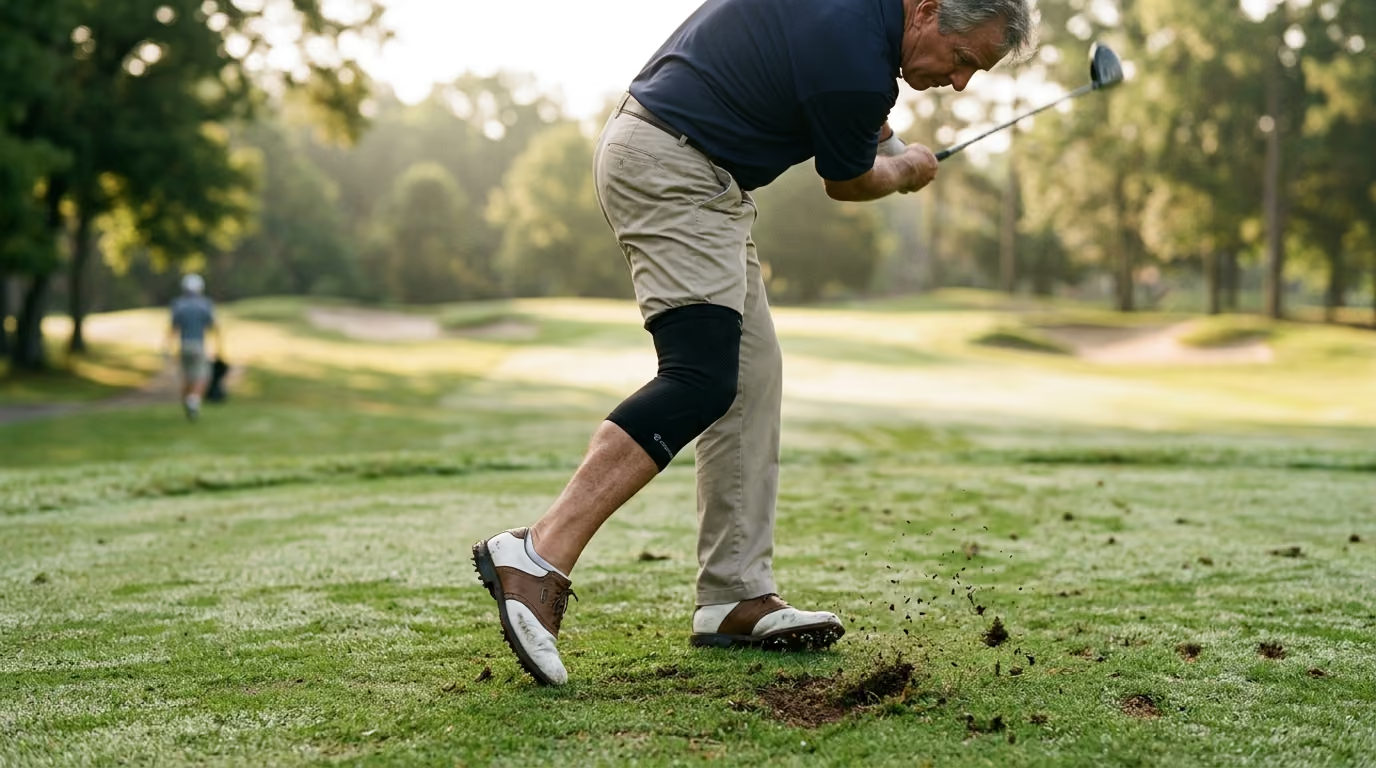
Stepping up to the tee box with osteoporosis feels daunting, but simple swing adjustments protect your spine and hips during every round.




The afternoon sun casts long shadows across the fourteenth fairway. You are playing a steady round, but your lower back is starting to feel the miles. As your ball rests near the green, you bend over to pick it up from the cup. A sudden, sharp twinge in your mid back makes you pause.
This moment of hesitation is a shared experience for many mature golfers. When you receive a diagnosis of osteopenia or osteoporosis, your relationship with the game changes. Every tee box, every bunker shot, and even bending down to tee up the ball can feel like a potential hazard. You begin to question whether your skeleton can handle the physical demands of the sport.
It is common to feel a sense of worry after learning your bone density is low. You might wonder if you need to give up your weekly foursome. The fear of a sudden fracture can easily overshadow your love for the game.
However, complete retirement from golf is often the wrong choice. The game offers immense physical and mental benefits that are vital as we age. Walking several miles in the fresh air keeps your heart and lungs healthy.
Staying active is also a key component of managing your bone density over time. Your bones need physical stimulus to stay strong and resilient. The challenge lies in balancing the health benefits of golf with the potential risks to your skeleton.
This guide is designed to help you navigate that balance safely. We will examine how to adjust your swing, your movement, and your equipment to protect your spine and hips. You can continue to play the game you love without putting your structural health at risk.
In our experience, senior players who make these smart adjustments often find they play with more consistency. They no longer swing with the tension that comes from fear. By learning how to load your body safely, you can extend your playing years and protect your independence. Let us look at what happens inside your body during a round of golf.
To build a safe approach to golf, we must first understand the biology of bone. Bone is not a static, mineral structure. It is a living, dynamic tissue that constantly remodels itself in response to physical stress.
When you place a safe physical load on a bone, it deforms slightly. This microscopic bending triggers specialized cells called osteoblasts to build new bone tissue. This process is known as mechanotransduction, and it is how we maintain skeletal strength as we age.
However, this system requires the right type of physical stress. Among physically active older adults, bone density loss remains a widespread issue. Research indicates that the prevalence of osteoporosis can be as high as 39.4 percent in the lumbar spine or femoral neck, even in active individuals. This means that general, unstructured activity is not always enough to prevent bone loss.
This brings us to the famous study of golf caddies, which highlights the power of walking. Researchers tracked the bone mineral density of professional caddies over several years. They found that these individuals experienced continuous gains in femoral neck bone density.
The secret was the sheer volume of consistent, weight-bearing walking. Every step a caddy takes carries their body weight plus the load of a golf bag. This repetitive, vertical impact signals the body to strengthen the hip joints.
For the recreational golfer, walking the course is the most beneficial aspect of the game. It provides a steady stream of axial loading. This vertical pressure is highly effective at preserving the density of your femur and pelvis.
Interestingly, studies on professional golfers show a different result. Researchers found no significant increase in lumbar spine or femoral neck bone density in professional players compared to inactive controls. This suggests that the high-velocity swing itself is not a primary driver of bone density.
The rapid twisting of a swing does not provide the steady, prolonged loading that bones need to grow stronger. Instead, the swing generates high peak forces that can actually exceed the strength of fragile bones. It is the walking between shots, not the hitting of the ball, that protects your hips.
For female golfers, the hormonal environment plays a critical role in this process. Postmenopausal women experience a rapid drop in estrogen, which accelerates bone loss. Research published in the British Journal of Sports Medicine shows that playing golf works in harmony with Hormone Replacement Therapy.
When combined with Hormone Replacement Therapy, the physical activity of golf leads to significant improvements in lower spine bone strength. The therapy helps preserve bone minerals, while the physical movement stimulates new bone growth. This dual approach is highly effective for managing your long-term skeletal health.
These findings show that golf can be a powerful health tool. But we must manage the mechanical forces of the swing to avoid self-inflicted harm. To do this, we need to look at how the spine behaves under rotational stress.
This combination is a key component of healthy ageing for golfers of all skill levels. It allows you to maintain your active lifestyle while keeping your bones structurally sound.
The human spine is a marvel of engineering, composed of twenty-four individual bones called vertebrae. Each vertebra has a thick front section called the vertebral body and smaller bony structures in the back. These bones are cushioned by soft discs that absorb shock as you move.
In a healthy spine, these structures work together to allow a wide range of movement. However, when osteoporosis weakens the vertebral bodies, the mechanics of the spine change. The front part of the bone becomes porous and fragile, making it highly susceptible to compression.
The primary risk for any golfer with bone density concerns is the twist-flexion conflict. This biomechanical hazard occurs when you bend forward at the waist while simultaneously twisting your torso. It is the exact position many golfers adopt during the backswing and downswing.
When you bend forward, you compress the front of your vertebral bodies. If you add a rapid rotation to this bent position, you introduce shear and torsional forces. The front of the weak vertebrae cannot withstand this combined pressure, leading to a wedge fracture.
A wedge fracture causes the front of the vertebra to collapse into a triangle shape. This collapse can happen during a single, forceful swing or build up over time through micro-fractures. The result is a loss of height, chronic back pain, and a permanent forward stoop.
To protect your spine, you must distinguish between safe vertical loading and dangerous shear forces. Safe loading is axial compression, which runs straight down your spine. When you stand tall or walk, your body weight is distributed evenly across the entire surface of each vertebra.
This vertical pressure is highly beneficial. It stimulates the bone cells to absorb calcium and maintain their density. It is the natural, healthy way to load your skeleton during physical activity.
Shear force, on the other hand, acts horizontally across your spine. It tries to slide one vertebra over the bone below it. The golf swing generates massive shear force in the lower back as the upper body rotates against the pelvis.
Torsional force is the twisting pressure applied to the spinal joints. When these forces are combined with forward bending, the risk of injury rises dramatically. Our objective is to design a swing that eliminates these horizontal and twisting forces on the spine.
The first step in this process is adopting the "I" Frame Framework. This is a postural strategy that maintains a strict vertical line between your hips and shoulders. Imagine your torso as a solid, rectangular box that rotates as a single unit.
In a standard golf setup, players often fall into two dangerous postural patterns. The first is the "C-shape" posture, where the upper back is rounded and the shoulders slump forward. This puts constant forward pressure on your thoracic vertebrae.
The second is the "S-shape" posture, where the lower back is arched excessively. This position pinches the joints in your lower spine and concentrates rotational stress in one small area. Both postures prevent your spine from rotating safely.
The "I" Frame keeps your spine in a neutral position. You bend from your hips, not your back, keeping your spine straight from your tailbone to your head. This neutral alignment allows your torso to rotate without bending, minimizing the risk of a wedge fracture.
Finally, we must implement end-range avoidance. This safety protocol requires you to stop your swing before you reach your maximum joint flexibility. When you swing to your physical limit, your muscles must act as a hard brake to stop the movement.
This sudden braking creates a whip-like deceleration force that strains your bones and ligaments. By stopping your swing short of your physical limit, you make sure the transition remains smooth. This protects your spine from the high-torque forces that occur at the end of the swing.
Making specific changes to your swing is the most direct way to reduce spinal stress. You do not need a complicated technique to play safely. You simply need to implement three core modifications that protect your skeletal structure.
The first modification is raising your front heel during the backswing. In a traditional modern swing, players are taught to keep their lead heel planted firmly on the ground. This creates a large stretch between the upper body and the hips, known as the X-Factor.
While this stretch generates high clubhead speed, it is highly dangerous for thin bones. Keeping your heel down locks your pelvis in place. This forces your lumbar spine to perform the entire rotational turn.
By letting your front heel lift, you unlock your pelvis. Your hips can now rotate freely along with your shoulders. Focus entirely on turning your trail hip as you complete your backswing.
This simple adjustment allows your entire trunk to rotate as a single, coordinated unit. It distributes the rotational force across your hips, knees, and ankles. These large, lower-body joints are much better suited to handle the load than your delicate spine.
The second modification is opening your lead stance at address. When you set up to the ball, flare your front foot toward the target. Aim for an angle of 30 to 45 degrees rather than keeping it perpendicular to the target line.
Flaring your foot pre-rotates your lead hip joint. On the downswing, your hips must clear to allow the club to pass through impact. If your front foot is square, your lead hip can hit a mechanical wall, forcing your lower back to twist violently to finish the swing.
Opening your stance allows your hips to slide and rotate smoothly through the ball. It eliminates the abrupt torque on your lower back at impact. This change makes the downswing feel effortless and pain-free.
The third modification is shortening your backswing by 25 to 30 percent. Many senior golfers struggle to maintain a long, high backswing. They force their arms and shoulders back, which causes their spine to bend sideways and twist.
A shorter, controlled backswing reduces these destructive forces. You can think of this as a three-quarter swing. You will be surprised to find that your distance does not suffer significantly.
By shortening the swing, you maintain better balance and strike the ball closer to the sweet spot. The solid contact compensates for the slightly shorter swing path. Most importantly, you keep your spine well away from its dangerous physical limits.
These physical adjustments are the foundation of safe golf. They allow you to enjoy the sport without putting your spine in jeopardy. Incorporating focused injury prevention strategies into your setup will preserve your skeletal integrity.
You can find more detail on how these modifications fit into a broader lifestyle in our comprehensive resources section.
Many golfers do not realize that the most dangerous moments on the course do not involve hitting the ball. Instead, injuries often occur when players bend down to perform simple tasks. Bending over to place a tee, mark a ball, or lift a club from the ground is a hidden hazard.
The standard way people bend down involves rounding the lower back. This movement puts your spine into deep flexion. Under the force of gravity, this position places a heavy bending load on your vertebral bodies.
For someone with osteoporosis, this simple movement can cause a vertebral compression fracture. To eliminate this risk, you must replace the standard waist-bend with the Golfer's Reach. This technique is a variation of the single-leg Romanian deadlift, a highly respected strength exercise.
To execute the Golfer's Reach, start by standing close to the object you want to retrieve. Place the head of your putter or driver on the ground next to you. Hold the grip firmly with one hand to create a stable, third point of contact like a tripod.
Shift your entire body weight onto your standing leg. Keep the knee of this supporting leg slightly soft, not locked straight. As you begin to lean forward, lift your opposite leg straight out behind you.
Your torso and your back leg must move together like a seesaw. Keep your spine perfectly straight from your neck down to your lower back. There should be no rounding or bending in your spine at any point.
Hinge forward from your hip joint until your hand is low enough to reach the ball. Grab the object, then push down through the heel of your supporting leg. Squeeze your glute muscles to return your body to a tall, standing position.
This movement completely bypasses your spinal joints. The entire load of your upper body is carried by your hip muscles and your hamstrings. These are some of the strongest muscles in your body, designed specifically for heavy lifting.
Using the Golfer's Reach on every hole turns ball retrieval into a strength-building exercise. It protects your back from sudden, harmful bends. Over time, this safe movement pattern becomes automatic, keeping you safe both on and off the course.
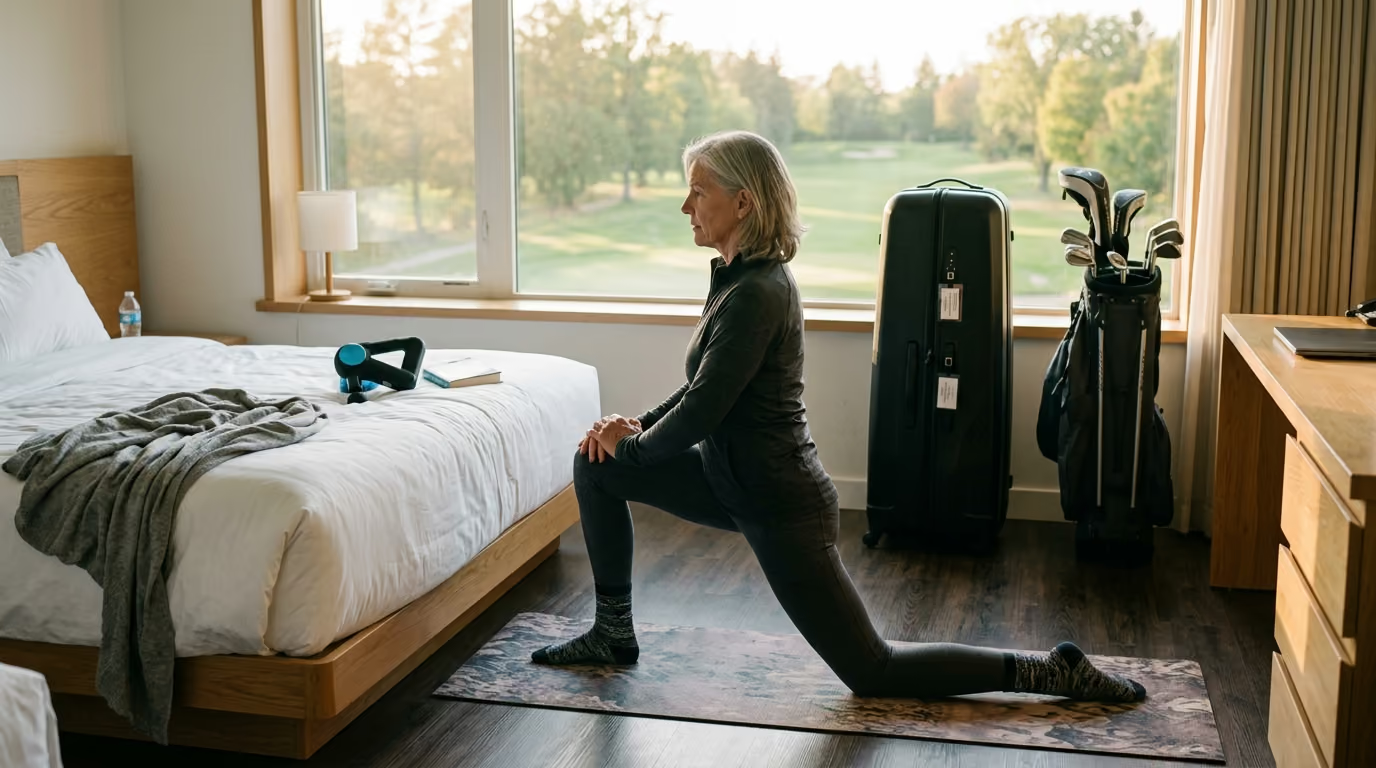
A resilient skeleton requires consistent daily preparation. You cannot expect your body to handle the forces of golf if you only train on the course. A structured, daily routine is necessary to build the supportive musculature around your bones.
One of the most effective exercises for golfers is the Prone Cobra. This movement targets your back extensors, including the erector spinae and the multifidus. These muscles run along your spine and act as a natural brace, keeping your vertebrae aligned.
To perform the Prone Cobra, lie face down on a supportive exercise mat. Keep your legs straight and let your feet rest naturally. Tuck your chin slightly as if you are holding a tennis ball under your chin.
Slowly raise your chest and shoulders off the floor. As you lift, rotate your arms so your thumbs point toward the ceiling. Squeeze your shoulder blades together and hold this position for five seconds.
Keep your lower belly pressed into the floor to avoid over-arching your lower back. Lower your chest back to the mat with control. Perform three sets of ten repetitions daily to build endurance in your back muscles.
This exercise prepares your body to maintain the "I" Frame posture throughout your round. It prevents the slumping that leads to injury. Strong back muscles are your best defense against spinal compression.
In addition to back extension work, you must incorporate resistance training into your weekly routine. The American College of Sports Medicine recommends lifting weights 2 to 3 days per week. This training must be done at a moderate to high intensity to build bone.
To stimulate bone growth, you must use weights that make 8 to 12 repetitions challenging. This corresponds to roughly 70 to 80 percent of your maximum capacity. Light, easy weights do not place enough stress on the bone to trigger the remodeling process.
Focus on compound movements that load your hips and spine safely. Exercises like the leg press, wall sits, and seated rows are excellent options. They allow you to apply load to your skeleton without risking your balance.
These functional movements are vital for developing proper strength and stability. They build a solid foundation that supports your active lifestyle.
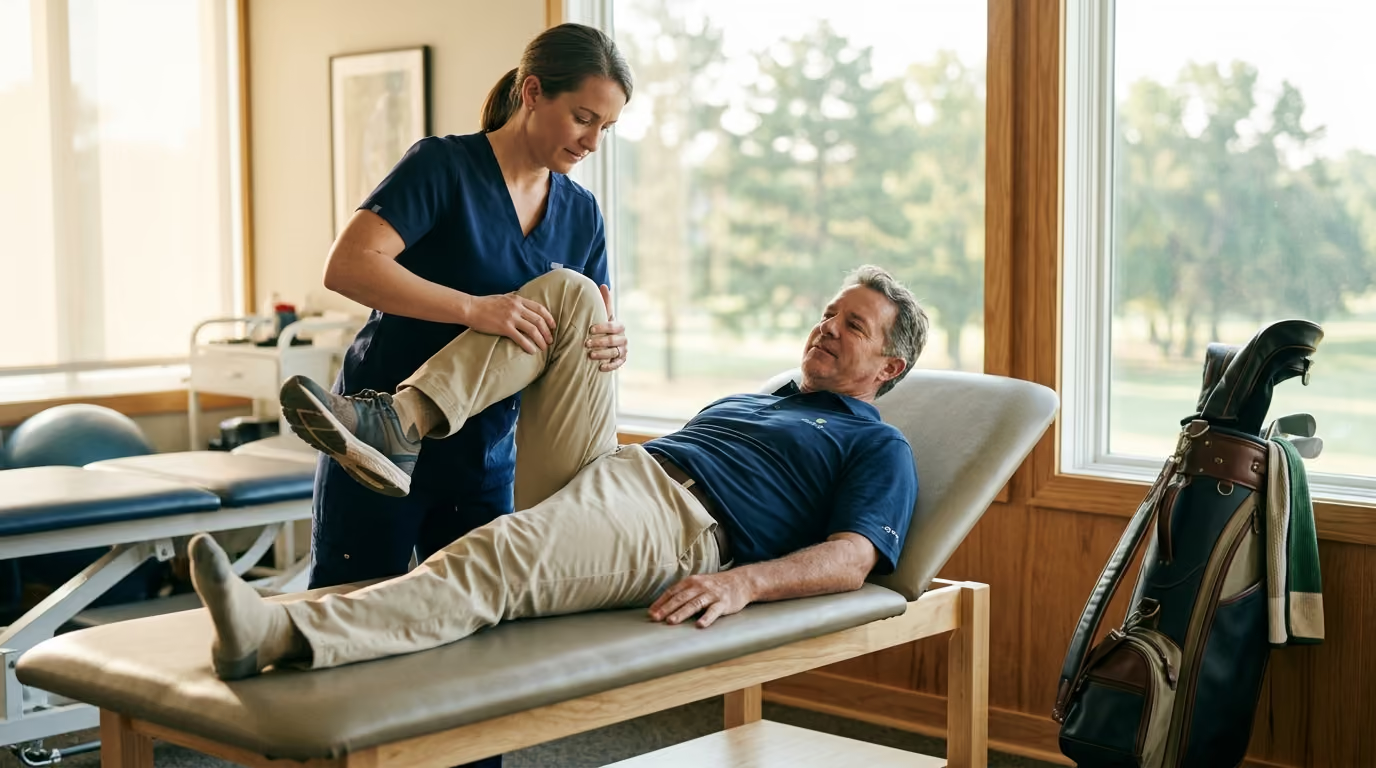
Our team has personal experience with the challenges of physical rehabilitation. When I developed medial epicondylitis, commonly known as golfer's elbow, I thought I needed complete rest. Six weeks off the course did nothing to help.
I finally learned that active recovery with a flexbar was the actual solution. It taught me that treating golf injuries requires loading the tissue properly, not just sitting on the couch and hoping for the best.
This same principle applies to osteoporosis. You cannot build stronger bones by avoiding all physical activity. Your bones need safe, controlled loads to stay strong. Resting too much actually accelerates bone loss.
Along with strength training, you must focus on balance and coordination. Balance exercises are a critical part of fall prevention. In people with osteoporosis, a fall is the leading cause of hip and wrist fractures.
Spend 15 to 20 minutes daily on balance work. Start with simple drills like standing on one leg while holding onto a sturdy chair. As your balance improves, try closing your eyes or standing on a soft cushion.
You can also practice tandem walking, where you walk in a straight line placing one foot directly in front of the other. This drill improves your coordination on uneven turf. These balance skills are your ultimate shield against falls on the golf course.
By combining back strengthening, resistance training, and balance work, you create a complete physical preparation program. This approach is a core part of effective recovery and longevity for mature golfers. It makes sure your body is always ready for the physical challenge of the game.
When golfers try to adapt to an osteoporosis diagnosis, they often fall into common traps. These mistakes can lead to unnecessary pain or even injury on the course. Understanding these errors will help you make safer choices during your rounds.
The first major mistake is falling for the low impact myth. Because golf does not involve the pounding impact of running, many players assume it is completely safe for their bones. They think their skeleton is not under stress during a round.
This is a dangerous misconception. While golf is low impact in terms of landing forces, it is high impact in terms of rotational torque. The speed and power of a golf swing generate significant twisting forces across your spine.
If your bones are thin, this torque can easily exceed their fracture threshold. You must treat the golf swing with the same respect you would give to a heavy gym lift. Modifying your movement is necessary to prevent injury.
The second common mistake is carrying a heavy golf bag. A fully loaded golf bag can easily weigh twenty pounds or more. Carrying this load on your shoulders places a continuous, heavy compression force on your spine.
As you walk up and down hills, your body must twist and bend to support this weight. This combination of continuous load and spinal movement is a recipe for vertebral compression. It is a high-risk activity that should be avoided at all costs.
Instead, you should always use a push-cart or an electric caddy. These tools remove the weight from your shoulders entirely. You can walk the course freely, enjoying the positive weight-bearing benefits without the dangerous vertical compression.
The third mistake is repetitive waist-bending during a round. Golfers bend down dozens of times during eighteen holes. They bend to place a tee, mark a ball, repair pitch marks, and clean their clubs.
If you use a standard waist-hinge for all of these movements, you accumulate massive stress on your lower spine. This repetitive bending can cause microscopic fractures in your vertebrae over time. These micro-fractures eventually lead to a painful collapse of the bone.
You must use the Golfer's Reach for every single retrieval on the course. Making this movement a non-negotiable habit is a key part of your safety strategy. It keeps you from placing your spine in a vulnerable position.
Your choice of golf equipment has a direct impact on your physical safety. The right gear can act as a shock absorber, protecting your joints and bones from unnecessary stress. Making a few strategic changes to your bag can significantly improve your comfort on the course.
First, evaluate your golf shafts. Traditional steel shafts are heavy and stiff, transmitting the shock of impact directly into your hands, arms, and spine. If you hit a shot fat, the vibration can jar your skeletal system.
Switching to graphite shafts is a smart move for bone safety. Graphite is lighter and naturally absorbs high-frequency vibrations. This reduces the amount of shock that reaches your joints, making the swing much gentler on your body.
Next, look at your club selection. Long irons require high swing speeds to lift the ball into the air. This demands an aggressive, high-effort swing that increases rotational torque on your spine.
Replace your long irons with high-lofted woods and hybrids. A 7-wood or 9-wood is much easier to swing than a 3-iron or 4-iron. These clubs are designed to slide through the turf, allowing you to use a smooth, rhythmic swing.
Grip thickness is another area where you can make improvements. Standard grips can force you to squeeze the club tightly, which creates tension in your forearms and shoulders. This tension prevents a smooth release of the clubhead.
Switching to midsize or oversized grips can help reduce this hand tension. A larger grip allows your hands to relax, which encourages a smoother, more natural swing. This reduces the physical effort needed to hold the club.
Finally, think about how you transport your clubs. If you do not use a motorized cart, a three-wheel push-cart is the best choice. Pushing a cart ahead of you allows you to walk with a straight, neutral spine.
Avoid two-wheel pull-carts, which you must drag behind you. Pulling a cart forces you to twist your torso while walking under load. This asymmetric rotation can strain your lower back and put uneven pressure on your vertebrae.
By making these equipment adjustments, you support your overall mobility and protect your spine. The right gear allows you to play with less effort and more comfort. You can focus on your target instead of worrying about your back.
Playing golf with osteoporosis is entirely possible when you prioritize smart movement over raw power. By making simple adjustments to your swing, setup, and daily routine, you can protect your spine while enjoying the game.
For more insights on maintaining your physical health, you can visit our main blog. Protecting your bones, modifying your movements, and walking the course with confidence will keep your game strong.
Expert Takeaway: Protect your spine by rotating your whole body as a single unit and lifting with a straight back on every hole.
Revisit this guide if you experience any mild stiffness after a round, or when preparing for the start of a new golf season. Checking these swing adjustments regularly will help you maintain safe habits.
Keep walking the course with confidence and play the game you love without fear.
Follow Golfergy for practical insights on performance, mobility, recovery and healthy ageing. Stay connected for new articles, research-led guidance and ideas to help you play better for longer.


Explore practical resources on performance, recovery, mobility and golf longevity.
Read the Blog