Stiff hips and lost swing speed toward the end of a round happen when inactive glutes force your lower back to take the strain.




Glute activation is the process of waking up the large muscles in your buttocks so they can work during physical movement. It is not about building massive muscle size or lifting heavy weights at the gym. It is about restoring the electrical connection between your brain and your glutes.
Many golfers believe that hitting the ball further requires fast arm speed. This is a common misconception. The real engine of the golf swing is your lower body. Your glutes are the largest and most powerful muscles in your frame.
When these muscles stop working, your swing speed drops and your lower back takes the strain. This guide provides a detailed look at why these muscles go dormant. We will explain how to wake them up so you can protect your spine and hit the ball further.
We will look at the science of hip movement and real golf swing faults. We will also share simple daily routines that you can start tonight. If you want to protect your body and play golf pain-free for years, this resource is for you.
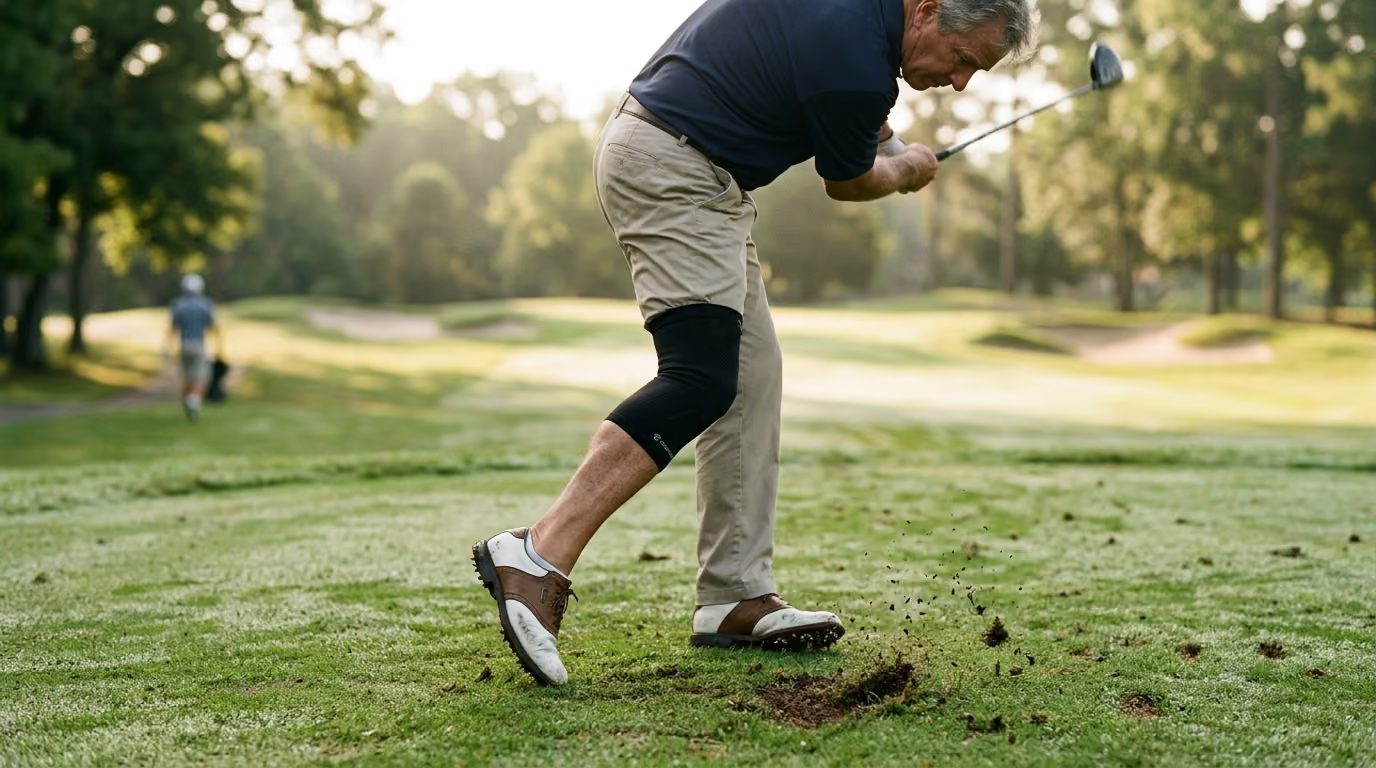
Imagine standing on the fourteenth tee. You have played a solid round of golf so far. Your playing partners are watching you set up for a crucial drive. You take a full backswing, but as you transition into the downswing, you feel a familiar dull ache in your lower back.
Your hips feel blocked. Instead of rotating through the ball, you slide forward and flip your wrists. The ball fades weakly into the right rough. Your back feels stiff, and you dread the walk to your ball.
This is a scenario that many mature players know all too well. It is often blamed on old age or bad luck. But the real cause is happening right in your hips.
A few years ago, I noticed my swing falling apart around the 14th hole. My lower back would tighten up, and I started compensating with my arms. I spent months thinking it was a swing flaw. It was not until I started a simple evening hip mobility routine that I realized my glutes were just turning off from fatigue. Fixing that one physical limitation brought my back nine scores down drastically.
In our experience, this pattern is incredibly common among golfers over forty. When the glutes get tired or turn off, other muscles must do their job. The lower back is the first area to suffer.
Your lower back is designed for stability, not for generating massive rotational power. When you force your lower back to produce power, injury is only a matter of time. Waking up your glutes allows your lower back to stay stable. This protects your spine and keeps you pain-free until the eighteenth green.
When your glutes turn off, your pelvis tilts forward. This tilt increases the arch in your lower back, which compresses your spinal discs. During a powerful swing, this compression can cause severe pain. By keeping your glutes active, you keep your pelvis in a neutral position.
This neutral position allows your hips to turn freely. Your lower back does not have to twist excessively. You can maintain a consistent spine angle throughout your swing. This leads to cleaner contact and less soreness after your round.
Your lower back is not the only joint that suffers when your glutes go to sleep. Your knees are also at high risk of injury. The gluteus medius is a smaller glute muscle that sits on the side of your hip. Its main job is to stabilize your pelvis and control the rotation of your thigh bone.
When your gluteus medius is weak, your thigh bone rotates inward during the downswing. This causes your knee to collapse inward toward your other leg. Biomechanists call this movement knee valgus. It places a massive amount of lateral stress on the knee joint.
This lateral stress can damage the ligaments and cartilage in your knee. Golfers often feel this as a sharp pain on the inside of their lead knee. The pain usually appears during the transition and impact phases of the swing. You might think you have a knee problem, but the issue is actually a lack of hip stability.
Your body works as a chain. If the hip does not stabilize the upper leg, the knee must twist to compensate. The knee is a simple hinge joint that is only designed to bend forward and backward. Forcing it to twist under high speed is a recipe for chronic pain.
By waking up your gluteus medius, you keep your thigh bone aligned. This prevents your knee from collapsing inward. Your knee joint can then function as a stable hinge. This simple change can eliminate knee pain and make your swing feel much more secure.
To maintain your physical health and stay active, you must address these lateral forces. Protecting your knees is just as important as protecting your back. Strong glutes help keep every joint in your legs working together in harmony.
When your hips are stable, your knees do not have to slide or twist. You can push into the ground with confidence. This stability is the foundation of a smooth, repeatable swing that does not wear out your joints.
Gluteal amnesia is a real physical condition. Dr. Stuart McGill, a leading world authority on spine mechanics, popularized this term. It refers to a state where the glute muscles fail to fire at the correct time or with the right force.
This is not a structural disease. It is a communication breakdown between your nerves and your muscles. The brain stops sending strong signals to the glutes.
This condition is very common among desk workers. A study from 2026 found that fifty-nine percent of sedentary office workers suffer from gluteal amnesia. If you sit at a desk for eight hours a day, you are at high risk. Your brain simply forgets how to use these muscles when you stand up to play golf.
This happens because of a physiological rule called reciprocal inhibition. When one muscle is constantly tight, the muscle on the opposite side of the joint is neurologically shut down. Sitting keeps your hip flexors in a short, tight position. This constant tightness sends a signal to your brain to turn off your glutes.
When you arrive at the golf course, your glutes are still asleep. As you swing, your body looks for other muscles to do the work. This leads to a postural imbalance known as Lower Crossed Syndrome.
This pattern combines weak glutes and abdominals with tight hip flexors and lower back muscles. This cross pattern pulls your pelvis out of alignment. Your lower back arches excessively, and your stomach sags forward. This position leaves your lumbar spine completely unprotected during the violent forces of the golf swing.
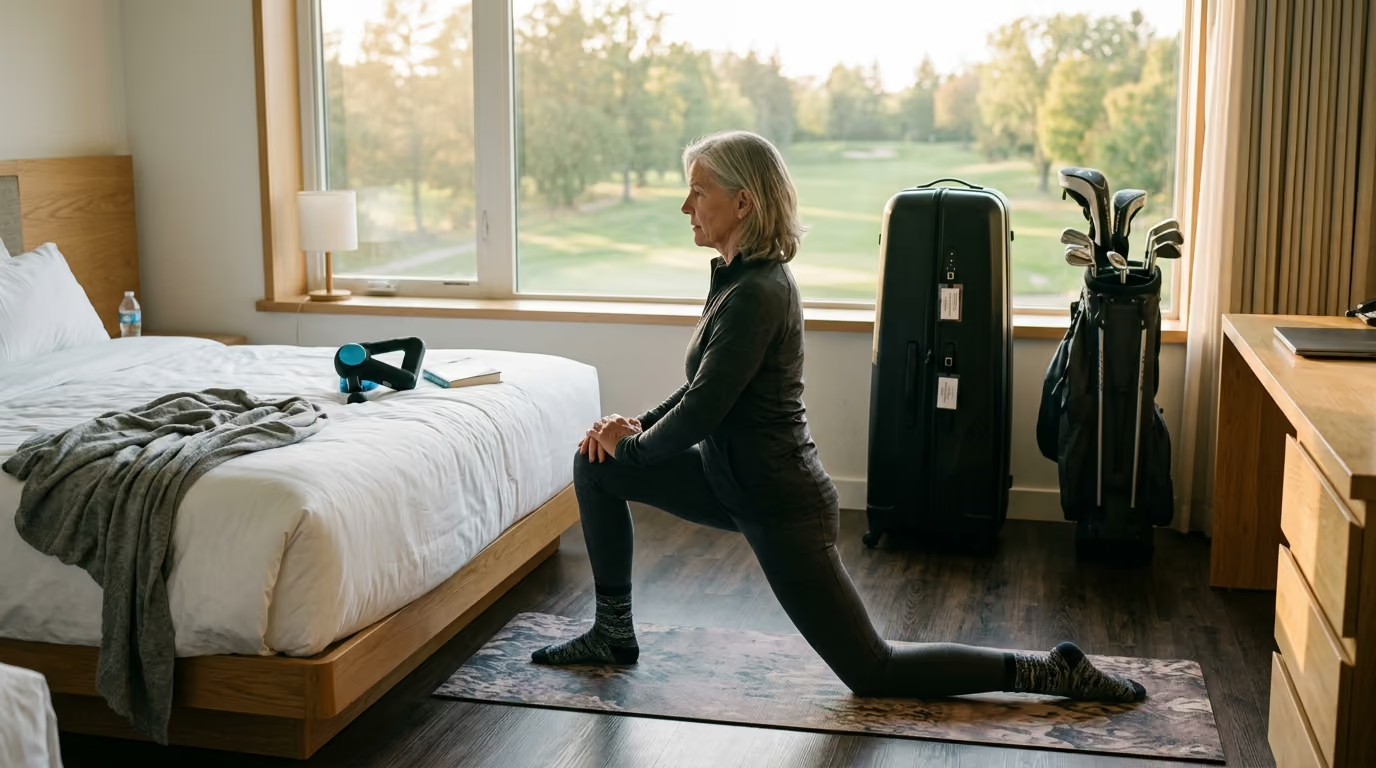
To fix this, you must break the cycle of tightness and weakness. You need to stretch your tight hip flexors and wake up your weak glutes. This restores balance to your pelvis and takes the pressure off your spine. It is the first step toward a healthy, pain-free golf swing.
If you ignore this posture, your swing will remain limited. No amount of practice on the driving range can override a neurological shutdown. You must wake up the muscles before you can improve your movement.
The Titleist Performance Institute has studied swing faults for decades. They found that early extension is the most common swing fault among amateur players. Early extension occurs when your pelvis moves toward the ball during the downswing. Instead of rotating around your lead hip, your hips thrust forward.
This movement pattern is directly linked to weak glutes. Your glutes are responsible for holding your pelvis back and rotating your hips. If your glutes are weak, your body cannot maintain its posture. You stand up during the downswing to keep your balance.
This movement places an incredible amount of stress on your lower back. When you thrust your hips forward, your lumbar spine is forced to bend and compress. This can lead to disc issues and muscle spasms over time. Your arms also have less room to swing, which leads to inconsistent ball striking.
Another common issue is S-Posture. This happens when a golfer arches their lower back too much at setup. Many players do this because they were told to stick their butt out.
This posture immediately shuts down your abdominals and glutes. It pre-loads your lumbar spine with tension before you even swing. It makes it almost impossible for your hips to rotate properly during your backswing. This forces you to use your arms to lift the club, which reduces your power.
To correct early extension, you cannot just use swing thoughts. You must build the physical strength to hold your posture. Strong glutes act as an anchor for your pelvis. They allow you to rotate your hips through the ball without thrusting forward.
This rotation keeps your spine angle constant. It gives your arms plenty of room to swing through the hitting zone. You will hit the ball more consistently and protect your back from painful compression.
Many golfers believe that flexibility is the key to distance. They spend hours stretching their arms and shoulders. However, research shows that lower body strength is much more important for clubhead speed.
Studies published in the Journal of Strength and Conditioning Research show a strong link between lower body power and swing speed. A major meta-analysis found a large correlation of r = 0.63 between squat strength and clubhead speed. If you want to hit the ball further, you need a strong lower body.
Another study showed that improving hip abduction strength leads to direct gains. Golfers who completed an eight-week hip training program saw a significant increase in clubhead speed, with an effect size of d = 0.65. This training focused on the gluteus medius, which stabilizes the hips during the swing.
Dr. Chris Bishop from the London Sport Institute has done extensive research on this topic. His work confirms that explosive lower body strength is a primary factor in golf performance. When your glutes work properly, you can push off the ground with massive force.
This ground force travels up through your body and into the clubhead. If your glutes are weak, you cannot generate this ground force. You must rely on your upper body to swing the club. This limit to your power also increases your risk of shoulder and elbow injuries.
To improve your game, you should focus on building lower body strength. Passive stretching will not give you the speed you want. A strong, active lower body is the true key to longer drives. For more training tips, you can read our golf performance articles.
Using your legs for power is also much more efficient. It requires less effort than trying to swing as fast as possible with your arms. You will feel less tired at the end of eighteen holes.
You do not need a gym to wake up your glutes before your round. You can do a few simple movements right next to your golf cart. These exercises take less than three minutes but can change how your body moves.
First, try a simple standing glute squeeze. Stand with your feet shoulder width apart. Focus entirely on turning your trail hip inward slightly. Squeeze your buttocks as hard as you can for five seconds, then release.
Repeat this ten times. This helps restore the nerve connection to the muscle. It acts as a wake-up call for dormant tissue.
Second, perform a set of gentle bodyweight squats. Stand with your feet at your golf stance width. Keep your back straight and lower your hips down as if sitting in a chair. Focus entirely on pushing through your heels as you stand up. Feel your glutes contract at the top of the movement.
Do ten slow squats. This gets the blood flowing to your lower body. It also prepares your joints for the squatting motion used in the swing.
Third, use a golf club for balance and perform standing hip extensions. Hold your driver in front of you for support. Slowly move your right leg straight back behind you. Do not arch your lower back.
Focus entirely on squeezing your right glute at the peak, then repeat on the left side. Do ten repetitions on each leg. This warm-up makes sure your hips are ready to rotate. It helps prevent your lower back from taking over on the first tee.
These simple movements can be done quietly while waiting for your tee time. They make a massive difference in how your hips feel during your first few swings. You will feel more stable and less stiff right from the start.
To fix gluteal amnesia for good, you need a daily routine. This routine should focus on both core stability and hip strength. Dr. Stuart McGill recommends three specific exercises to protect the spine. These are known as McGill's Big Three.
The first exercise is the modified curl-up. Lie on your back with one knee bent and one leg straight. Place your hands under your lower back to support your spine. Slowly lift your head and shoulders a few inches off the floor, hold for ten seconds, and lower back down.
This builds core endurance without flexing your lumbar spine. Do this ten times.
The second exercise is the side bridge. Lie on your side and prop yourself up on your elbow. Keep your knees bent at ninety degrees if you are a beginner, or keep your legs straight for a challenge. Lift your hips until your body forms a straight line from head to toe.
Hold this position for ten seconds, then switch sides. Repeat this three times on each side.
The third exercise is the bird-dog. Start on your hands and knees. Slowly extend your right arm forward and your left leg straight back. Keep your hips level and do not let your back sag.
Hold for ten seconds, then return to the starting position and switch sides. Do eight repetitions on each side. This exercise builds deep stability in your lower back.
For golf-specific glute strength, our team recommends adding two movements from the Titleist Performance Institute. First, try single-leg squats to a box. Place a mini-band just above your knees. Stand on one leg and slowly lower your hips until you touch a box or chair behind you.
Stand back up by pushing through your heel. The band forces your gluteus medius to work to keep your knee from collapsing inward. Do eight repetitions on each leg.
Second, perform wall-supported squats. Stand with your back against a wall and walk your feet out about two feet. Lower your hips until your thighs are parallel to the floor. Focus on tucking your pelvis about fifteen degrees forward.
This pelvic tilt helps you feel your glutes fire without overarching your back. Hold this position for thirty seconds. This routine is an excellent way to prepare your body for golf.
To protect your joints further, you can combine this routine with other warm-ups. Read our articles on preventing common golf injuries to understand how these exercises build resilience. Discover how these habits fit into maintaining your physical health as you age. Keeping your body strong is the best way to enjoy golf for decades.
The most common mistake is the belief that you must squeeze your glutes during the entire golf swing. Some instructors tell students to keep constant tension in their lower body. This is actually counterproductive.
Research by Dr. Stuart McGill shows that great athletes rely on pulsed relaxation. Your muscles should be relaxed at address. They contract explosively at impact, and then they relax again during the follow-through. Constant tension slows down your swing.
It also tires your muscles out quickly, leading to early fatigue. You want your glutes to be active but not rigid. Think of them as a spring that releases its energy at the perfect moment.
Another mistake is spending too much time on passive stretching. Many golfers spend twenty minutes stretching their hamstrings and lower back before a round. Studies show that flexibility has very little correlation with clubhead speed. If you stretch a muscle too much, you can actually reduce its ability to produce power.
Focus on active activation rather than passive stretching. You want to wake up the muscles, not make them loose and weak. For better results, focus on dynamic movements.
A third mistake is ignoring hip mobility while trying to build strength. If your hip joints are stiff, your glutes cannot work through a full range of motion. You must combine glute strength with exercises that improve hip rotation. Check out our golf mobility routines to learn how to open up your hips safely. This combination is key to protecting your joints.
If your hips are locked, your glutes cannot fire correctly. You must address both strength and mobility to see real improvement. This balanced approach is the safest way to train.
Your equipment can have a surprising impact on how your muscles fire. Your connection to the ground starts with your golf shoes. If your shoes do not support your feet, your glutes cannot work efficiently.
Many modern golf shoes have a high heel-to-toe drop. This means the heel is raised significantly higher than the forefoot. This design shifts your weight forward onto your toes. This shift can cause your hip flexors to tighten and your glutes to turn off.
Look for golf shoes with a lower profile or a minimal heel drop. This keeps your weight centered over your arches and heels. It allows you to push into the ground more effectively.
If you want to learn more about how ground forces impact your game, read our resource on ankle mobility and stability.
Your orthotics can also play a role. If you have flat feet, your ankles may roll inward during your swing. This inward collapse shuts down your gluteus medius. Custom orthotics can help stabilize your arches.
This stabilization keeps your knees aligned and your glutes active. If you feel pain in your lower body, check your shoes first. A simple change in footwear can often solve complex movement issues.
A flat, stable base allows your body to work as intended. It helps you ground yourself during the swing. This grounding is where your power begins.
Your lower back will only find lasting safety when your glutes are awake and strong enough to power your swing.
A simple test is to stand on one leg and try to squeeze your buttock muscle on that side. If the muscle feels soft or you cannot feel it contract, your glutes are likely dormant. You can also watch your swing on video. If your hips move toward the ball during your downswing, your glutes are not doing their job. This is early extension, and it is a clear sign of weak glutes.
No, walking is a low-intensity activity that does not require explosive muscle contraction. If you have gluteal amnesia, walking will often rely on your hamstrings and lower back muscles instead. You need specific, targeted activation movements to turn the glutes back on before you play. Walking on dormant glutes can actually make your lower back pain worse.
Not necessarily. If your glutes are neurologically shut down, your body will compensate during heavy squats. Your lower back and quadriceps will do most of the lifting. You must perform low-load activation exercises first to ensure the glutes are awake before adding heavy weight. Otherwise, you are just strengthening a bad movement pattern.
Most golfers see an improvement in muscle firing within two weeks of daily activation exercises. However, if you sit for long periods every day, you must maintain these habits. Consistency is key to keeping these muscles active for the long term. Making glute activation a regular part of your pre-round routine will keep your hips healthy as you age.
Follow Golfergy for practical insights on performance, mobility, recovery and healthy ageing. Stay connected for new articles, research-led guidance and ideas to help you play better for longer.


Explore practical resources on performance, recovery, mobility and golf longevity.
Read the Blog