
Golf swing power comes from active glutes instead of expensive drivers, creating more clubhead speed and protecting your lower back from injury.




Why does my lower back hurt after golf? This is a question thousands of mature players search every week. You finish your round, pack your clubs, and feel a dull ache in your lower spine. You might think this discomfort is just a natural sign of getting older.
The real culprit is often sitting right beneath you. Your glutes have likely gone quiet because of your daily routine. When these muscles do not fire, your swing suffers and your back takes a beating. This guide provides a definitive blueprint to fix this problem for good.
Many players focus on new drivers or complex swing theories to fix their game. They overlook the simple physical foundation that makes a good swing possible. Focusing on injury prevention is the most reliable way to keep playing the game you love. By waking up your glutes, you protect your body and find your natural power.
To understand why your hips matter, we must look at how the body creates speed. The glutes are the primary power generators in the golf swing. They help you leverage what scientists call Ground Reaction Force. This is the physical force that occurs when you push your feet into the turf.
When you push down, the ground pushes back with equal force. This energy travels from your feet up through your legs and into your pelvis. The glutes act as the bridge that directs this energy up the kinetic chain. Without active glutes, this energy stops at your waist and never reaches the clubhead.
The glute group consists of three main muscles. Each muscle has a specific job during your golf swing. The gluteus maximus is the largest muscle in the human body. It acts as a powerful hip extensor during your downswing.
During the downswing, this muscle drives what experts call triple extension. This is the rapid straightening of your ankle, knee, and hip. This motion pushes your pelvis forward and around, which creates raw speed.
The gluteus medius and minimus sit on the outer side of your hip. These muscles provide critical lateral stability during your swing. They keep your pelvis steady and level as you turn. This stability prevents two major swing flaws that ruin contact.
First, they stop sway, which is lateral movement away from the target during the backswing. Second, they stop slide, which is lateral movement toward the target during the downswing. Both flaws prevent you from hitting the ball cleanly.
Scientific studies support these biomechanical roles. Research published in the Journal of Strength and Conditioning Research shows a clear link between glute strength and clubhead speed. Low-handicap golfers show much higher gluteal activation than high-handicap players. Their pelvic rotation speeds are also significantly faster.
A study by Callaway et al. in the Golf Science Journal found a strong correlation between gluteus maximus and medius strength and overall handicap. Golfers with stronger hips consistently swing faster and carry the ball further. Building lower body strength is not about lifting heavy weights. It is about helping your muscles work the way they were designed to work.
Many mature players suffer from a condition called glute amnesia. Some doctors call this dormant butt syndrome. It is a neuromuscular issue rather than a lack of actual muscle size. Your brain simply loses its connection to the glutes.
The muscle is physically there, but the signal to contract is weak. This is a software issue in your nervous system. It is not a hardware issue with the muscle tissue itself. You can have large muscles that still fail to fire when you swing a club.
The main cause of this disconnect is reciprocal inhibition. This biological process happens when you sit for long periods. Sitting causes your hip flexors, specifically the iliopsoas, to shorten and tighten. Your brain senses this constant tension in the front of your hip.
It responds by sending a chemical signal to turn off the opposing muscles in the back. Your glutes receive this signal and go to sleep. When you finally stand up to play golf, the glutes remain inactive. Your body still needs to move, so it finds other ways to complete the swing.
It relies on your lower back and hamstrings to do the work of your glutes. This compensation pattern is highly inefficient. Your lower back muscles are designed for stability, not for generating rotational power.
Standing up more during the day is not enough to fix this issue. Once the brain-to-muscle connection is broken, you need active retraining. You must perform specific movements to rebuild that neural pathway. This process is like rebuilding a road after a storm.
You have to lay down new pavement before traffic can flow smoothly. Improving your hip mobility is the first step in this recovery process. It allows your pelvis to move without restriction.
When your glutes fail to fire, your lower back pays a heavy price. Lower back pain is the most common injury in golf. It accounts for 18% to 54% of all documented golf ailments. The risk is high for both recreational players and professionals.
Data shows that professional golfers have a lifetime back pain rate of 55% to 73.5%. Amateurs experience it at a rate of 15% to 35%. Professionals hurt their backs because of swing volume. Amateurs hurt their backs because of poor movement patterns and weak muscles.
The lack of glute support leads directly to a swing flaw called early extension. In a healthy swing, your hips stay back in their original posture. If your glutes are weak, they cannot hold your pelvis in this tilted position. Your hips will move forward toward the ball during the downswing.
This forward movement forces your spine to stand up straight before impact. Your lower back muscles must contract hard to keep you balanced. This sudden contraction puts massive stress on your lumbar joints. Over time, this repetitive stress leads to chronic muscle strain or disc herniations.
Early extension also ruins your ball striking. When your hips crowd the ball, you lose the room needed to swing your arms. You might hit thin shots, blocks, or nasty slices. Your clubhead speed drops because you cannot transfer energy from the ground.
By fixing your glutes, you protect your back and find your natural power. Proper physical recovery after a round is also much easier when your muscles work correctly. Your body does not have to repair damaged joints. It only has to rest tired muscles.
Let us look at how this problem appears during a real round of golf. Imagine you are playing on a crisp Saturday morning. You spent the week working at your desk, sitting for eight hours a day. You arrived at the course with just enough time to grab a coffee and hit three practice swings.
The first few holes go well enough. By the seventh hole, you notice a familiar tightness creeping into your lower back. You try to swing harder to gain back your lost distance. On the tenth tee, you face a long par four with a tight fairway.
You take a wide stance and make a big turn. At the top of your backswing, your trail hip feels locked. Since your glutes cannot stabilize your pelvis, your hips slide away from the target. You start your downswing by pulling hard with your upper body.
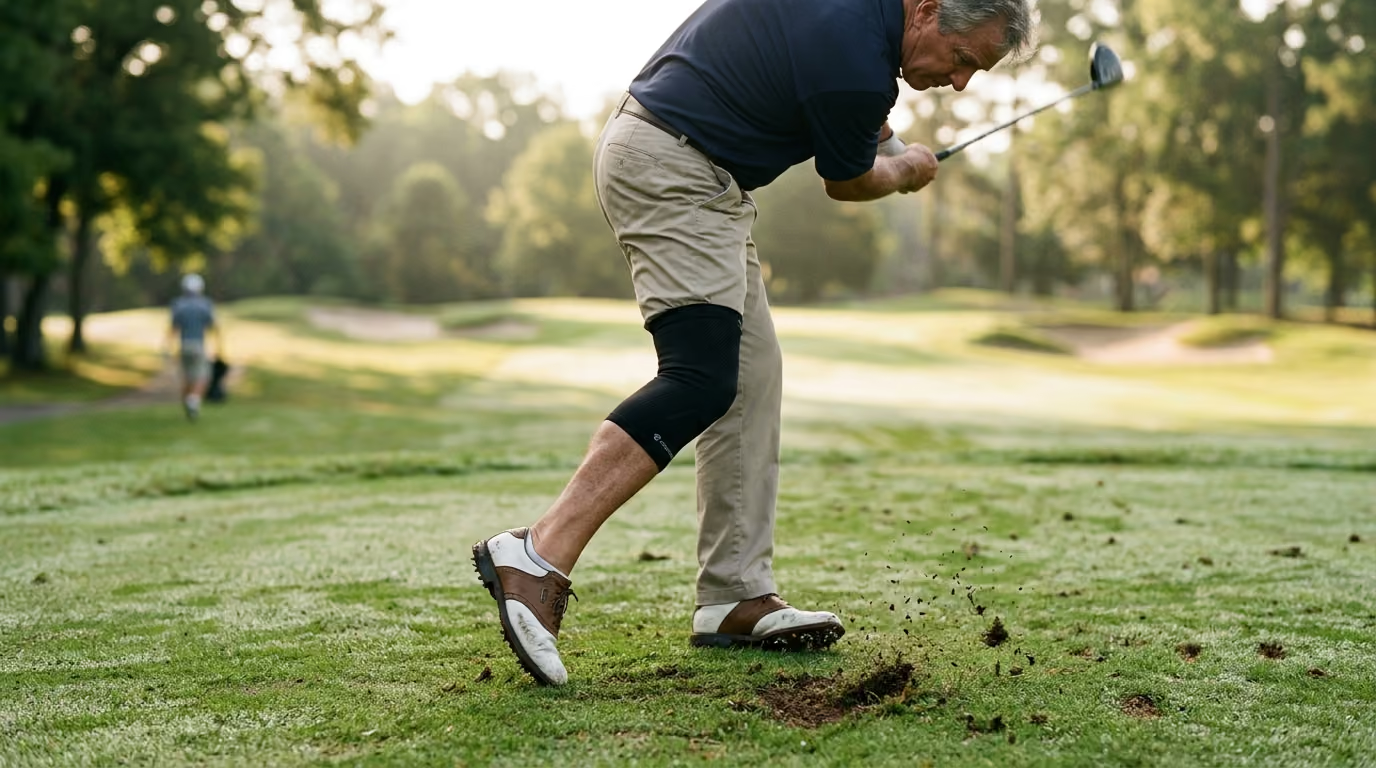
As you make impact, your hips jump forward toward the ball. Your spine stands up, and you feel a sharp pinch in your lower back. Your ball slices into the right trees, and you are left rubbing your spine.
Your glutes did not help you push off the ground. Your lower back had to do all the heavy lifting. This is the classic presentation of glute amnesia on the golf course.
You can easily test your pelvic function at home. The Titleist Performance Institute utilizes two primary screens to check for glute function. These screens help you identify if you suffer from glute amnesia. You do not need any special equipment to perform them.
The first screen is the Single-Leg Bridge Test. Lie flat on your back with your knees bent and your feet flat on the floor. Lift your hips up until your body forms a straight line from your knees to your shoulders.
Now, lift one foot off the ground and extend that leg straight out. Try to hold this position for 10 to 15 seconds. A passing score means you hold the position with a level pelvis and no cramping.
If you fail, you will feel immediate cramping in your hamstring or your lower back. Your hip on the unsupported side might also dip toward the ground. This failure proves your brain is relying on secondary muscles instead of your glutes.
The second screen is the Pelvic Tilt Test. Stand in your normal golf posture with your arms crossed over your chest. Try to tilt your pelvis forward, arching your lower back.
Then, tilt your pelvis backward, tucking your tailbone under. Watch your movement in a mirror. You should be able to tilt your pelvis back and forth smoothly.
Your knees and chest should remain still. If your knees bend or your chest moves, you lack pelvic control. This lack of control shows that your glutes are not working with your core.
If you are on the first tee and need a quick fix, you can wake up your glutes in two minutes. Stand next to your golf cart or hold a club for balance. Lift your trail foot slightly off the ground.
Focus entirely on squeezing your trail glute as hard as you can. Hold this squeeze for five seconds, then release. Repeat this ten times on each side.
Next, perform a standing pelvic tilt. Place your hands on your hips while standing in a shallow golf posture. Slowly tuck your tailbone under until you feel your glutes engage.
Hold for three seconds, then return to neutral. Do ten repetitions. This quick routine reminds your brain that these muscles exist. It helps prepare them for the forces of your first tee shot.
To fix glute amnesia permanently, you need a structured home routine. This routine focuses on building strength and improving coordination. You should perform these exercises three times a week.
They take less than fifteen minutes to complete. Do not rush through these movements. Focus on the quality of each repetition.
Start with the Glute Bridge with a squeeze. Lie on your back with your knees bent and your feet flat. Place a small foam block or a rolled towel between your knees.
Squeeze the block gently to engage your inner thighs. Now, push through your heels and lift your hips. Focus entirely on turning your trail hip and lead hip upward.
Hold the top position for three seconds before lowering down. Perform three sets of twelve repetitions. This exercise teaches your glutes to work without your hamstrings taking over.
The second exercise is the Clamshell. Lie on your side with your knees bent at a 90-degree angle and your heels together. Keep your feet touching throughout the movement.
Slowly raise your top knee while keeping your pelvis perfectly still. Do not let your lower back rotate backward. Focus entirely on contracting your outer hip muscle.
Lower your knee back down slowly. Perform three sets of fifteen repetitions on each side. This exercise builds the lateral stability needed to prevent sway and slide.
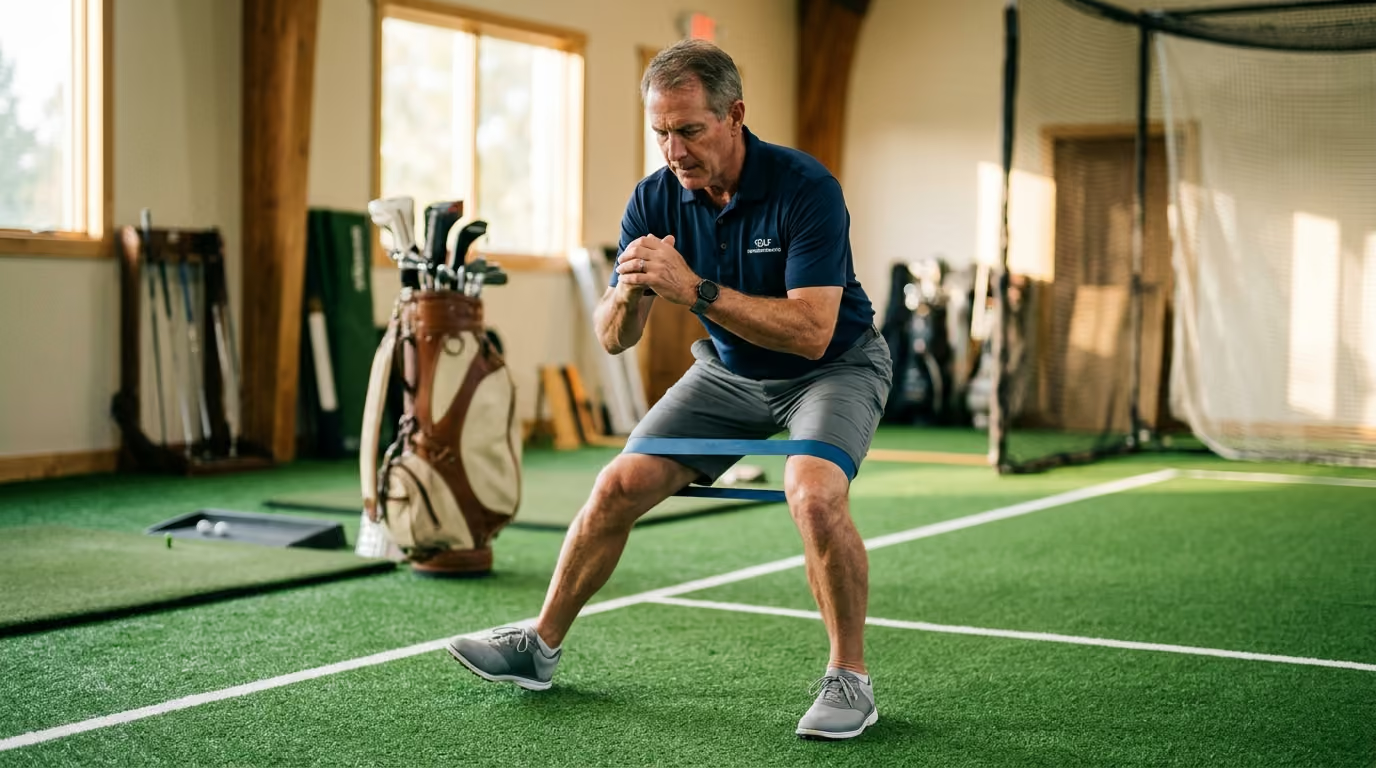
The third exercise is the Monster Walk. Place a light resistance band around your ankles. Stand in a shallow golf posture with your feet hip-width apart.
Take small, controlled steps sideways, keeping tension on the band. Do not let your knees collapse inward. Keep your chest up and your back straight.
Focus entirely on pushing through your outer hips. Walk ten steps to the right, then ten steps to the left. Repeat this sequence three times. This movement strengthens your gluteus medius under a dynamic load.
Many golfers make mistakes when trying to activate their glutes. The most common mistake is confusing strength with activation. You might be able to squat heavy weights, but that does not mean your glutes fire during a swing.
A golf swing is a dynamic movement that lasts less than two seconds. You must train the brain to recruit these muscles quickly. Static strength does not always translate to dynamic speed.
Another common mistake is the static glute clench. Some players try to squeeze their glutes tightly throughout the entire swing. This constant tension actually locks your pelvis in place.
It prevents a fluid hip turn and limits your swing speed. Your glutes must turn on and off dynamically at the right moments. They should contract hard at impact, not during your setup.
We also see many players struggle with quad dominance. When performing squats or lunges, they push their knees too far forward. This poor form shifts the workload to the front of the thighs.
The glutes stay quiet, and the exercise does not help your golf swing. Focus on pushing your hips back during these movements. Imagine you are sitting back into a chair.
Your choice of golf equipment can also affect how your glutes work. Your shoes play a major role in how you interact with the ground. Shoes with a high heel-to-toe drop shift your weight forward onto your toes.
This forward shift can quiet your glutes and make you quad-dominant. It prevents you from loading your heels properly during the backswing. This loading is necessary to activate the posterior chain.
Consider wearing shoes with a lower heel profile. This design keeps your weight balanced over your mid-foot and heel. It makes it much easier to engage your posterior chain.
Proper arch support is also important. If your arches collapse, your knees will cave inward during the swing. This inward collapse turns off the gluteus medius.
If you struggle with flat feet, look into custom orthotics. They can help keep your lower body aligned and your glutes active. A stable foot leads to a stable pelvis.
Waking up your glutes is the single most effective way to protect your lower back and maintain swing speed as you age.
Follow Golfergy for practical insights on performance, mobility, recovery and healthy ageing. Stay connected for new articles, research-led guidance and ideas to help you play better for longer.


Explore practical resources on performance, recovery, mobility and golf longevity.
Read the Blog