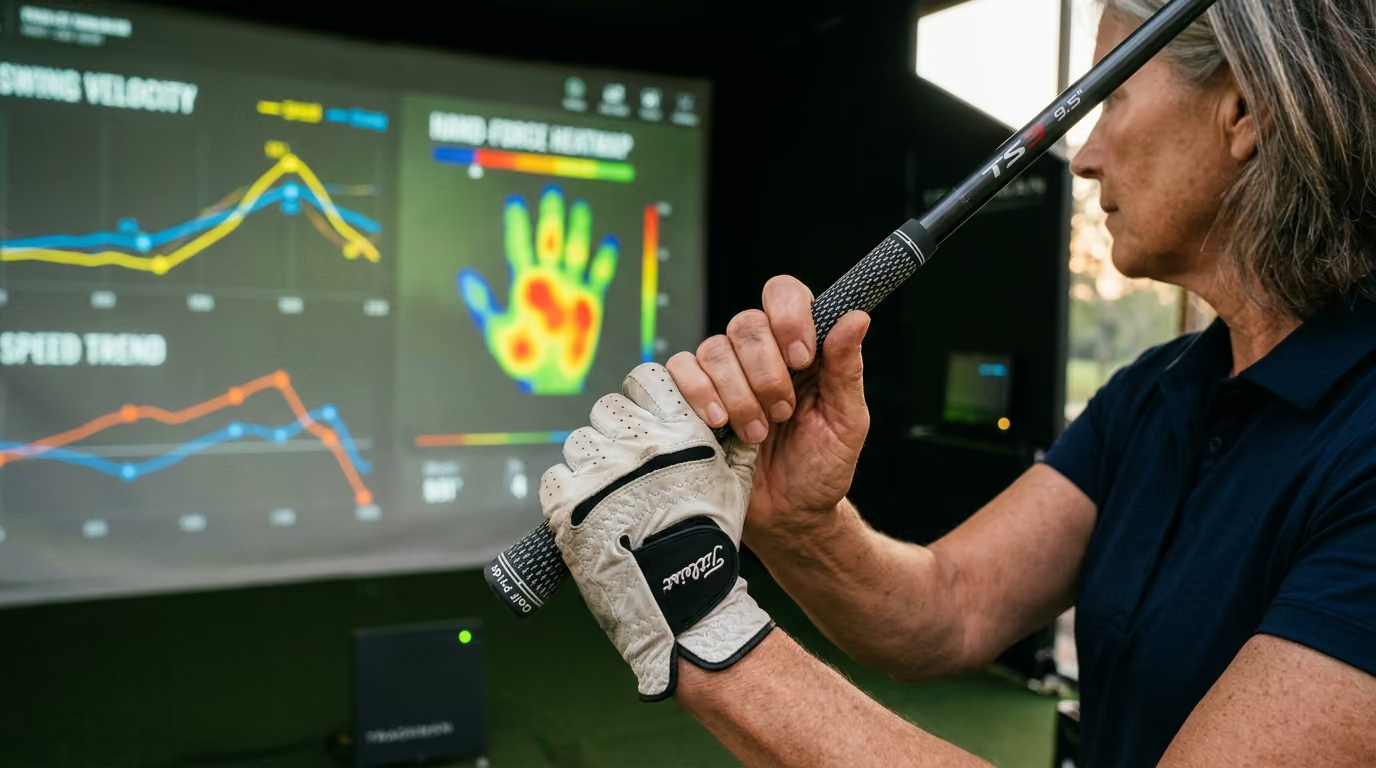
Senior golfers can protect their driving distance and clubhead speed by replacing basic endurance cardio with targeted power and rotational strength training.




Many dedicated golfers believe that spending hours on a treadmill or stationary bike is the key to maintaining their game as they grow older. They assume that cardiovascular endurance is the primary defense against back-nine fatigue and distance loss. However, this focus on aerobic capacity actually accelerates the loss of the specific athletic qualities needed to strike a golf ball with authority. While cardiovascular fitness keeps your heart healthy, it does nothing to prevent the rapid decline of explosive swing power.
To stay competitive after age forty, you must shift your perspective from simple cardiovascular endurance to physical capability. Capability means having the raw power, rotational range, and joint stability to execute a repeatable swing. This resource provides a comprehensive analysis of transitioning your physical preparation from slow cardio to high-velocity movement. We will examine the sports science behind aging muscles, establish a practical training framework, and outline a step-by-step pathway to help you maintain your driving distance for decades.
Let us look at a common scenario that plays out on golf courses every weekend. You stand on the fourteenth tee of a challenging layout. Your heart rate is calm, and your breathing is steady because you walk five miles every day. Yet, when you swing your driver, the ball flight lacks its usual penetration. Your playing partners hit their drives twenty yards past yours, even though they seem to put less effort into their swings.
This scenario highlights a common disconnect between cardiovascular health and golf capability. Walking the course provides aerobic conditioning, but it does not maintain the explosive power needed for a forceful swing. When you reach the late holes of a round, your swing speed drops because your power-producing muscles are fatigued. You do not lack the stamina to walk the course. Instead, you lack the physical capacity to generate speed when your muscles are tired.
To address this issue, you must understand where your current performance stands relative to your peers. Sports performance researchers have compiled extensive databases to establish clubhead speed benchmarks across different age brackets. According to clubhead speed data from Par4Success, swing speed naturally declines with age. For male golfers between the ages of 50 and 59, an average swing speed ranges from 85 to 95 miles per hour. Elite players in this age group can still achieve swing speeds of 105 miles per hour or higher.
As players enter the 60 to 69 age bracket, the average swing speed drops to 80 to 90 miles per hour. Elite senior players in their sixties can still maintain speeds around 98 miles per hour. Once players cross the age of 70, the average speed declines further to between 72 and 85 miles per hour. Knowing these benchmarks allows you to assess your current performance objectively. If your clubhead speed has fallen below these averages, your current exercise routine is likely failing to stimulate your power-producing muscles.
Every mile per hour of swing speed you lose translates directly to a loss of distance. Biomechanical studies show that one mile per hour of clubhead speed equates to roughly two and a half yards of carry distance. If your swing speed drops from 95 to 85 miles per hour, your drives will carry twenty-five yards shorter. This loss of distance changes the entire way you play the course. You find yourself hitting long irons and hybrids into greens where you used to hit short irons.
To reverse this trend, you must measure your clubhead speed using a reliable launch monitor. Visit a local fitting center or use a personal tracking device during a practice session. Warm up thoroughly and hit ten drives with maximum effort. Record the speed of each swing and calculate your average. Comparing your average to the age-based benchmarks will show you exactly how much power you have lost to the aging process.
To stop your driving distance from shrinking, you must understand what happens inside your body as you age. Medical researchers use the term sarcopenia to describe the natural loss of muscle mass and function that begins around age 40. Without targeted intervention, adults typically lose three to eight percent of their muscle mass every decade. This loss is not uniform across all muscle types.
The human body contains two primary types of muscle fibers. Type I fibers, or slow-twitch fibers, are built for endurance activities like walking and long-distance running. Type II fibers, or fast-twitch fibers, are responsible for explosive, high-velocity movements like jumping or swinging a golf club. Research published in national medical databases shows that aging targets fast-twitch muscle fibers at approximately twice the rate of slow-twitch fibers.
As these fast-twitch fibers shrink, your ability to generate force in a fraction of a second plummets. This physical attribute is measured by the Power Index, which calculates how efficiently you transfer momentum into the golf ball. The Power Index combines your clubhead speed, swing timing, and body mass to measure your capability. To keep this index high, you must train your nervous system to activate muscles quickly.
This speed of activation is known in biomechanics as the Rate of Force Development. In a functional golf swing, energy must flow in a precise kinematic sequence. This sequence begins when your feet push against the turf. The force travels up through your legs, turns your hips, rotates your torso, and finally whips your arms and club through the ball. If you lose fast-twitch muscle capacity in your lower body, this chain breaks down, and your swing becomes weak and arm-dominated.
Your nervous system also plays a critical role in this process. As you age, the communication between your brain and your fast-twitch motor units becomes slower. This delay means that even if you have muscle mass, you cannot recruit it quickly enough during the swing. Traditional cardio does not train these high-threshold motor units. Only heavy resistance training or high-velocity power movements can force your brain to recruit these vital fibers.
Furthermore, the loss of fast-twitch fibers reduces your structural safety margin. Strong, fast-twitch muscle fibers absorb the high forces generated during a golf swing. When these fibers shrink, those intense forces are transferred directly to your joints, tendons, and ligaments. This shift increases your susceptibility to chronic issues like golfer's elbow, knee pain, and lower back strains. Transitioning to capability training protects your joints while restoring your swing speed.
Before you try to swing faster, you must build a physical foundation that can handle high speeds. Sports scientists at the Titleist Performance Institute use a clear hierarchy to guide athletic development. This hierarchy consists of three distinct levels: mobility, stability, and power. You cannot safely generate power if you lack the stability to control your body, and you cannot build stability if your joints cannot move.
Mobility is the first and most critical level of the pyramid. For a golfer, this means having adequate rotational freedom in the thoracic spine and the hips. If your hips are tight, your body will try to find rotation in your lower back during the backswing. This compensation causes poor ball-striking and increases your risk of injury. Prioritizing targeted golf mobility training over raw cardiovascular volume is the first step to rebuilding your swing.
You can perform simple screening tests to evaluate your joint range of motion. Sit tall on a chair with your knees together, and hold a club across your chest. Attempt to rotate your shoulders as far to the right and left as possible without moving your knees. If you cannot rotate your shoulders forty-five degrees in each direction, your thoracic spine is restricted. This restriction prevents you from making a full backswing, forcing you to bend your arms or sway your hips to finish the turn.
Once your joints can move through a full range of motion, you must develop stability. Stability is the ability of your muscles to control a joint during movement. For golfers, this requires deep core activation and strong gluteal muscles. Your glutes act as the primary stabilizers of your pelvis during the swing. If your glutes are weak, your pelvis will sway or slide instead of rotating cleanly.
The final level of the hierarchy is power. Power is the product of strength and speed. Once your hips and spine can rotate freely, and your core can stabilize your pelvis, you can safely apply high-velocity forces. This is where the capability transition pays off. By following this progressive order, you prepare your joints to absorb the intense forces of a fast downswing without breakdown.
Skipping the mobility and stability steps is a common path to injury. When you try to swing faster with stiff joints, your body forces other areas to move beyond their natural limits. This compensation leads to the classic physical breakdowns seen in mature golfers, such as lower back pain and shoulder impingement. Respecting the hierarchy guarantees that your power training builds a functional, resilient swing.
Many experienced golfers arrive at the course and immediately begin stretching their muscles. They hold deep, static stretches for thirty seconds or longer, thinking this will loosen them up. However, peer-reviewed sports science research warns against this practice before explosive activities. Studies show that holding static stretches immediately before a round can decrease your power production by nine to twenty-eight percent for up to an hour.
When you hold a muscle in a stretched position, you temporarily reduce its tension and desensitize the nervous system. This makes the muscle less capable of contracting quickly when you swing. Your brain cannot signal the fast-twitch fibers to fire at their maximum rate. As a result, your swing feels sluggish, and your ball flight suffers during the opening holes.
To prepare your body for the first tee, you must replace static stretching with a dynamic warm-up. This routine should take less than five minutes and should focus on gentle, continuous movement. Start by standing tall and holding a mid-iron across your shoulders. Focus entirely on turning your trail hip backward, then rotate your lead hip through to the target. Repeat this movement ten times to wake up your hips.
Next, hold the club in front of you with both hands and perform slow, controlled arm circles. This movement increases blood flow to your shoulders and upper back without over-stretching the tissues. Finally, perform ten light bodyweight squats, focusing on pushing your heels into the turf. This simple sequence primes your nervous system, raises your core temperature, and prepares your muscles to deliver peak power on your very first swing.
A proper dynamic warm-up also improves your joint lubrication. Gentle movement stimulates the production of synovial fluid, which acts as a natural shock absorber for your knees, hips, and spine. This fluid reduces wear and tear on your cartilage during the high-speed rotations of your swing. By spending five minutes warming up dynamically, you safeguard your joints for the entire eighteen holes.
Additionally, this movement pattern prepares your mind for the athletic task ahead. Dynamic exercises mimic the coordination needed for the golf swing, helping you establish a better mind-muscle connection. You will step onto the first tee feeling loose, coordinated, and ready to release the club with full speed. This physical preparation translates to better initial tee shots and less frustration during your opening holes.
To build lasting capability, you need a structured weekly routine that fits your lifestyle. A three-day split is ideal for mature competitive players. This frequency provides enough stimulus to trigger muscle adaptation while allowing plenty of time for recovery. Trying to lift heavy weights or jump every day can lead to chronic fatigue and joint pain. Implementing structured strength training routines for golfers helps keep your body resilient.
Each training session should focus on a specific aspect of the physical hierarchy. We recommend scheduling your sessions on non-consecutive days, such as Monday, Wednesday, and Friday. This schedule leaves your weekends free for playing rounds and practicing your short game. Each workout should take no more than forty-five minutes to complete, making it highly sustainable.
The first training session of the week focuses on building a solid foundation of strength. You do not need to lift extreme weights to see results. Focus instead on movements that target the large muscle groups of your lower body and back. Begin with goblet squats, holding a light dumbbell or kettlebell against your chest. Focus entirely on keeping your chest upright as you lower your hips. Perform three sets of six repetitions, leaving three to four repetitions left in your tank.
Next, transition to the floor for glute bridges to strengthen your posterior chain. Lie on your back with your knees bent and your feet flat on the floor. Focus entirely on squeezing your glutes to lift your hips toward the ceiling. Hold this position for two seconds, then slowly lower your hips back to the ground. Complete three sets of ten repetitions, ensuring your lower back does not arch excessively. Finish the session with single-arm dumbbell rows to strengthen your upper back and shoulders.
The second session of the week is dedicated to reclaiming your joint range of motion and improving your balance. This session does not involve heavy resistance. Instead, you will focus on controlled, deliberate movements. Begin with the ninety-ninety hip mobility stretch. Sit on the floor with your front leg bent at a ninety-degree angle and your back leg bent at a ninety-degree angle. Focus entirely on rotating your torso toward your front knee, holding the position for thirty seconds on each side.
After completing the hip stretches, perform the thoracic open-book exercise. Lie on your side with your knees bent and tucked toward your chest. Keep your bottom hand on your knees, and open your top arm like a book, trying to touch your shoulder to the floor behind you. Repeat this movement ten times on each side to loosen your upper spine. Finish the session with single-leg balance stands, holding each leg up for thirty seconds to train your ankle stabilizers.
The final session of the week is where you convert your strength and mobility into actual swing speed. This workout utilizes light resistance and high-velocity movements to target those crucial fast-twitch muscle fibers. Start with medicine ball rotational throws against a solid wall. Hold a light medicine ball, weighing four to six pounds, at waist height. Focus entirely on turning your trail hip back, then explosively turn and throw the ball against the wall.
Perform three sets of six throws on each side, resting for one minute between sets. Next, use a light kettlebell or dumbbell to perform basic hip hinges or kettlebell swings. Focus entirely on pushing your hips backward as if you are trying to touch a wall behind you with your glutes. Finally, use a light resistance band anchored at chest height. Hold the band with both hands and perform rapid, high-velocity rotations, focusing on the speed of the movement rather than the resistance.
This three-day rotation provides a balanced approach to golf fitness. It addresses the root causes of distance loss without overloading your recovery systems. By dedicating a small amount of time to these focused exercises, you will notice a significant improvement in your movement quality on the course. Your swing will feel more stable, your balance will improve, and your driver distance will return.
Many competitive players continue to enjoy the game after undergoing total hip or knee replacements. If you have had joint replacement surgery, you do not have to abandon your pursuit of power. However, you must modify your approach to protect your new joints. Research from major orthopedic institutions suggests starting with a conservative return-to-play timeline. This timeline typically spans ten to twelve weeks before you attempt a full, high-velocity swing.
During your recovery and early training phases, you should follow the fifty-fifty rule. This rule dictates that you should only use fifty percent of your maximum range of motion and fifty percent of your maximum swing speed. This restriction allows the surrounding soft tissues and bone interfaces to heal securely. As your strength improves and your surgeon gives approval, you can gradually increase both variables.
To rebuild control in a replaced knee or hip, you must practice eccentric deceleration. The step-down exercise is an excellent tool for this purpose. Stand on a low platform or a step that is four inches high. Balance on your target leg, and slowly lower your opposite heel toward the floor. Focus entirely on keeping your knee aligned over your second toe as you lower your body. Perform two sets of eight controlled repetitions on each leg to build joint stability.
Another vital exercise for players with joint replacements is the hip hinge dowel drill. Hold a wooden dowel or a PVC pipe along your spine. The dowel must make contact with three points: the back of your head, your upper back, and your tailbone. Focus entirely on bending forward at your hips while keeping all three points of contact on the dowel. This movement patterns a safe hip hinge, which reduces rotational stress and supports injury prevention in your lower body.
You should also monitor how your joints feel after each training session. Mild muscle soreness is normal, but sharp joint pain or increased swelling is a sign to back off. If you experience these symptoms, reduce the range of motion or decrease the weight in your next workout. Working closely with a physical therapist who understands the golf swing can help you navigate these adjustments safely.
As your body adapts to the joint replacement, your movement quality will actually improve. A new joint often eliminates chronic pain that has restricted your swing for years. By training the muscles around the joint to function correctly, you can unlock a level of power that you have not felt in a decade. This combination of medical intervention and smart training is a reliable way to extend your playing years.
Your physical capability is directly influenced by the equipment you wear on the course. For players with joint replacements or lower-back issues, footwear plays a significant role. Traditional spiked golf shoes lock your feet firmly into the turf. While this provides excellent traction, it also transfers all the rotational force of your swing directly into your knees, hips, and lower back.
To protect your joints, consider switching to spikeless golf shoes. Spikeless shoes allow for a small amount of foot slippage during the rotational phase of the swing. This micro-movement acts as a pressure-release valve, reducing the torsional stress placed on your artificial joints or sensitive back. Modern spikeless shoes offer ample traction for competitive play while prioritizing your physical longevity.
Your physical capability also dictates your equipment specifications. If you are actively working to restore your hand and forearm strength, your grip size matters. Grips that are too small can cause you to squeeze the club too tightly, leading to tension in your forearms and shoulders. Oversized grips can help reduce this tension, allowing for a freer release of the clubhead.
Additionally, as you transition your fitness routine, pay close attention to your club shafts. If your swing speed has naturally declined to the lower benchmarks, a shaft that is too stiff will hinder your performance. Moving to a lighter shaft with a more active tip profile can help you maintain your launch conditions without forcing you to swing harder than your body allows. Matching your equipment to your current physical capabilities is key for healthy ageing on the course and maintaining independence.
The alignment of your lead foot at address is another mechanical adjustment to consider. Setting up with your lead foot flared open ten to fifteen degrees reduces the rotational strain on your lead knee and hip. This minor change allows your body to rotate through the ball more easily, promoting a cleaner release. It is a simple setup tweak that works in harmony with your physical capability training.
Finally, consider the weight of your entire club set. Moving from heavy steel shafts to lighter graphite options in your irons and hybrids can reduce physical fatigue over eighteen holes. This weight reduction allows you to maintain your swing speed from the first hole to the last. By aligning your physical preparation with smart equipment choices, you create a sustainable formula for competitive success.
Many mature golfers avoid weight training because they believe lifting weights will make them stiff and bulky. They worry that resistance training will ruin their swing mechanics or lead to muscle-bound tightness. This misconception is highly damaging to senior athletes. In reality, targeted resistance training is the single most effective tool for preventing age-related muscle loss and maintaining bone density.
You do not need to train like a bodybuilder to reap the benefits of strength work. Performing basic multi-joint exercises with moderate resistance actually improves your functional flexibility. When you move a weight through a full range of motion, you teach your nervous system to control that new range. This dual benefit of strength and mobility is precisely what keeps your swing fluid and powerful.
Another common mistake is relying solely on cardiovascular exercise to stay fit for golf. While walking several miles a day is great for your cardiovascular health, it does nothing to stop sarcopenia. Slow-velocity cardio training does not stimulate your fast-twitch muscle fibers. If you only walk or cycle, your body will continue to lose the explosive capability required to generate swing speed.
To combat this, you must supplement your walking with resistance and power work. Think of cardiovascular fitness as your engine size, and power training as your fuel efficiency. You need both to perform at your best on the course. Balancing your endurance work with explosive movements ensures you have the stamina to walk eighteen holes and the speed to drive the ball past your opponents.
A third pitfall is attempting to perform explosive speed training before establishing a foundation of mobility and stability. If your joints are locked and your core is weak, forcing your body to move at high speeds is a recipe for injury. Many golfers buy speed-training aids and immediately begin swinging them at maximum effort. This sudden stress often leads to muscle strains, joint inflammation, or back spasms.
To avoid this mistake, respect the hierarchy of athletic development. Spend at least four weeks focusing exclusively on joint mobility and basic strength before you introduce high-velocity movements. This patient approach allows your tendons, ligaments, and muscles to adapt to the new demands. Building your physical capability gradually is the safest way to secure long-term performance gains.
When it comes to physical training for mature athletes, consistency is far more valuable than intensity. You do not need to exhaust yourself in every workout to make meaningful progress. A moderate training session that you can repeat week after week is infinitely better than an extreme workout that leaves you sore for days. Focus on making minor, incremental improvements in your movement quality and speed.
Research shows that consistent, golf-specific training programs can yield measurable results in a short period. An eight-week program combining traditional strength with high-velocity movements has been shown to increase clubhead speed by four to fifteen percent. Additionally, these programs improve static balance by up to twenty-five percent, which directly translates to cleaner ball-striking on uneven lies.
As you transition your fitness routine, pay close attention to the feedback your body provides. There is a clear difference between the normal muscle soreness of training and the sharp pain of an impending injury. If an exercise causes discomfort in your joints, stop immediately and modify the movement. Adjusting the range of motion, reducing the weight, or slowing down the speed can help you train safely around physical limitations.
Remember that your goal is to play better golf and enjoy the game for as long as possible. Your fitness routine should support your on-course performance, not detract from it. By adopting a smart, Capability-driven approach to your health, you protect your body from wear and tear. This investment in your physical well-being ensures you can step onto the first tee with confidence for years to come.
To maintain your driving distance and protect your joints as you age, you must trade long hours of slow cardio for a structured routine that builds joint mobility, core stability, and explosive fast-twitch power.
Follow Golfergy for practical insights on performance, mobility, recovery and healthy ageing. Stay connected for new articles, research-led guidance and ideas to help you play better for longer.


Explore practical resources on performance, recovery, mobility and golf longevity.
Read the Blog