Custom club fitting protects your joints from physical strain by matching equipment specifications to your natural swing mechanics and posture.




Why does your lower back ache after eighteen holes? Why do your wrists and elbows feel sore the day after a round?
Many golfers search for answers in swing tutorials or dynamic stretches. They buy massage guns and ice packs to soothe their sore joints. They assume that physical wear is just a natural consequence of playing golf past the age of forty.
The real cause of your discomfort might be sitting inside your golf bag.
This guide will explain how custom club fitting protects your joints from physical strain. You will learn how the correct shafts, grips, and club lengths prevent injury. We will examine the science of kinetic impact and posture. By matching your equipment to your physical needs, you can protect your body and play pain-free golf for decades.
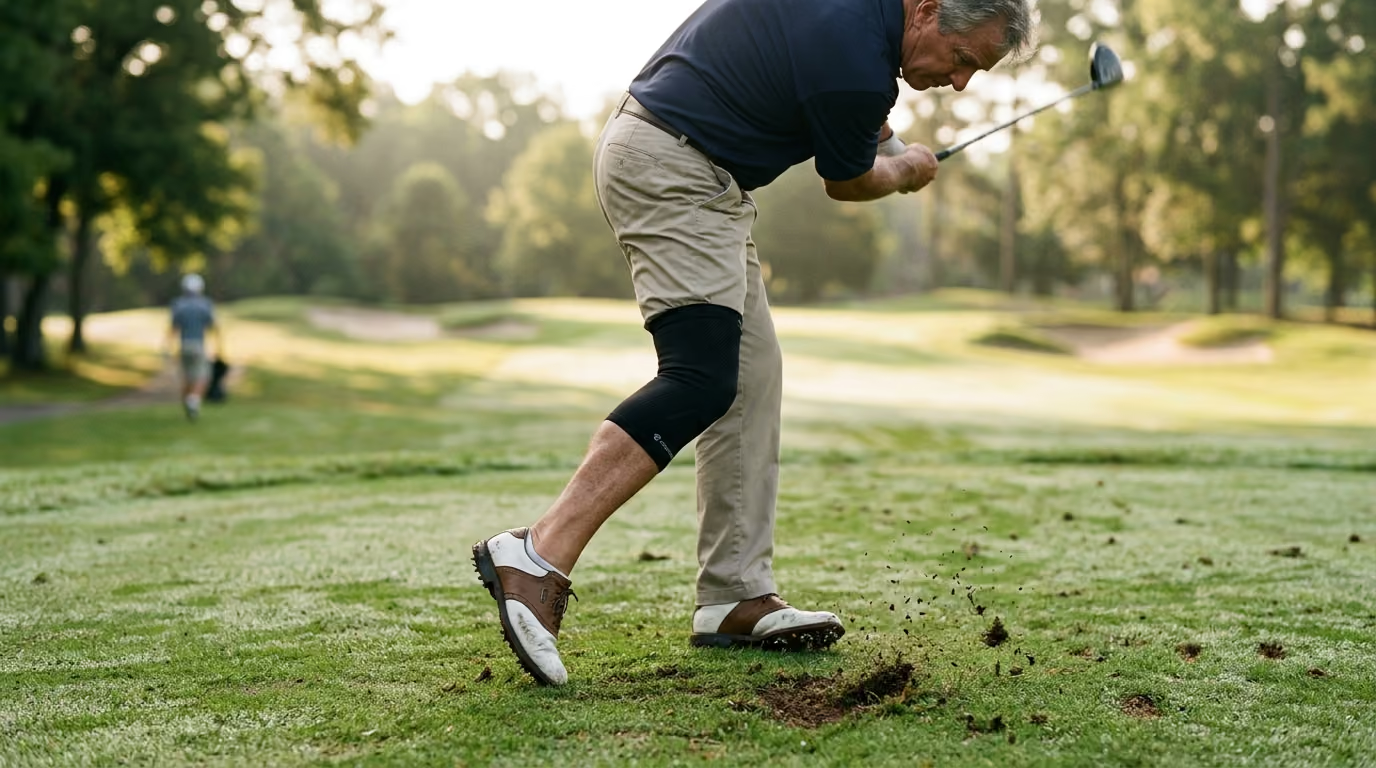
Standing on the fourteenth tee, your lower back feels tight and stiff. Your lead wrist twinges as you pull your five-iron from your bag. You step up to the ball in the light rough. Because your irons are slightly too short, you must bend deeper at the waist.
Your body must adapt to make clean contact with the ball. This is what sports scientists call the compensation cycle. Research from Sports Medicine Weekly shows that when your clubs do not match your body, you make subconscious adjustments. Your brain forces your muscles to alter your posture mid-swing.
You might round your spine to reach the ball. You might flip your wrists at impact to square the clubface. These sudden movements help you hit the ball, but they place immense strain on your joints.
The lead arm experiences heavy stress during the late downswing. Your muscles must work overtime to control an unbalanced club. This repetitive strain leads to chronic pain in your elbows, shoulders, and lower back. Over time, these small adjustments turn into serious overuse injuries.
When a golf club strikes the ball or the turf, a massive amount of energy is created. This energy does not simply disappear. It travels up the club shaft and enters your hands, wrists, and elbows. Biomechanists refer to this process as kinetic shock transfer.
The materials in your golf club dictate how this energy behaves. A stiff club behaves like a tuning fork. It sends harsh, high-frequency vibrations directly into your soft tissues. Your tendons and muscles must absorb this force.
Over time, this constant vibration creates tiny micro-tears in your muscles. This is the primary cause of medial epicondylitis, which is commonly known as golfer's elbow. According to research from Sports Medicine Weekly, using ill-fitted clubs accelerates this tissue damage.
To protect your joints, you must direct this shock away from your body. Your equipment should act as a shield. Properly fitted clubs absorb the force of impact before it reaches your joints. This absorption allows your body to recover faster after every round you play. To prevent injuries, you must understand how different club components handle these forces. You can learn more about physical protection on our injury prevention page.
Many golfers select their clubs based on static measurements. They look at a standard wall chart at a local sporting goods store. They measure their total height and the distance from their wrist to the floor.
Static measurements are a decent starting point for beginners. They do not account for how your body moves during a real golf swing. A static chart assumes you have perfect mobility and youthful flexibility.
A longevity-focused approach requires a dynamic fitting. Dynamic fitting analyzes your swing speed, your body positions at impact, and your joint rotation. It tracks how your body behaves under the physical stress of a full swing.
If you have stiff hips, your swing path will look different than a flexible player's path. A dynamic fitting adjusts the club specifications to match your current physical limits. It prevents your body from making painful compensations. This focus on individual movement is key to maintaining your physical health as you age.
The golf shaft is the engine of the club. It controls the timing of the swing and the force of impact. The weight, material, and flex of the shaft determine how much physical strain your joints experience.
For many decades, heavy steel shafts were the industry standard. Steel is durable and consistent, but it is highly inefficient at dampening vibrations. It transmits harsh energy directly to your hands and wrists.
A study published in the Journal of Sports Sciences examined this force transfer. The researchers discovered that switching from steel to graphite shafts reduces peak impact force at the elbow by about 22%. Graphite is made of carbon fiber and resin.
This material absorbs high-frequency vibrations before they reach your hands. If you suffer from arthritis or wrist pain, graphite shafts are an excellent choice. The reduction in shock allows your tendons to heal. It also prevents the flare-ups that often cut a golf season short.
Shaft flex refers to how much the shaft bends during the swing. Many recreational golfers use shafts that are much too stiff for their swing speed. They choose stiff shafts because they want to feel like competitive players.
Using a stiff shaft requires immense physical effort. You must swing faster and harder to load the shaft properly. This extra effort increases your risk of muscle strains and joint fatigue.
The Journal of Sports Sciences study showed that stiffer shafts transmit forces at a faster rate. Using a regular flex steel shaft instead of a stiff steel shaft reduces peak force at the elbow by 15%. The softer shaft bends more easily, which reduces the need for aggressive muscle activation.
For the ultimate joint protection, you should consider the steel-to-graphite leap. Moving from a stiff steel shaft to a regular flex graphite shaft reduces peak impact forces by up to 35%. This change preserves your physical energy during the back nine. It allows you to maintain your swing speed without hurting your body.
The weight of your shafts also plays a major role in physical longevity. Heavy shafts require more muscle strength to lift and swing. As you tire on the back nine, your posture begins to break down.
When your posture breaks down, your joints must support your body weight. This leads to lower back pain and poor hip rotation. Lighter shafts reduce the overall workload on your cardiovascular system and your muscles.
By reducing shaft weight, you can maintain your posture throughout the entire round. You will feel fresh on the eighteenth green. You will also experience less muscle soreness the next day. To explore more about maintaining your physical conditioning, check out our healthy ageing resources.
The grip is your only physical connection to the golf club. If your grips do not fit your hands, your swing will suffer. Your body will also pay a physical price.
Most off-the-rack golf clubs come with standard-sized grips. For many adult golfers, these standard grips are actually undersized. Using a grip that is too small can cause significant joint pain.
A 2026 study in the Journal of Sports Sciences looked at forty-eight golfers with medial elbow pain. The researchers discovered that 79% of these players used grips that were too small for their hands.
When a grip is too small, you cannot hold the club securely with light pressure. Your fingers must curl tightly around the thin rubber. This tight grip causes your forearm muscles to contract with excessive force.
An undersized grip requires 20% to 30% more grip force to control the club during a swing. This extra squeeze over-activates your flexor digitorum and flexor carpi ulnaris muscles. These are the muscles that run from your fingers to the inside of your elbow.
This constant muscle tension pulls on the tendons at your elbow joint. Over eighteen holes, you squeeze the club hundreds of times. This repetitive contraction leads to severe inflammation and tendon pain.
By switching to a larger grip, you can reduce this muscle activation. A midsize or jumbo grip fills your hands completely. This allows you to hold the club securely with minimal forearm tension.
You can easily check your grip size at home. Wrap your top hand around your club grip as if you are preparing to hit a shot. Look closely at your ring finger and middle finger.
The tips of these fingers should touch your thumb pad very lightly. They should not dig into your palm. If your fingers press firmly into your palm, your grip is too small.
If your fingers do not touch your palm at all, the grip is too large. Golfers with a ring finger measurement of 18 centimeters or larger usually need midsize or jumbo grips. Making this change is one of the cheapest ways to reduce elbow pain.
Your spine is highly vulnerable to injury during the golf swing. Maintaining a neutral posture is crucial for protecting your lower back. The length and lie angle of your clubs dictate your posture at address.
If your clubs are too short, you cannot stand in an athletic posture. You must bend forward from your waist to get the clubhead down to the ground. This posture forces your thoracic spine to round like a dome.
According to the National Institutes of Health, rounding your upper back overstretches your posterior muscles. It also places immense pressure on your lumbar discs. As you rotate your spine in this rounded position, you create dangerous twisting forces on your lower back.
This twisting motion can lead to herniated discs and muscle spasms. Correct club length allows you to stand with a straight, neutral spine. It keeps your head up and your chest open.
With a neutral spine, your core muscles can support your body during the swing. Your hips can rotate freely, which reduces the twisting force on your lower back. You can read more about spinal health on our mobility page.
The lie angle is the angle between the shaft and the sole of the clubhead. When you address the ball, the sole of the club should rest flat on the ground.
If your lie angle is incorrect, the toe or the heel of the club will point upward. This misalignment forces you to alter your hands at address. You might raise or lower your hands to make the club look flat.
These adjustments alter your posture and your wrist angles. During the swing, your body will try to correct this misalignment. You might tilt your spine sideways to keep the ball online.
A professional fitter uses dynamic lie angle adjustments to find your perfect fit. They watch how your club strikes a special lie board. Adjusting your lie angle by just one degree can instantly improve your posture. It removes lateral stress from your knees and lower back.
If you feel joint pain during a round, you cannot change your clubs immediately. You can take immediate action to reduce the physical toll on your body.
First, focus entirely on turning your trail hip during your backswing. Do not try to make a massive shoulder turn if your hips are locked. Allowing your trail hip to turn freely opens up your pelvis. This reduces the twisting strain on your lower back.
Second, check your grip pressure on the tee. Consciously hold the club with a lighter grip. On a scale of one to ten, aim for a grip pressure of three. This prevents your forearm muscles from locking up before the swing even begins.
Third, tee your ball slightly higher when using your driver. This extra height allows you to sweep the ball off the tee without bending your spine forward. It helps you maintain a upright posture at impact.
Finally, take shorter practice swings. Avoid hitting the turf hard during your warm-up swings. Every time your club strikes the ground, your wrists absorb the impact. Save your joint energy for the actual shots.
Equipment is only half of the longevity equation. You must also prepare your body to handle the forces of the game. A simple daily physical routine will keep your joints resilient.
Do not walk straight from your car to the first tee. Cold tendons are stiff and brittle. They are highly susceptible to micro-tears from sudden impacts.
Spend five minutes warming up your joints. Start with gentle wrist flexor stretches. Extend your lead arm forward with your palm facing up. Use your other hand to gently pull your fingers down toward the ground.
Hold this stretch for twenty seconds, then switch arms. This opens up the forearm muscles and prepares them for the grip forces. Next, perform simple shoulder shrugs and torso twists to mobilize your upper back.
To protect your back, you must learn to bend from your hips, not your spine. Practice the hip hinge daily at home. Stand with your feet shoulder-width apart.
Place a golf club along your spine. The club should touch the back of your head, your upper back, and your tailbone. Bend forward slowly while keeping all three points of contact on the club.
Your knees should bend slightly, but your spine must remain straight. This movement teaches your glutes and hamstrings to support your body weight. It prevents your lower back from rounding when you address the ball.
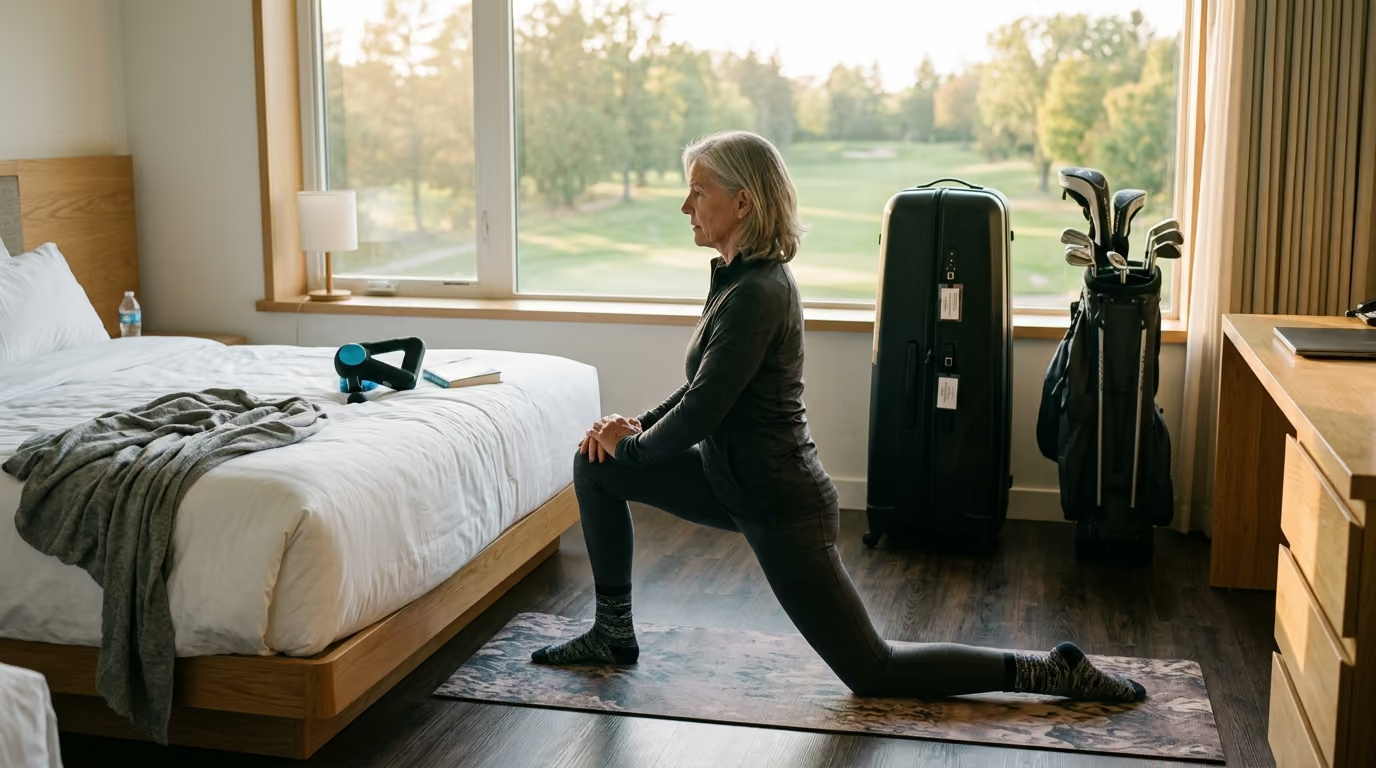
After your round, spend five minutes stretching your lower body. Focus on your hip flexors and hamstrings. These muscles get tight from walking and riding in a golf cart.
Tight hip flexors pull on your pelvis, which arches your lower back. Stretching these muscles allows your spine to return to a neutral position. It accelerates your physical recovery and prepares you for your next round. You can find more recovery strategies on our recovery section.
Many mature golfers make simple equipment mistakes that lead to joint pain. These mistakes often stem from outdated advice or pride.
The most common mistake is attempting to play with equipment designed for young, elite players. Many golfers buy heavy steel shafts and stiff clubheads because they see professionals using them on television.
Elite players have exceptional core strength and high swing speeds. Their bodies can handle the intense physical demands of stiff equipment. Recreational players often lack this physical conditioning.
Using pro-level equipment forces your body to overcompensate. You must swing with maximum effort on every single shot. This constant physical exertion leads to early fatigue and joint inflammation.
Golf grips do not last forever. The rubber slowly degrades due to sweat, dirt, and UV light. As grips age, they become slick and hard.
A slick grip slips in your hands during the swing. To prevent this slip, you must squeeze the club much harder. This increased grip pressure causes immediate forearm fatigue and elbow strain.
According to the National Institutes of Health, you should replace your grips every forty to fifty rounds. If you play once a week, you should regrip your clubs every year. Fresh grips feel tacky and soft. They allow you to maintain a relaxed grip pressure, which protects your wrists and elbows.
Many golfers play with the same set of clubs for ten or fifteen years. They assume that because they hit these clubs well in the past, they should keep using them.
Your body changes as you age. Your flexibility decreases, and your swing speed naturally slows down. If you do not update your equipment, your old clubs will begin to work against you.
A shaft that was perfect for you at age forty might be too stiff at age fifty-five. Failing to update your gear forces your muscles to work harder to achieve the same distance. A regular dynamic fitting check-up every three years will ensure your clubs match your current physical capabilities. You can read more about selecting appropriate gear on our strength page.
To protect your body from unnecessary physical strain, you should establish a systematic routine for checking your gear. This routine ensures that your equipment is always working to protect your joints.
Every three months, examine the condition of your grips. Feel the rubber with your bare hands. Look for smooth, shiny spots where your fingers rest.
If the rubber feels hard or looks shiny, it is time for a replacement. Do not wait for the rubber to start cracking before you change them. Clean your grips with warm, soapy water after every five rounds to remove hand oils and dirt. This simple cleaning restores the tackiness of the rubber and reduces grip tension.
The lead arm handles the majority of the pulling force during your downswing. This intense physical load can easily damage the elbow tendon if your equipment is too heavy.
Hold your lead arm straight out in front of you. Lift your five-iron with your lead hand only. If your wrist shakes or you feel pain in your elbow, the club is too heavy for your current strength.
Consider switching to a lighter shaft weight. Reducing the weight of your long irons will protect your lead elbow from chronic strain.
Your connection to the ground is just as important as your connection to the club. Worn-out golf shoes lose their traction and support.
If your shoes slip during your swing, your knees and hips must twist violently to keep your balance. This sudden twisting can strain your ligaments and cause joint pain.
Inspect the spikes on your shoes before every round. Replace worn plastic spikes immediately. If you wear spikeless shoes, check the tread pattern for flat spots. Invest in supportive, stable shoes that keep your feet planted firmly on the turf.
You do not have to live with joint pain after playing golf. By making smart decisions about your equipment, you can protect your body and enjoy the game for many years. Use this simple checklist this week to get started:
Taking these steps will help you maintain your physical health on the course. Your body will thank you, and your scorecard will reflect your improved comfort. For more information about our mission and resources, visit our about page or contact us with your questions. You can also explore our full library of articles on our blog.
Properly fitted equipment is not just about better ball flight, it is the ultimate tool for keeping your joints healthy and your golf swing pain-free as you age.
Follow Golfergy for practical insights on performance, mobility, recovery and healthy ageing. Stay connected for new articles, research-led guidance and ideas to help you play better for longer.


Explore practical resources on performance, recovery, mobility and golf longevity.
Read the Blog