Thrusting your hips toward the ball during the downswing strains your lower back and requires mobility fixes to protect your spine.




Many golfers believe that early extension is just an annoying swing flaw. They think it only causes a bad shot shape or a loss of distance. They spend hours on the range trying to fix it with complex swing thoughts. This approach usually fails because it treats a physical limitation as a technical error.
In reality, early extension is a protective reaction by your body. It is your brain trying to solve a movement problem. When your hips and ankles lack the ability to move correctly, your body must find another way to swing the club. It does this by pushing your pelvis forward toward the golf ball.
This movement pattern is one of the leading causes of back pain in recreational players. It places your lower back under massive, unnatural loads. If you continue to swing this way, you risk serious injury. Understanding how your body works is the key to preventing long-term physical damage.
By addressing the physical roots of early extension, you can protect your spine. This guide looks at the biomechanics of this flaw and how to resolve it safely. Taking a structured approach helps you build a more durable swing for years to come. This is a vital step in injury prevention for any golfer over forty.
The Titleist Performance Institute has spent decades researching the connection between your body and your swing. Their findings show that early extension is the most common swing characteristic among amateur players. It affects over seventy percent of recreational golfers. Yet, most players still try to fix it using tips they see online.
These online tips often tell you to stay in posture or keep your tush back. If your joints do not have the flexibility to do this, these cues are useless. Your body will simply ignore the cue to protect itself from falling over. To make lasting changes, you must address the physical blockages first.
This comprehensive guide is written specifically for mature golfers who want to protect their spines. We will look at why your body moves this way and what you can do about it. By making small, daily changes, you can restore your mobility and play pain-free. Let us begin by looking at how this problem appears during a typical round of golf.
Imagine you are standing on the tee of a long par-four late in your round. Your body is tired, and your lower back has started to feel tight. You look down a narrow fairway and prepare to hit your drive. You swing the club back and start your downswing.
As you swing down, your hips thrust forward toward the ball line. Your upper body straightens up to make room for your arms. You feel a sudden loss of balance. Your hands must flip at the last second to try to square the clubface.
The result is a weak shot that misses the fairway. It might fly high and wide to the right. It might also hook sharply into the trees on the left. These misses are the classic hallmark of early extension.
You also feel a sharp, pinching sensation in your lower back. Your muscles tighten further as you walk off the tee box. This discomfort is not just simple fatigue. It is a sign that your spine is absorbing forces it was never designed to handle.
This pattern often gets worse during the final holes of a round. As your core muscles tire, your body loses its ability to stabilize your posture. You find yourself standing up more at impact just to reach the ball. Over time, this recurring stress leads to chronic soreness and longer recovery times after playing.
The physical toll of this movement is cumulative. During the first few holes, your muscles are fresh and can mask the issue. You might stay in posture through sheer effort. But by the tenth hole, your primary stabilizing muscles begin to fatigue.
When this happens, your nervous system seeks the easiest path to complete the swing. It bypasses your tired leg and core muscles. It relies instead on the passive structures of your spine to absorb the force of your swing. This leads to the tight, stiff feeling that many golfers accept as a normal part of aging.
You can diagnose this issue yourself by paying attention to your balance. If you finish your swing with your weight on your toes, you are likely early extending. If you feel like your arms are blocked by your body, this is another clear sign. Recognizing these warnings early can help you avoid serious injury on the course.
To protect your body, you need to understand the physical forces at play. The golf swing is a highly dynamic movement that places unique demands on the spine. During a normal swing, your lower back must withstand immense compressive loads. Research shows these loads can reach up to eight times your body weight.
These massive forces occur at the L4 and L5 spinal segments. A healthy swing distributes these loads across your core muscles and hips. When you early extend, this natural distribution system fails. Your spine is forced to absorb the impact in a compromised position.
Biomechanical studies show that early extension increases shear stress on the vertebrae. Anterior shear forces can approach 1.6 times your body weight during the downswing. Medial shear forces reach approximately 0.6 times your body weight during the follow-through. These forces twist and bend your spine at high speeds.
Sports scientists use the term "crunch factor" to describe this danger. This factor measures the combination of rapid rotation and lateral side-bending of the spine. When you early extend, you increase the crunch factor significantly. Your facet joints are compressed, and your spinal discs are pinched.
The joint-by-joint approach explains why this happens. Your body relies on a chain of alternating stable and mobile joints. Your hips must be highly mobile to rotate through the swing. Your lumbar spine must remain stable to protect your nerve pathways.
If your hips cannot rotate, your lower back must move to compensate. The stable joints of your spine are forced to become mobile. This reversal of roles leads to micro-trauma in the spinal tissues. Over time, these shear forces can cause stress fractures in the vertebrae.
This process can lead to a condition called spondylolysis. Research shows that the shear loads in amateur swings are often high enough to cause these fractures. When your core muscles cannot stabilize your pelvis, your spine bears the entire load. This makes proper pelvic movement critical for your recovery and longevity.
Foundational research by Hosea and colleagues highlighted the scale of these spinal forces. Their work demonstrated that the lumbar spine of an amateur golfer experiences loads similar to those of a professional football lineman. The difference is that a football player is trained to absorb these impacts, while a golfer often is not.
Furthermore, research by Cole and Grimshaw in 2016 verified that the modern golf swing has increased these shear stresses. The emphasis on generating high clubhead speed has put more pressure on the lumbar region. If your swing mechanics are flawed, these high-velocity forces will accelerate wear and tear.
When you early extend, you also turn off your abdominal wall. The forward thrust of your pelvis slackens the deep core muscles. Without active core support, your spine has no muscular shield. The bones, joints, and discs must absorb the entire force of the swing alone.
Many golfers believe they early extend because of a bad swing habit. They do not realize that their physical limitations dictate their movement. If your joints cannot move through the proper range, you cannot maintain your posture. Let us look at the specific physical causes of this swing flaw.
Ankle mobility is often the first place to look. Your ankles must flex deeply during the downswing to keep your weight balanced. If your ankles are stiff, your heels will lift early. Your brain senses you are falling forward, so it thrusts your hips toward the ball to stay upright.
You can check this with a simple squat test. Try to squat down deeply while keeping your heels flat on the floor. If you cannot do this, your ankles are restricted. This restriction will affect your posture every time you swing a club.
Limited internal rotation of your hips is another primary cause. During the downswing, you must be able to rotate around your lead hip. This movement is often called posting up on your lead side. If your lead hip cannot rotate inward, your pelvis cannot clear.
Since your pelvis cannot turn, it must move forward instead. This forces your entire upper body to lift to create room for your hands. Improving your mobility in this area is critical for a healthy swing. Without it, your spine will continue to suffer.
Another common issue is weak gluteal muscles. The gluteus maximus and medius are the primary stabilizers of your pelvis. Many golfers spend hours sitting at a desk every day. This inactive lifestyle leads to a condition known as gluteal amnesia.
When your glutes are weak, your hip flexors become tight and overactive. This muscle imbalance is called Lower Crossed Syndrome. It pulls your pelvis into a bad position before you even start your swing. Your lower back is forced to arch excessively at address.
This excessive arch is known as S-Posture. This posture turns off your abdominal muscles and locks your facet joints. Your body has no choice but to early extend to get back to impact. Correcting this requires building strength in your glutes and core.
Some golfers fall into a C-Posture instead. This is characterized by rounded shoulders and a slumped upper back. This rounded position limits your ability to turn your chest. You must then lift your body vertically to lift the club, which triggers early extension.
To compound these issues, mature golfers often experience a natural decline in tissue elasticity. The collagen in your tendons and ligaments becomes stiffer over time. This makes it even harder to reach the deep hip and ankle angles required for a modern swing. If you do not actively maintain these ranges, your body will compensate by early extending.
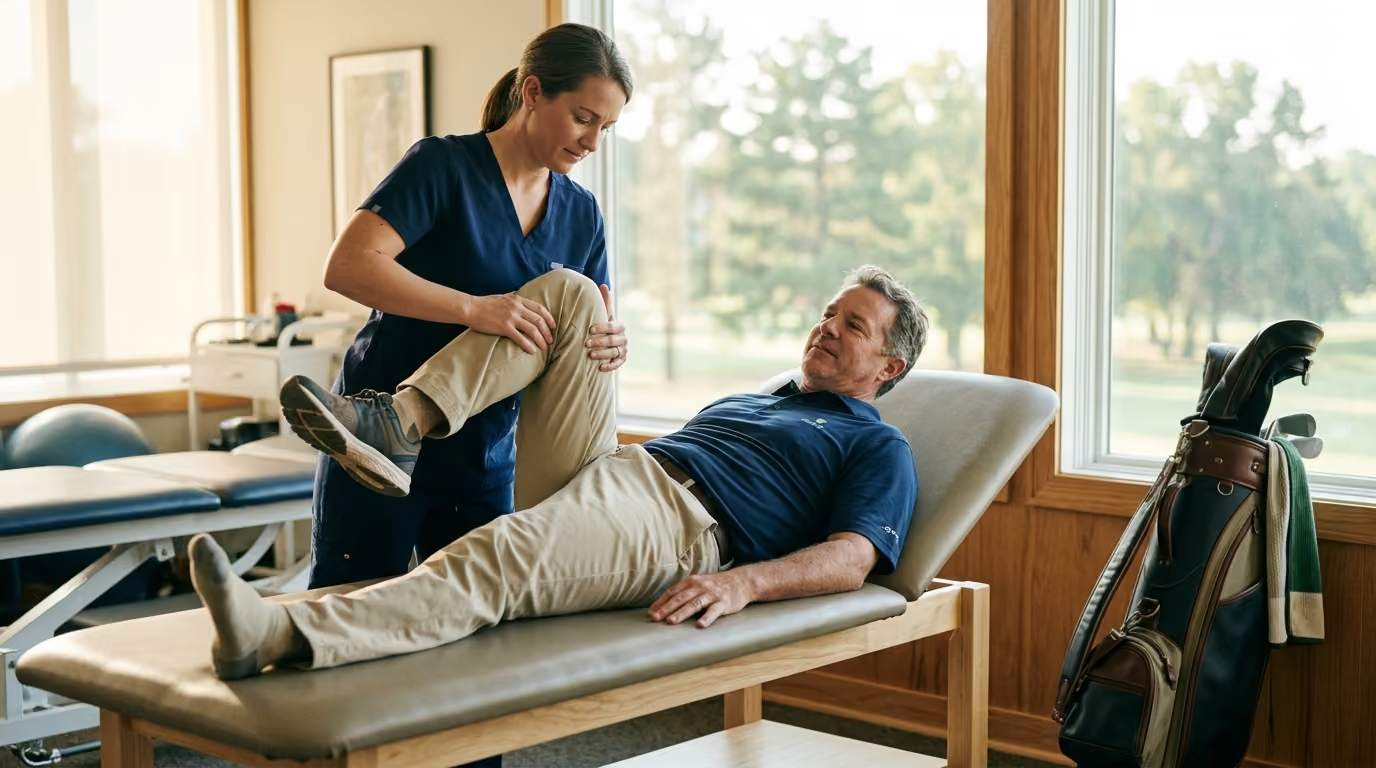
This is why a physical screen is so helpful. Knowing if your issue is ankle stiffness, hip restriction, or weak glutes allows you to focus your efforts. You can waste years trying to fix a swing path when the real problem is in your joints. Correcting these physical issues is the most direct path to a pain-free swing.
When you are playing a round, you cannot stop to do mobility training. You need an immediate way to protect your back and hit better shots. These simple adjustments can help you manage early extension while on the course. They do not require complex thoughts or physical changes.
First, focus entirely on pushing your trail hip back during the downswing. For a right-handed golfer, this is your right hip. As you start your transition, feel like your trail hip is moving away from the ball. This single focus helps keep your pelvis back and preserves your spine angle.
Next, pay attention to your lead heel. Focus entirely on keeping your lead heel planted on the turf through impact. If your heel lifts early, your hips are likely moving toward the ball. Keeping that heel down helps stabilize your lead leg and allows your hips to turn safely.
You can also use a simple alignment stick as a visual guide. Place the stick in the ground just behind your trail hip at address. Feel your glutes make light contact with the stick. Try to maintain this contact until after you strike the ball.
This drill provides instant feedback without distracting you from your game. If you feel your hips move away from the stick, you know you are early extending. This awareness allows you to make quick adjustments between shots. These steps can keep you playing safely during your round.
Another simple adjustment is to slightly widen your stance. A wider stance lowers your center of gravity and increases your base of support. This makes it easier to keep your weight centered rather than shifting onto your toes. It also reduces the urge to thrust your pelvis forward to stay balanced.
You can also try flaring your feet outward at address. Flare both your lead and trail feet about fifteen to twenty degrees. This position opens up your hip joints and makes rotation much easier. It reduces the amount of internal rotation required from your hips, which is helpful if you have joint stiffness.
These on-course adjustments are designed to manage the symptoms of early extension. They help you get through your round without causing severe spinal compression. However, they do not cure the underlying physical issues. To do that, you must dedicate time to a structured home routine.
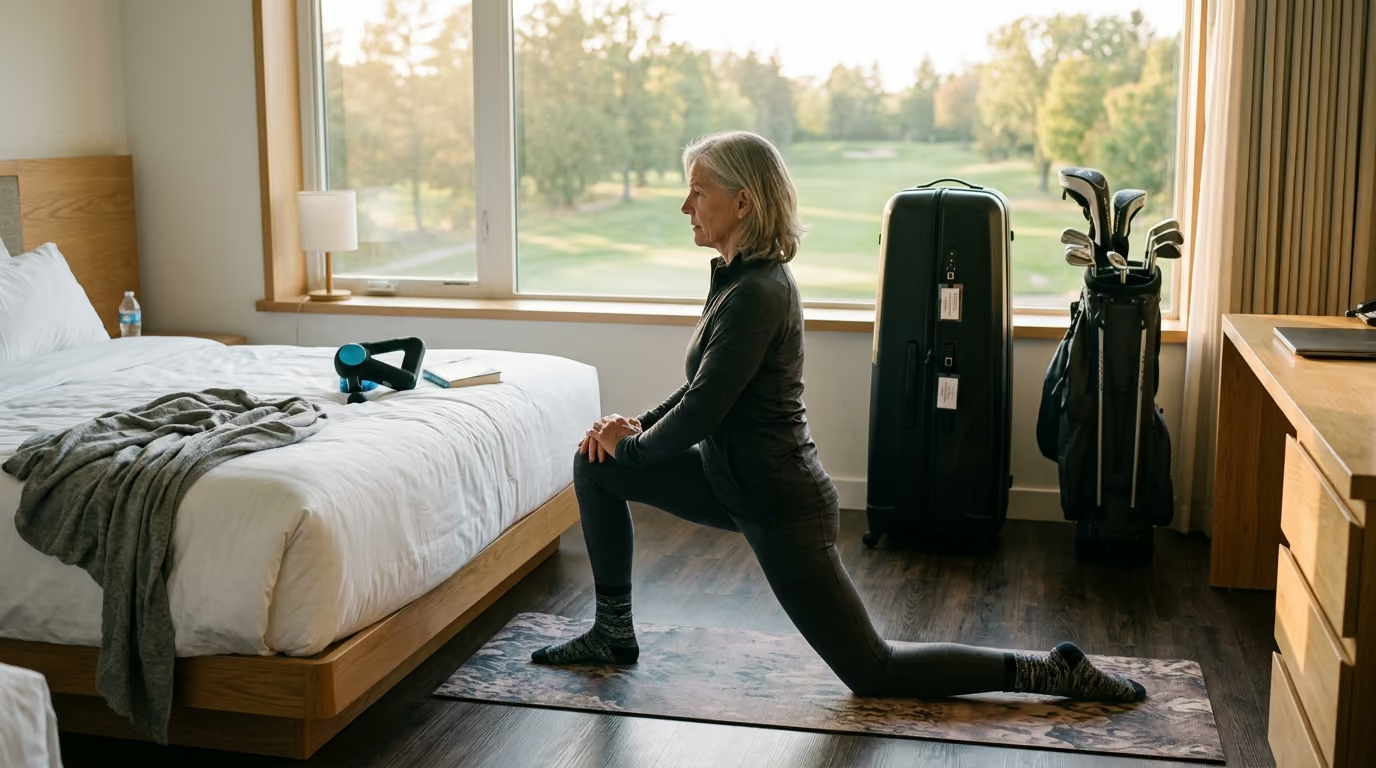
To eliminate early extension for good, you must address the root physical causes. This requires a consistent, off-course routine focused on flexibility and strength. You can perform these exercises at home with minimal equipment. Dedicating fifteen minutes a day to these movements will protect your spine and improve your swing.
Begin with ankle mobilization exercises. Stand facing a wall with your toes about three inches from the baseboard. Keep your heel firmly on the ground. Slowly push your knee forward until it touches the wall.
Perform ten repetitions on each leg. If your knee easily touches the wall, move your foot back another inch. Focus entirely on keeping your heel flat during the movement. This simple stretch improves your ankle flexion and helps you maintain balance during your swing.
Next, work on your hip internal rotation. Sit on the floor with your knees bent at ninety degrees. Place your feet wider than hip-width apart. Slowly drop one knee inward toward the floor while keeping your hips on the ground.
Hold this position for thirty seconds, then switch sides. Focus entirely on turning your lead hip inward. You should feel a deep stretch in the side of your hip. This mobility is necessary to clear your hips during the downswing.
To build pelvic stability, perform the glute bridge. Lie on your back with your knees bent and feet flat on the floor. Place your arms at your sides. Slowly lift your hips toward the ceiling until your body forms a straight line.
Focus entirely on squeezing your glute muscles at the top of the movement. Hold this position for three seconds, then lower your hips back down. Complete three sets of twelve repetitions. This exercise wakes up your glutes and helps stabilize your pelvis.
Finally, practice the Wall Drill to train your muscle memory. Stand with your glutes touching a wall without a club. Take your normal golf posture. Slowly turn back and focus entirely on keeping your trail glute against the wall.
As you transition down, focus entirely on getting your lead glute to touch the wall. Your trail glute should release as your lead glute makes contact. This simple drill simulates proper hip clearance without the distraction of hitting a ball. Practicing this movement regularly will build a safer, more efficient swing. For more ideas on structured routines, check our golf performance resources.
To make these exercises more effective, perform them as a warm-up before you play. Waking up your glutes and stretching your hips before a round prepares your nervous system for the swing. It makes it easier to access these ranges of motion on the first tee. This simple habit can prevent the sudden back pain that often ruins a good start.
Consistency is much more important than intensity when doing mobility work. Doing five minutes of stretches every day is better than thirty minutes once a week. Your body needs frequent, gentle inputs to make lasting changes to joint ranges. Keep your movements controlled and never force a stretch into a painful range.
Many golfers recognize they are early extending and try to fix it quickly. Unfortunately, some common swing tips can make the problem worse. These incorrect fixes can increase the strain on your lower back and lead to injury. Understanding these mistakes is key to protecting your health.
The first dangerous mistake is trying to keep your head down. Many golfers are told to keep their head down to stay in posture. If your hips are thrusting forward, forcing your head down creates a severe pinch in your spine. Your lower back is compressed between your forward hips and your downward head.
This pinching effect increases the risk of disc herniations and facet joint wear. Your head should move naturally with your torso during the swing. Forcing it down does not fix the root cause of early extension. It only adds dangerous physical stress to a vulnerable area.
Another mistake is forcing the X-Factor without adequate core strength. The X-Factor is the difference between your shoulder turn and hip turn. While a large gap can create power, it requires significant muscle control to do safely. If your hips are unstable, trying to maximize this turn twists your lower back excessively.
Your lumbar spine is not designed for extreme rotation. It is built for stability and support. Trying to force a larger turn without a stable base can cause muscle strains and joint damage. Focus on clean hip movement instead of forcing a massive, unnatural stretch.
Finally, avoid trying to fix a physical issue with purely technical thoughts. You cannot think your way out of a tight hip or a stiff ankle. If your joints physically cannot move, your body will compensate. No swing cue can override a physical limitation without causing stress elsewhere.
You must address your mobility and strength before you can change your swing. Trying to force a correct swing path with restricted joints is a recipe for injury. Focus on preparing your body first, and the swing adjustments will follow much easier.
Another common pitfall is overusing training aids that force a position. If a training aid locks your pelvis in place but your hips lack mobility, another joint must yield. Usually, this means your lower back or knees will bear the extra stress. Use training aids only as a guide, never as a tool to force a movement your body cannot physically perform.
Your golf equipment can have a significant impact on your body mechanics. If your gear does not fit your physical needs, it can encourage early extension. A few simple checks can help make sure your equipment is supporting your posture rather than ruining it.
Start by looking at your golf shoes. Many traditional golf shoes have a high heel-to-toe drop. This design lifts your heel and shifts your weight forward onto your toes. This forward balance makes it very difficult to keep your hips back during the downswing.
Consider switching to a shoe with a lower heel-to-toe drop. Zero-drop or minimalist golf shoes keep your feet flat on the ground. This helps you distribute your weight evenly and maintain your posture. Better foot contact with the ground improves your overall stability.
Next, check the length of your clubs. If your clubs are too short, you must bend over too much at address. This rounded setup limits your shoulder rotation and encourages early extension. Make sure your clubs are fitted to your height and arm length.
The lie angle of your clubs is also important. If your clubs are too upright, you may stand up during the swing to prevent the club from digging into the turf. A professional club fitting can make sure your gear matches your physical setup. This support is crucial for healthy ageing and long-term enjoyment of the game.
Finally, examine the thickness of your grips. Grips that are too thin can cause your hands to be too active. This often leads to stalling your hip turn and flipping your wrists at impact. Slightly thicker grips can help quiet your hands and encourage a smoother hip rotation.
If you play with shafts that are too stiff or too heavy, your body will also react. Heavy shafts require more physical effort to swing, which can cause you to lose your posture under fatigue. A softer, lighter shaft can help you maintain a smooth, controlled rhythm. This reduces the need to thrust your body forward to generate speed.
Protecting your spine is the most important thing you can do for your golf game. Early extension is not just a swing flaw that ruins your scorecard. It is a sign that your body is compensating for physical limitations. By addressing these limits, you can play better and protect your health.
As we get older, our bodies lose flexibility and strength. We must adapt our training and our expectations to match our physical needs. Taking care of your joints now will allow you to enjoy the game for many years to come. Focus on mobility, build strength, and avoid dangerous swing tips.
To protect your lower back and improve your ball flight, focus entirely on clearing your trail hip and building the physical mobility to support it.
Follow Golfergy for practical insights on performance, mobility, recovery and healthy ageing. Stay connected for new articles, research-led guidance and ideas to help you play better for longer.


Explore practical resources on performance, recovery, mobility and golf longevity.
Read the Blog