
A new WSJ Magazine feature highlights how lower-body strength supports longevity. Learn why targeted resistance training beats extreme flexibility for older golfers.




You just finished a grueling eighteen holes on a humid afternoon, and your lower back is screaming as you order a clubhouse drink. Stretching that tight back is the exact wrong move to fix the pain. A tired golfer often blames a lack of flexibility for their stiffness. The true solution actually requires building serious muscle mass instead.
The August 19, 2026 issue of WSJ Magazine features an article titled "Is the Secret to Men’s Longevity a Great Butt?" The feature frames a growing interest among high-profile men in using glute strength for longevity. The publication suggests that the key to a long life may be rock-solid glutes. This growing cultural interest aligns perfectly with what functional movement experts have known for years.
A durable golf swing requires a foundation built on golf longevity and physical performance. General resistance training provides the stability needed to walk the course comfortably. The media focus on glute strength reflects a broader shift toward functional aging. We are moving away from viewing exercise purely through an appearance lens.
Mature golfers face a crossroads when their physical capability starts to decline. Option A focuses on consistent lower-body resistance training to stabilize the pelvis. Option B centers on chasing extreme flexibility to mimic younger players. Golfers typically find themselves choosing between these two paths when their usual weekend routine stops working.
The golf industry has heavily promoted Option B for decades. Players are told that long drives require massive shoulder turns and endless stretching routines. Option A represents a fundamental shift in how we prepare for the game. It treats the body like a powerful machine that needs strong brakes to survive.
Understanding this choice completely changes your weekly training routine. Option A demands moderate effort with weights a few times a week. Option B demands daily stretching sessions that often yield minimal performance gains. Let us examine how each approach impacts your body over time.
Option A relies on practical resistance training to maintain control during the swing. A large observational analysis reported that people doing roughly 90 to 120 minutes of strength training weekly had a 13% lower risk of death from any cause. The study involved nearly 150,000 health professionals followed for up to 30 years. Almost 36,000 deaths were recorded during the follow-up period.
The same analysis linked general strength training to a 19% lower risk of cardiovascular-disease death. It also reported a 27% lower risk of neurological-disease death. This method clearly provides substantial longevity benefits for older athletes. However, this method does present potential drawbacks for older joints if executed poorly.
Loaded exercises can aggravate existing pain or knee arthritis if prescribed incorrectly. Golfers with a prior spinal injury should always seek individualized medical clearance. The cited research does not establish a universal exercise prescription for those specific conditions. You must progress gradually by improving your control and range of motion first.
Readers should note that the mortality study was observational in nature. This means it identified positive associations rather than proving direct causation. The study focused on general strength training rather than isolated glute exercises. Therefore, it would be inaccurate to convert these results into claims about specific movements alone.
The apparent benefit of strength training did not continue increasing indefinitely. The report notes that beyond approximately two hours of weekly weightlifting, additional training was not associated with further reductions in overall mortality risk. This is great news for golfers who have limited time to train. You do not need to live in the gym to see significant physical benefits.
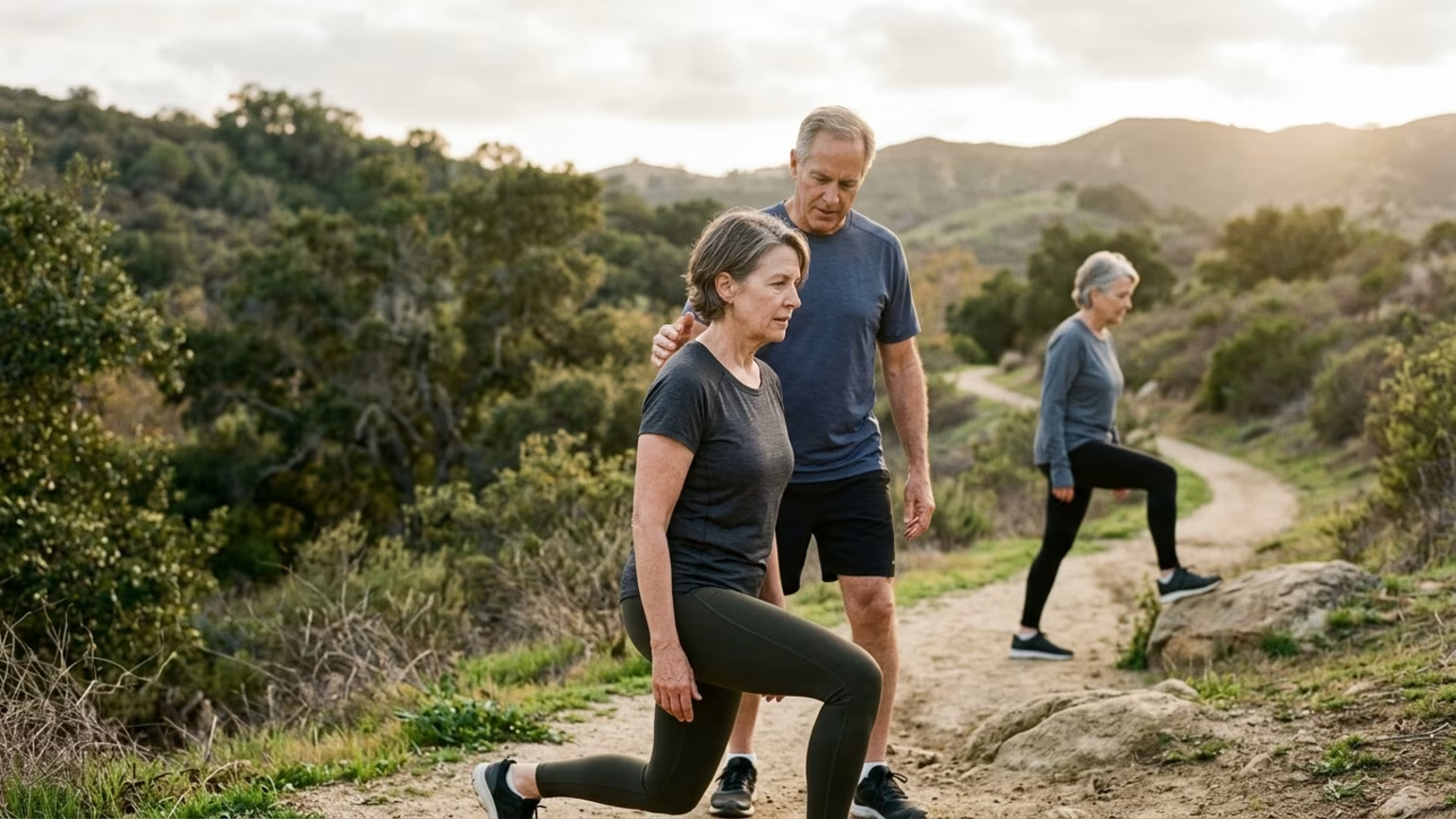
To execute Option A safely, you must incorporate movements that train hip extension. A practical weekly target is two strength sessions. Exercises like sit-to-stands, supported split squats, bridges, and loaded carries provide excellent stability. You can combine these movements with golf-specific strength, balance, and rotational control to protect your back.
Option B promises massive distance through extreme stretching routines. Many older golfers dedicate hours to twisting their spines in hopes of increasing their backswing. This constant push for flexibility ignores the physical wear and tear on aging joints. Stretching a joint without strengthening the muscles around it leads directly to joint instability.
That instability is exactly what causes acute back pain on the back nine. An overly flexible spine lacks the muscular brakes needed to stop the club safely. The modern golf swing generates incredible force that must be absorbed by the hips. When you lack lower-body strength, that force transfers entirely into your lower spine.
The hidden physical cost of chasing extreme golf flexibility usually appears as nagging soft tissue injuries. Stretching alone does very little to improve your actual force production on the course. Instead of trying to touch your toes, you need the stability to support your swing. You simply cannot stretch your way out of physical weakness.
This reality makes Option B a poor choice for long-term health. The WSJ Magazine framing rightly puts the focus back on functional power. Older players need force absorption much more than they need a bigger shoulder turn. A loose body breaks down much faster than a strong body.
When evaluating these paths for better play, strength training clearly wins the longevity tie-breaker. A 2025 overview of systematic reviews found evidence that resistance-based activity performed at least twice weekly can help address frailty. This review looked at adults aged 50 and older. The overview synthesized 23 reviews covering 98 primary studies and 18,768 unique participants.
Resistance training was beneficial in 28 primary studies involving 3,246 participants. However, the overview noted that results vary based on program length and participant condition. One trial involving 66 prefrail adults showed that eight weeks of training did not reverse frailty status. This highlights the need for a long-term commitment rather than a quick fix.
You must combine resistance workouts with regular cardiovascular conditioning for the best results. The 30-year observational study found the lowest mortality association among participants combining aerobic activity with strength training. Doing roughly one to two hours of strength training each week alongside cardio lowered the mortality risk by about 45%. The evidence heavily favors general resistance training over isolated stretching protocols.
Building strong glutes allows you to coordinate small movements safely. For example, when you focus entirely on turning your trail hip, strong glutes stabilize your pelvis. This stability translates to better balance and joint health in your swing. Resistance training keeps you walking the fairways with power and control for decades.
The cultural conversation around fitness is shifting toward functional durability. The WSJ Magazine feature proves that men are prioritizing physical capability over pure aesthetics. You do not need extreme specialization to see results on the golf course. You simply need to practice moderate resistance exercises twice a week.
Combine this training with regular walking to support your overall sleep, recovery, and physical longevity. Treat your lower body like the engine of your golf swing. When the engine is strong, the entire system functions with less stress. This balanced approach protects your spine from the repetitive trauma of the game.
Choose Option B for acute tension relief, and choose Option A for long-term swing health. The game becomes much more enjoyable when your body stops fighting every movement. True physical resilience builds quietly over time.
Follow Golfergy for practical insights on performance, mobility, recovery and healthy ageing. Stay connected for new articles, research-led guidance and ideas to help you play better for longer.


A practical look at golf strength after 40, with research on older golfers and simple habits for connecting training goals to a coordinated swing.


How legs, trunk and upper body share the work of a golf swing, with simple planning habits and a measured look at evidence for older golfers.

Understand mobility versus stability in golf, what older-golfer research reports, and two modest habits for comfortable movement control.
Explore practical resources on performance, recovery, mobility and golf longevity.
Read the Blog


