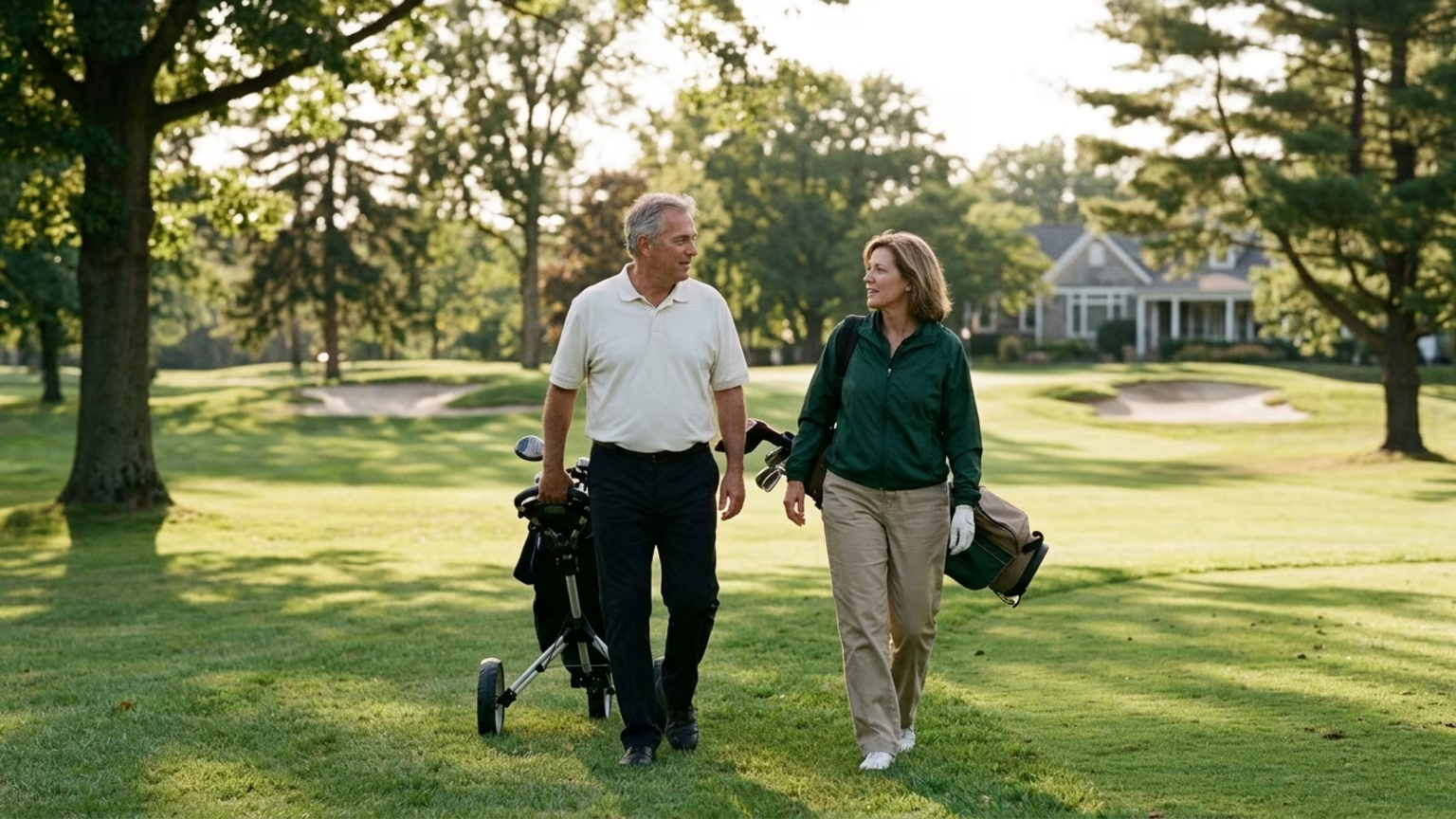
Build a practical golf warm-up from walking to comfortable mobility and fuller swings, while keeping preparation separate from long-term conditioning.




A golf warm-up is a gradual move from everyday activity to the movements and effort of your swing. Its purpose is preparation for play. The useful question is not whether you completed a certain number of minutes, but whether you moved progressively toward the swing you intend to make.
The physical focus is comfortable movement through the hips, trunk, shoulders and ankles before fuller practice swings. In its guidance for golfers over 65, Sports Medicine Weekly recommends brisk walking followed by controlled movements through those areas. Short-iron half swings come next, with fuller swings following as the body feels ready.
For experienced golfers, that offers a straightforward way to organize preparation without turning the practice area into a workout station.
On the course, this progression connects ordinary movement to the task ahead. Walking is the general activity. Moving the hips and trunk alongside the shoulders and ankles brings attention to the body areas named in the guidance. Practice swings then make the preparation specific to golf.
The swing rehearsal is the bridge between moving comfortably and asking for more effort. A short-iron half swing gives the progression a clear starting point. The next step is not automatically the biggest swing available. Sports Medicine Weekly advises paying attention to stiffness or pain before increasing effort.
What does that feel like in practice? The question is whether the current movement feels manageable before moving toward a fuller swing. Stiffness is something to notice rather than a reason to force more turn. Pain should not become a challenge to overcome through harder practice swings.
Across 18 holes, the same attention to symptoms remains relevant. This does not mean repeating an entire warm-up at every tee. It means not treating preparation as a box checked before the opening shot, then ignoring how movement feels during play. Persistent or concerning symptoms call for advice from a qualified clinician rather than pushing through a routine.
For related reading, see how whole-body rotation fits a comfortable turn.
For a golfer passing 40 or 50, it helps to separate readiness for today's round from physical capacity built over time. Sports Medicine Weekly distinguishes warming up before full swings from ongoing exercise for hip, core and shoulder strength. Those are related jobs, but they are not the same job.
The article also describes a trial of an eight-week program in men aged 55 to 79 that improved strength, range of motion and clubhead speed. That finding concerns a separate exercise program. It is not evidence that a few practice swings produce the same changes.
The age-specific limits deserve a clear statement. Guidance for golfers over 65 does not establish how quickly mobility changes after 40 or 50, or explain the biological causes of those changes. It should not be read as a timetable for an individual's decline. Nor does the guidance establish one ideal warm-up duration or repetition count for every golfer.
There is also a limit to the injury claim. A golf-injury guide reports that a 2019 systematic review found evidence connecting warm-ups to injury prevention mixed and inconclusive. Its account also notes that an association between warming up and fewer injury reports does not prove prevention. Warming up cannot guarantee an injury-free round.
The practical distinction is clear: use pre-round movement to prepare for play and separate conditioning to build strength and mobility. A birthday alone does not provide a personal exercise prescription. For the longer-term side of that distinction, see Golfergy's guide to golf-focused strength work.
The source-supported progression can be organized into two accessible habits. Neither requires a complicated exercise menu. Both keep attention on one part of the preparation at a time.
The first habit is to put general movement before swing effort. Sports Medicine Weekly recommends beginning with a brisk walk. Marching is another practical way to organize that general-movement stage before moving into controlled mobility.
The next part is comfortable movement through the areas named in the guidance: hips, trunk, shoulders and ankles. The focus stays on moving one area at a time rather than trying to combine several unfamiliar actions. When attention is on the hips, keep the task about hip movement. Then move on to another area.
The guidance names body areas rather than establishing one mandatory drill for each. That leaves room for familiar movements that feel manageable. The aim is controlled preparation, not a contest to reach the largest possible range.
A hand on a stable support can be an optional adaptation for a standing movement. Treat that as a way to make the movement manageable, not as a required balance test or a proven injury-prevention drill. Balance does not need to become a separate challenge before the round.
For another view of the same transition, read about building from walking toward swings.
The second habit is to make the first practice swings partial and easy. Sports Medicine Weekly specifically suggests short-iron half swings before full swings. That gives the club-specific stage a clear beginning without asking the opening rehearsal to match the intended tee shot.
From there, the progression moves toward fuller swings as the body feels ready. Swing length and effort do not need to jump together. The useful focus is the movement being rehearsed now, followed by attention to how it feels before increasing the demand.
This is not an invitation to keep adding effort until something feels wrong. The source's emphasis is on monitoring stiffness or pain along the way. The progression follows the response to the current movement rather than a fixed obligation to reach full effort.
For a recreational golfer, the value is a clear order: move first, work through comfortable mobility, then rehearse the swing. There is no need to turn that order into a crowded checklist. A simple progression is easier to keep focused on the task ahead.
Prepare the hips and trunk alongside the shoulders and ankles, with Playing Better for Longer as the goal.
Follow Golfergy for practical insights on performance, mobility, recovery and healthy ageing. Stay connected for new articles, research-led guidance and ideas to help you play better for longer.


Shot Scope’s LM1 data offers age and handicap benchmarks for driver speed and carry. Here’s how golfers over 40 can read the figures.


A grounded look at balance after 40, with supported single-leg practice and a clear place for strength training and golf practice.
Understand useful golf mobility, the limits of flexibility research, and two gentle movement checks focused on a comfortable, controlled turn.
Explore practical resources on performance, recovery, mobility and golf longevity.
Read the Blog