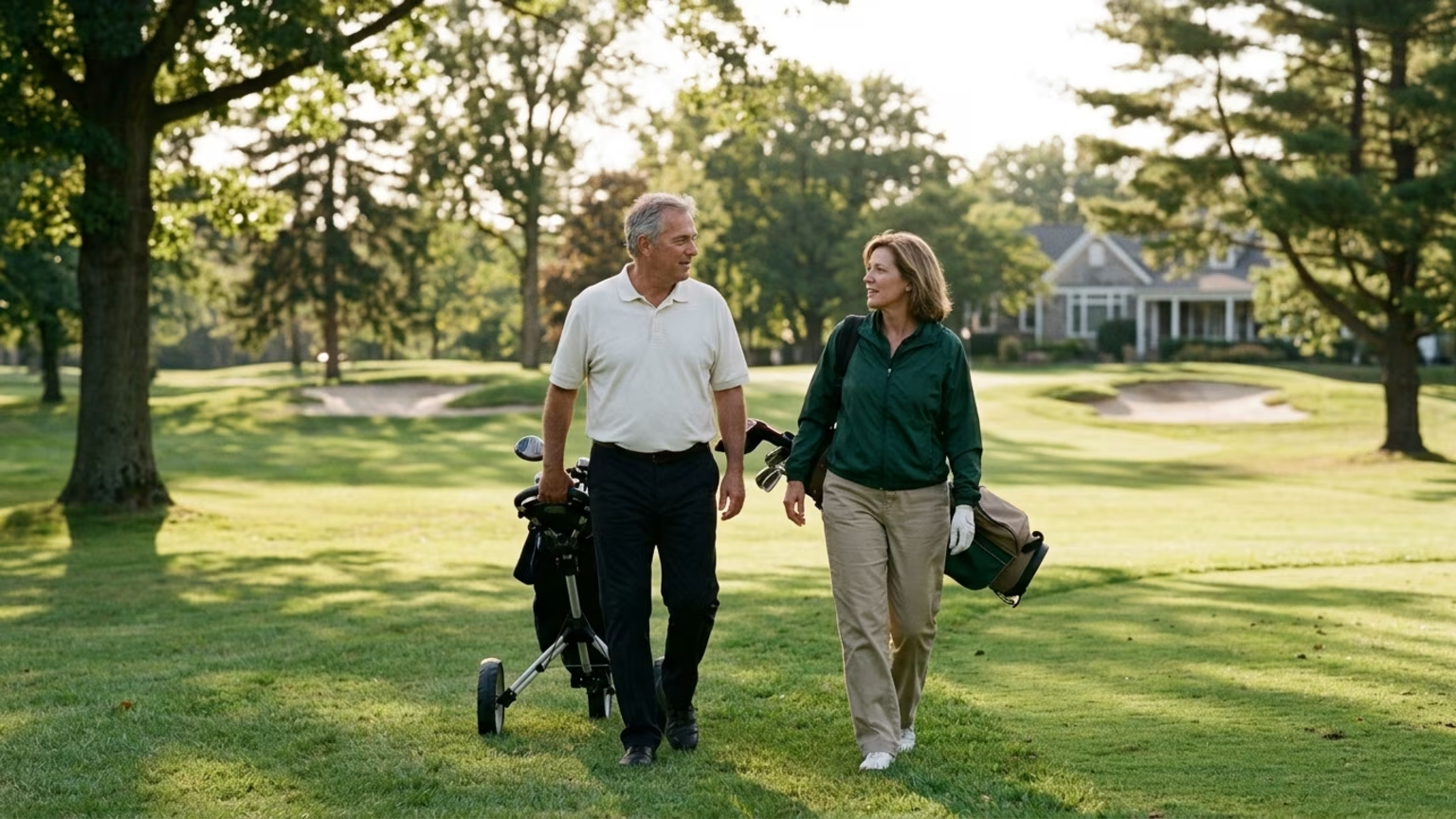
Learn how foundational strength and a closed chain movement sequence help older golfers maintain a repeatable and consistent swing without chasing pure distance.




Foundational strength in the golf swing is simply your body's capacity to sequence movement. It is the engine of a repeatable swing as you get older. Many players confuse golf specific strength with the ability to lift heavy weights in a traditional gym setting. In reality, functional golf strength focuses entirely on how well you transfer force through your body.
Fitness explainers from Royal Blue Fitness commonly describe the modern swing as a highly coordinated sequence. This sequence moves predictably from the ground and legs to the hips and trunk before reaching the arms and club. When these individual physical links operate with sufficient strength, your swing becomes a reliable chain reaction rather than a forced physical effort. You do not need to be a competitive powerlifter to build a resilient golf swing.
You simply need enough muscular endurance to support your body weight and maintain your posture during dynamic motion. Building this specific type of physical capacity allows you to swing with better rhythm. It also reduces the need to rely on perfect timing to make solid contact.
On the golf course, this mechanical sequence dictates how you feel and perform over every single shot. When you step onto the first tee, your legs and hips provide a stable base to manage your weight shift. As you begin to turn away from the ball, your trunk acts as the vital bridge linking your lower and upper body. Finally, your shoulders and arms help you control the club smoothly through the hitting zone.
If one of these bodily areas lacks the capacity to bear the load, your body quickly compensates to complete the motion. By the back nine, a weak trunk or unstable hips can lead to poor posture and missed fairways. Building a sturdy physical base is key to generating efficient force transfer during your entire round. A strong and conditioned movement chain means your body can repeat the exact same swing on the eighteenth hole that you made on the first.
Royal Blue Fitness describes the golf swing as a closed chain movement. This pathway links the legs to the pelvis and thoracic spine before reaching the arms and club. In plain English, a closed chain movement means your feet remain fixed to the ground while your body moves around that stable anchor. Force must travel upwards from the turf through each segment of your body without leaking out.
If your pelvis or thoracic spine cannot handle the rotational stress, the energy stops moving efficiently. When that force transfer breaks down, the upper body typically takes over to try and save the shot. You might feel this as a sudden urge to cast the club or throw your hands at the ball from the top of the backswing. These mechanical flaws are rarely just technical errors.
They are often direct results of physical fatigue in your larger muscle groups. Strengthening the closed chain pathway allows the larger muscles in your lower body to do the heavy lifting.
As golfers pass the age of 40 and 50, natural physical changes begin to challenge this delicate movement sequence. The hips and thoracic spine often lose their rotational freedom, while the legs gradually lose their stable endurance. When this overall physical capacity drops, older golfers frequently try to muscle the club with their arms to generate speed. This upper body compensation breaks the continuous movement chain linking your lower body to your torso and arms.
Maintaining your muscle condition becomes highly necessary to support the swing's base and keep the movement sequence completely intact. Without targeted physical maintenance, the repeatable mechanics you relied on in your thirties become much harder to execute on the course. Your body simply struggles to link the ground up through your trunk to your hands effectively. Following a structured approach to maintaining physical capacity helps protect these vital structural connections.
A common misconception among older players is that strength training automatically translates to massive distance gains off the tee. The available evidence presents a much more measured reality for recreational players. The true value of targeted conditioning lies in supporting your body's functional movement capacity rather than chasing raw power. By prioritizing movement health, you build a swing that holds up under pressure without straining your joints.
When you focus on movement capacity, the legs and hips work together to support your natural weight shift properly. The trunk then safely transfers that generated energy outward to your extremities to power the golf club. The shoulders and arms simply guide the club with total control rather than forced and jerky effort. This measured approach prioritizes a reliable and pain free round over swinging aggressively for the fences on every single hole.
When older players consider starting a fitness routine, they often worry about the physical toll of lifting weights. However, the goal of a golf specific conditioning plan is to build steady consistency rather than peak muscular intensity. The eight week trial cited by Sports Medicine Weekly demonstrates that moderate programs can yield tangible benefits for older adults. You do not need to train like a professional athlete to see improvements in your daily range of motion.
By focusing on consistent and manageable exercises, you protect your joints from unnecessary strain while building a stronger physical base. Light resistance bands, bodyweight movements, and targeted mobility drills are often enough to keep the movement chain fully intact. This sensible approach allows your body to recover properly between rounds while still maintaining the strength needed for a repeatable swing. Treating your conditioning as a long term habit rather than a quick fix makes it much easier to stay on the course.
The research supports a structured approach to building movement capacity for senior players. Sports Medicine Weekly notes that targeted conditioning can build vital capacity in the hips, core, and shoulders. Their reported practitioner guidance suggests that dedicated strength and flexibility work may support the necessary range of motion used in everyday play. This strategy is specifically designed to maintain the physical strength required for fluid and coordinated movement over eighteen holes.
Furthermore, a 2023 cross sectional comparison published by Sports Medicine Weekly examined recreational golfers aged 65 to 79. The comparison found that these older players showed higher grip strength and better static and dynamic balance than their sedentary peers. While the publication cautions that the study does not prove golf caused these exact differences, the association is quite clear. Focusing on these specific areas, including maintaining proper hand health, keeps you actively playing the game.
Addressing your physical decline starts with accessible habits rather than complicated gym routines. Sports Medicine Weekly reports that a randomized trial of golfers aged 55 to 79 tested an eight week strength and flexibility program. This intervention improved the older participants' physical strength, range of motion, and overall clubhead speed. You can start building capacity by adopting a moderate routine that pairs light resistance work with daily rotational stretches for your trunk.
Another effective daily habit is to focus strictly on your static and dynamic balance during practice sessions. Since the legs and pelvis form the firm foundation of your movement chain, simple balance work directly supports a more stable swing. Practice holding your finish position until the ball lands to train your body to sequence force smoothly. Integrating consistent stability work gives your upper body a reliable platform to turn around.
Building foundational strength throughout your movement chain is the most reliable way to play better for longer.
Follow Golfergy for practical insights on performance, mobility, recovery and healthy ageing. Stay connected for new articles, research-led guidance and ideas to help you play better for longer.


A practical look at golf strength after 40, with research on older golfers and simple habits for connecting training goals to a coordinated swing.


How legs, trunk and upper body share the work of a golf swing, with simple planning habits and a measured look at evidence for older golfers.

Understand mobility versus stability in golf, what older-golfer research reports, and two modest habits for comfortable movement control.
Explore practical resources on performance, recovery, mobility and golf longevity.
Read the Blog