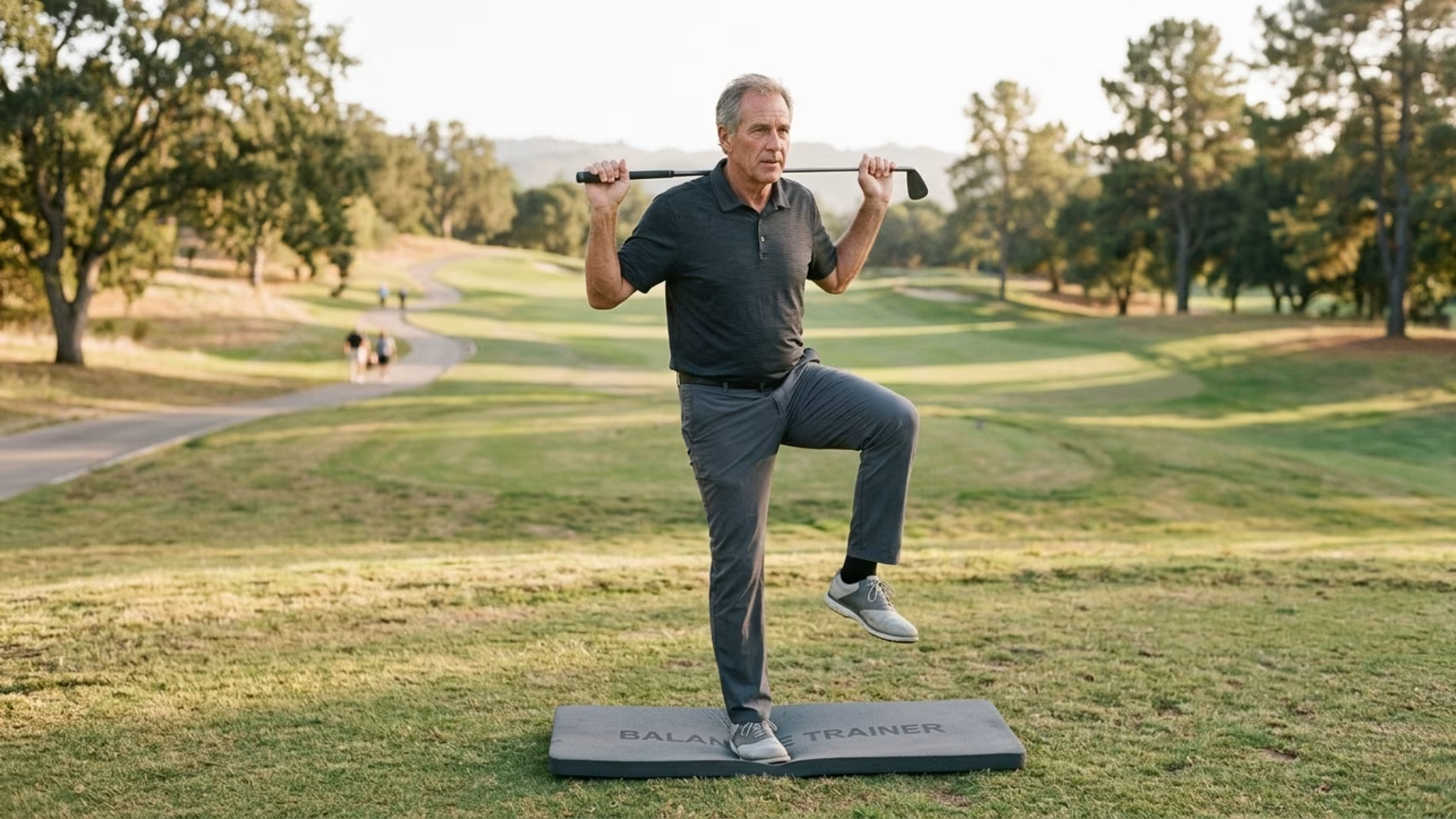

Improve your golf swing stability with this practical balance progression. Learn how single-leg control translates to better weight transfer for senior golfers.




A player stands on the back nine with their feet positioned on a subtle slope. The swing starts well but ends with an awkward step backward. The resulting shot fades weakly into the rough. This familiar scenario highlights a simple loss of physical control.
Many older players blame a loss of flexibility for their fading consistency. A quiet decline in basic stability often forces the body to restrict movement. This limits your ability to play your best golf. You can rebuild this foundation with targeted practice.
The 4-step framework for restoring swing stability:
Balance is a trainable skill that older golfers can improve with focused effort. A capable approach to stability protects your joints and supports better scoring.
Before starting a new routine, you need a safe baseline assessment. Find a sturdy counter or a heavy chair for safety. Stand up straight, place your fingertips lightly on the surface, and lift your trail foot slightly off the floor. Slowly remove your hands from the counter.
Notice what happens over the next ten seconds. Does your standing ankle wobble aggressively to keep you upright? Do you feel your hips shift to the side? Poor control here indicates a physical gap.
If you struggle to maintain a quiet posture, your golf swing will face similar challenges. A swing demands rapid rotation on a narrow base of support. You must possess the capacity to stand still before you can move dynamically.
A 2026 systematic review of sensorimotor interventions in older adults found significant improvements in dynamic balance, static balance, and neuromuscular control. The certainty of evidence varied by outcome. The results remain highly encouraging for maintaining athletic function. The same review reported a large effect for Berg Balance Scale performance, with an effect size of g = 0.94.
The researchers also noted improvements in Timed Up and Go performance, with an effect size of g = -0.89. To build a proprioceptive foundation, start with basic awareness. Stand near a support and shift your weight slowly from side to side. Focus entirely on feeling the pressure move across the bottom of each foot.
Once you feel comfortable, progress to standing on one leg with minimal fingertip support. Keep your breathing steady as you hold the position. Stop immediately if you feel sharp pain in your knees or lower back. This slow progression prepares your joints for the demands of the course.
The next step connects single-leg control directly to the golf swing. Golf instruction sources commonly describe the swing as a sequence in which pressure loads into the trail side during the backswing and moves toward the lead side through impact and the finish. You must be able to accept pressure on one side, control the pelvis and trunk, and then move forcefully toward the other side.
Practice this by getting into your normal golf posture without a club. Turn slowly into a backswing while feeling pressure load into your trail foot. Pause briefly at the top without sliding your hips backward. Shift your pressure smoothly toward your lead foot, and finish with your torso rotated.
Evaluating your ability to handle this pressure shift is a practical way to approach assessing your golf fitness safely. You do not need heavy weights to see immediate benefits. A slow rehearsal trains the nervous system to fire correctly. Focus strictly on maintaining a quiet head and a stable spine angle.
Enthusiastic golfers often rush through single-leg exercises without focusing on their form. They try to stand on one foot for as long as possible. This approach often causes poor pelvic posture. The goal is to build movement control rather than simply clocking minutes on a stopwatch.
The 2026 review found evidence of a nonlinear dose response for dynamic balance. The researchers noted potential attenuation of benefits as cumulative intervention time approached approximately 1,000 minutes. More practice is not always better for your nervous system. Short sessions performed consistently will yield better physical adaptation.
Another frequent mistake occurs during the simulated weight shift. Golf instruction material highlights loading the trail side during the backswing, beginning the transition toward the target, and finishing over the lead leg while preserving posture. Many older players sway their hips laterally instead of turning.
Swaying creates a false sensation of weight transfer. It actually moves your center of gravity outside your base of support. Focus entirely on turning your trail hip backward rather than sliding it away from the target. This protects your lower back from excess strain.
The ultimate goal of this practice is performing better on the course. Golf instruction sources describe a conventional full swing as ending with most of the golfer’s pressure on the lead side. A golfer who cannot comfortably stabilize on the lead leg may have difficulty holding a balanced finish. A visible finishing position is not a complete diagnostic of swing quality, but it provides useful feedback.
You can trigger this feeling before every shot with a simple cart-side rehearsal. Stand next to your golf bag, place a club gently on the ground for support, and take a slow practice swing. Focus exclusively on moving your pressure smoothly and holding a balanced finish for three seconds.
This small habit reminds your nervous system to prioritize stability over raw effort. It helps you judge uneven lies and adjust your stance width appropriately. Many players find that adopting more compact swing mechanics makes it easier to maintain this balance point.
You can also use this drill while waiting on the tee box. Rehearsing your finish builds confidence for the upcoming drive. A grounded mind leads to a more predictable golf shot.
Rebuilding your foundation takes patience and consistent effort. Practicing small weight shifts at home trains your body to manage the rotational forces of a real swing. The Bottom Line: The five minutes of daily balance practice you invest today will build the stable, repeatable swing you need for tomorrow.
Start your routine this evening by standing on one leg next to your kitchen counter.
Follow Golfergy for practical insights on performance, mobility, recovery and healthy ageing. Stay connected for new articles, research-led guidance and ideas to help you play better for longer.


A practical strength framework for golfers over 40, built around everyday goals, sensible progression and a careful look at limited golf research.


A research-led look at strength, balance, mobility and trunk control, with a flexible planning framework for golfers over 40.
Understand golf mobility after 40 with a comfortable-turn self-check, hip and shoulder guidance, and a clear look at flexibility and swing speed.
Explore practical resources on performance, recovery, mobility and golf longevity.
Read the Blog