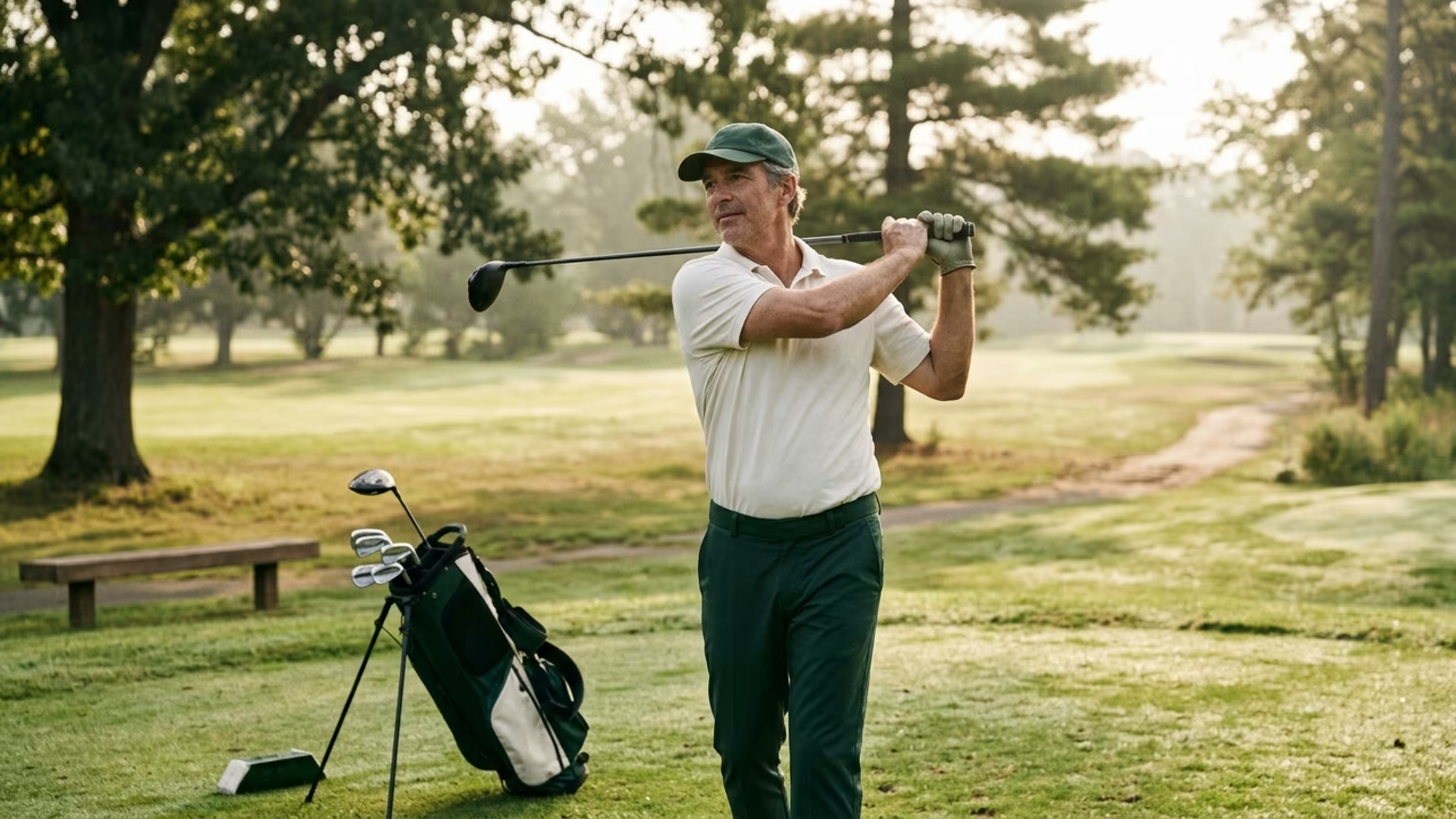

Building hip, trunk, and shoulder capacity helps golfers over 40 maintain a repeatable swing. Learn practical ways to support your body and manage fatigue.




Trunk control is simply your midsection's ability to remain stable while your upper body rotates. It is the steady foundation of your older golf swing. When you combine this stability with hip mobility and shoulder capacity, you get a repeatable motion. A repeatable swing does not rely on perfect timing to make solid contact.
Instead, it relies on a physical base that stays consistent from the first tee to the final putt. Building this base requires a targeted approach to physical training. You must prioritize the specific muscle groups that power the golf swing. Strength training provides the framework to maintain those physical capabilities over time.
Think about a normal round of 18 holes. Early in the day, your posture stays tall. Your shoulders turn fully behind the ball. Your hips rotate without much effort. This physical readiness makes it easy to find the center of the clubface during the opening holes.
By the back nine, things start to feel completely different. Walking the course takes a toll on your legs. The repetitive swinging motion fatigues your core muscles. If your lower body loses strength, your trunk begins to sway during the swing.
When the trunk sways, the shoulders have to work harder to save the shot. You might stand up out of your posture to make room for your arms. This common compensation often results in thin contact or a complete loss of balance. You are no longer swinging the club efficiently when this happens.
A stable trunk prevents this late-round collapse from ruining your scorecard. It acts as an anchor for your rapidly moving limbs. When your core remains engaged, your shoulders can rotate smoothly on their intended path. This biomechanical efficiency translates directly to more fairways hit when the match gets tight.
A repeatable swing requires exceptional balance from start to finish. Your feet must grip the turf while your upper body coils tightly. This opposing tension relies heavily on the strength of your lower body. When your legs are strong, your weight shifts smoothly from your trail foot to your lead foot.
As the round progresses, tired legs compromise this delicate weight shift. You might find yourself falling backward on your follow-through. This happens because your lead leg lacks the strength to post up and accept your body weight. Without a firm lead side, your club path becomes incredibly erratic.
Maintaining lower-body strength directly preserves your balance on uneven lies. Golf courses are rarely flat, and playing from sidehill slopes demands extra stability. A strong lower body anchors you to the ground when the terrain tries to pull you off balance. This physical advantage helps you execute difficult shots with much greater confidence.
Your feet and ankles also play a critical role in this stability chain. They transmit force from the ground up through your knees and into your hips. Keeping these lower extremities strong helps the rest of your swing maintain a solid platform.
As a golfer passes the age of 40, natural physical changes begin to alter the swing. Muscle mass slowly decreases if it is left completely untrained. Connective tissues become less elastic over the years. These internal shifts make it harder to maintain the dynamic posture required for good golf.
The hips are often the first area to show signs of ageing. Decades of sitting at a desk can shorten the hip flexors significantly. Tight hips force the lower back to handle rotation it was never designed to manage. This lack of mobility makes a full backswing feel like an absolute chore.
Your shoulders also undergo gradual changes past the age of 50. The joint capsules stiffen, reducing your functional overhead reach. This tightness restricts your follow-through and eventually costs you clubhead speed. Your swing naturally becomes shorter and much more reliant on your arms.
You cannot stop the clock, but you can manage these physical changes. You must actively build a strong base to counteract this natural decline. Without proper intervention, an aging body will constantly search for new swing compensations. These compensations often lead to inconsistent ball striking.
Ageing also affects how quickly you recover from a long day on the links. In your twenties, you could play 36 holes and wake up feeling completely fine. Past the age of 50, a single round can leave your back feeling tight for days. The body simply takes longer to repair the minor wear caused by a golf swing.
This slower recovery rate is a normal part of the ageing process. It means that you cannot rely on playing golf to keep yourself in golf shape. You must build a physical buffer to handle the stress of the game. A proactive conditioning plan reduces the severity of post-round soreness.
Prioritizing your practical recovery readiness is just as important as swinging the club. Rest days are necessary to allow your muscles to adapt and grow stronger. Pushing through stiffness often leads to poor swing habits and potential discomfort. Respecting your age means knowing when to rest and when to train.
Proper hydration and light movement on your off days can speed up this recovery. Taking a short walk helps flush metabolic waste from your tired leg muscles. Small lifestyle adjustments make a significant difference in how you feel on the first tee.
You do not need an exhaustive gym routine to make a noticeable difference. According to Sports Medicine Weekly, a short golf-specific exercise routine can be highly effective. The publication recommends training two or three times weekly. This training should focus specifically on hip, core, and shoulder capacity.
An eight-week strength-and-flexibility trial highlighted the value of this targeted approach. The trial involved golfers aged 55 to 79. Following the program, the participants improved their strength and their range of motion. They also saw a measurable increase in their clubhead speed.
Start your physical routine with simple movements that target one specific area. For example, you can practice seated trunk rotations at home. Keep your feet flat on the floor to isolate your midsection completely. Focus entirely on turning your trail hip slowly and deliberately.
Gradual loading is the smartest path forward for any older golfer. Start with bodyweight exercises before adding any external resistance. This cautious approach helps you develop usable strength without risking a sudden muscle strain. It is about building endurance for the course rather than lifting heavy weights.
Developing your hip and upper back control takes consistent patience. The research does not establish a single ideal exercise selection for all older players. Therefore, you should tailor any general routine to your own physical experience level. Listen to your body and adjust the movements as needed.
Consistency matters far more than the intensity of any single workout. Performing a few focused movements regularly will yield better results than sporadic gym sessions. You want to train your nervous system to support the rotational demands of your swing. Keeping the volume manageable means you can still play golf without feeling sore.
The available research does not prescribe a single load-increase schedule. You must make your own decisions about when to add weight or repetitions. A smart approach is to keep the resistance light until you master the technique. You can slowly add light dumbbells or resistance bands once the movement feels completely natural.
Focusing on slow and controlled movements yields the best results for older players. Rushing through your exercises often leads to poor form and potential muscle strains. Taking three seconds to complete each repetition builds muscular endurance very effectively. This slow tempo trains your body to maintain stability under tension.
Your breathing also plays a large part in trunk control. Exhaling during the hardest part of the movement braces your core automatically. This simple breathing habit protects your lower back during your physical training. It also translates directly to a more stable posture on the golf course.
Building your hip, trunk, and shoulder capacity is simply how you keep your swing repeatable, allowing you to play better for longer.
Follow Golfergy for practical insights on performance, mobility, recovery and healthy ageing. Stay connected for new articles, research-led guidance and ideas to help you play better for longer.


Build a practical golf warm-up from walking to comfortable mobility and fuller swings, while keeping preparation separate from long-term conditioning.


Shot Scope’s LM1 data offers age and handicap benchmarks for driver speed and carry. Here’s how golfers over 40 can read the figures.

A grounded look at balance after 40, with supported single-leg practice and a clear place for strength training and golf practice.
Explore practical resources on performance, recovery, mobility and golf longevity.
Read the Blog



