

We examine a 2026 Cell Metabolism report on protein restriction and explain why older golfers must prioritize muscle retention and adequate protein intake.




We usually begin these reports with a dated news lede regarding a player withdrawing from a golf tournament. The verified research provided for this article does not contain a professional injury or withdrawal. We state this plainly to respect the facts at hand. Our verifiable event instead comes directly from the laboratory.
In 2026, researchers published a new perspective in Cell Metabolism regarding human longevity mechanisms. Sora Q. Kim, Chris Morrison, and Sangho Yu authored the paper for LSU’s Pennington Biomedical Research Center. They propose that protein restriction may activate a coordinated physiological response. This response involves nutrient sensing, hormones, the brain and metabolism.
The work builds on evidence from model organisms where protein restriction is associated with lifespan extension across multiple species. Chris Morrison noted, "After years of work, we now believe the brain plays a critical role in coordinating the body's response to protein restriction." The authors argue that cellular nutrient sensing and tissue physiology should be understood as parts of one larger system.
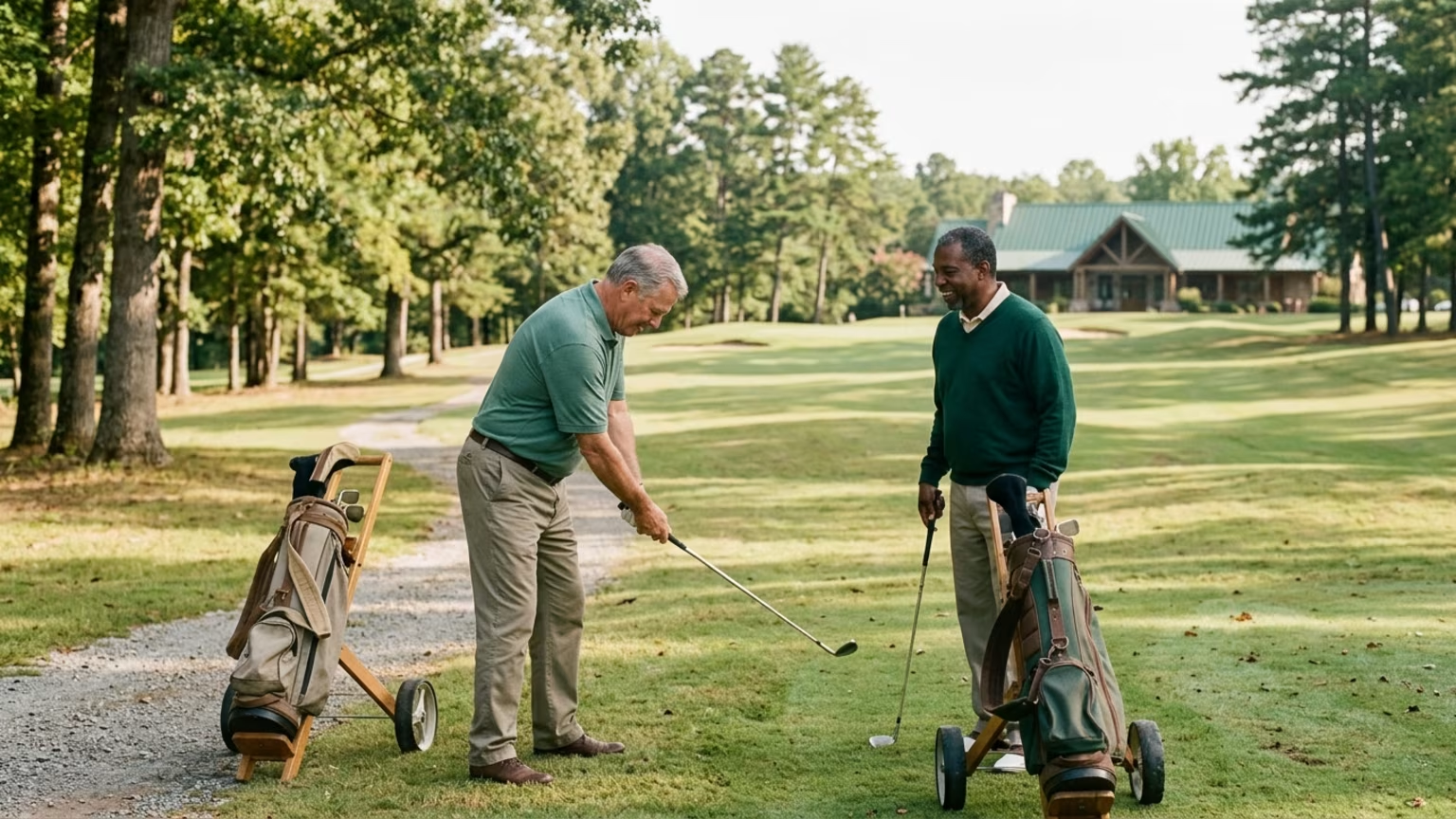
The saddest thing I have seen in golf is watching lifelong playing partners slowly drop out of our weekend group. It usually starts with a nagging shoulder or knee issue they ignore until it requires surgery. That pattern is exactly why I became obsessed with golf longevity. We do not have to stop playing as we age, provided we do the right maintenance work between rounds.
That required maintenance relies heavily on keeping our physical structures capable of handling repetitive rotation. A loss of muscle makes the golf swing much more dangerous for our joints. For the over-40 player, maintaining muscle mass is a clear priority over testing unproven dietary theories.
The standard structure for this report asks for an explanation of the physical mechanics behind a tour professional's issue. Because there is no tour pro injury to evaluate today, we plainly acknowledge that omission. We will instead look at the physical mechanics behind protein restriction and the body's internal responses. The researchers highlight a specific mechanism involving fibroblast growth factor 21.
This biological factor acts in the brain to help coordinate responses to protein scarcity. The report notes that this factor is required for the effects of protein restriction on metabolism and lifespan in the research discussed. The authors propose that changes in essential-amino-acid appetite could eventually serve as measurable indicators of this response. They caution that these are proposed research markers rather than validated clinical tests.
While the data on longevity mechanisms is interesting, golfers need to consider the physical reality of the sport. Maintaining adequate protein intake is commonly recommended to reduce the risk of sarcopenia and frailty. The conventional adult Recommended Dietary Allowance is 0.8 grams of protein per kilogram of body weight per day. A review notes that intakes of approximately 1.0 to 1.2 grams per kilogram per day are routinely recommended for adults over 65.
The most recent dietary guidelines discussed in the review suggest a range of 1.2 to 1.6 grams per kilogram per day. The review cites observational evidence regarding the benefits of a higher protein intake. Adults consuming 1.2 grams per kilogram per day experienced 40% less skeletal-muscle loss over three years than adults consuming 0.8 grams. Retaining that muscle directly supports a minimum effective strength plan for longer playing years.
The same review notes that the composition of protein and amino acids may matter greatly. It highlights methionine, isoleucine and valine as examples of specific amino acids studied in ageing research. However, this does not mean golfers should independently restrict those specific amino acids. The review describes the field as evolving, and the human application remains completely unresolved.
For active individuals, the International Society of Sports Nutrition position stand gives a higher general range. That range is 1.4 to 2.0 grams per kilogram per day for people who exercise. This statement is aimed at individuals who are trying to build or maintain lean muscle. It is a general position statement rather than a universal prescription for every older adult.
Older amateur players swing the club with much less speed than touring professionals. However, they still face a significant risk of physical decline. Professional golfers possess immense baseline strength to protect their bodies during aggressive swings. An older amateur player naturally loses lean muscle mass over time if they do not actively train to preserve it.
This steady decline reduces walking tolerance, compromises balance and lowers overall clubhead speed. Golfers rely heavily on ground reaction forces to generate power in the golf swing. That power begins in the lower body and transfers up through the core to the arms. If you lose leg strength and core stability, your swing sequence breaks down rapidly.
This mechanical breakdown forces the smaller joints in the arms and back to absorb unnatural amounts of force. When muscle mass decreases, the physical stress of the golf swing shifts heavily onto vulnerable joints. This vulnerability explains why a lack of strength often leads directly to nagging physical issues. The review reports that protein restriction initiated later in life can reduce lean mass.
This loss of muscle directly conflicts with the physical requirements of a repetitive rotational sport. A longevity strategy that looks promising in model organisms may not automatically be optimal for athletic performance. Golfers need a solid foundation of power and recovery capacity to handle a full round. Evaluating your functional physical capacities helps you understand where you might be losing valuable strength.
To avoid the fate of losing muscle and dropping out of your regular game, match your protein strategy to your training load. A golfer who regularly performs resistance training has different needs than someone resting. The most practical adjustment is to use your own performance and recovery signals to guide your daily nutrition. If you experience persistent soreness or declining strength, you should review your total energy intake.
Match your dietary strategy to the actual physical demands of your golf schedule. A golfer walking 18 holes multiple times a week burns significant energy and requires ample recovery fuel. A player recovering from a minor joint injury also needs proper nutrition to repair damaged tissue. Ignoring these physical realities in favor of a theoretical longevity diet could set your game back significantly.
When completing a physical warm-up or recovery routine, follow instructions carefully to protect your joints. Keep instructions focused on one small movement at a time, such as 'focus entirely on turning your trail hip'. Prioritize adequate protein intake to support these targeted movements and aid your overall physical recovery.
A common misconception is that early longevity research represents direct clinical instructions for human diets. The recent scientific report does not establish that protein restriction extends human lifespan. The researchers do not provide a specific protein restriction prescription or a safe duration for older adults. The article is a conceptual framework, not a dietary guideline for humans.
The related MedicalXpress report says that biological responses to protein restriction may vary widely. These responses can change according to sex, genetics, age and metabolic health. A dietary strategy that produces a favourable response in one model might not translate to another person. Therefore, applying these early findings to your own routine without medical supervision is highly unwise.
It is incorrect to read these scientific reports and immediately slash your protein intake. The evidence described is primarily from model organisms and mechanistic research, including fruit-fly work. The study discusses a biological hypothesis about adaptation, not a recommendation to eat less before a golf round. Golfers with specific medical conditions should always discuss major dietary changes with a qualified clinician.
Treating longevity nutrition as an evolving field is the safest approach. Understanding the broader lifetime strategy for health requires balancing these new findings with established medical guidance.
For the older golfer, healthy ageing means retaining the strength and stability required to keep playing consistently. The science of human longevity will continue to develop, but the immediate need for muscle retention is well documented. Maintaining the functional capacity to walk the course requires a thoughtful balance of nutrition and movement. What adjustments will you make to your mobility routine this season to steer clear of this hazard?
Follow Golfergy for practical insights on performance, mobility, recovery and healthy ageing. Stay connected for new articles, research-led guidance and ideas to help you play better for longer.



A review of a Cell Reports Medicine study showing how brief, high-intensity exercise impacts blood proteins, and what this means for older golfers' routines.


Examine the clinical evidence on how resistance training, proper protein intake and structured recovery help older golfers preserve muscle mass and stability.
Learn how the proposed movement span framework helps older golfers understand physical decline, maintain balance, and extend their playing years safely.
Explore practical resources on performance, recovery, mobility and golf longevity.
Read the Blog