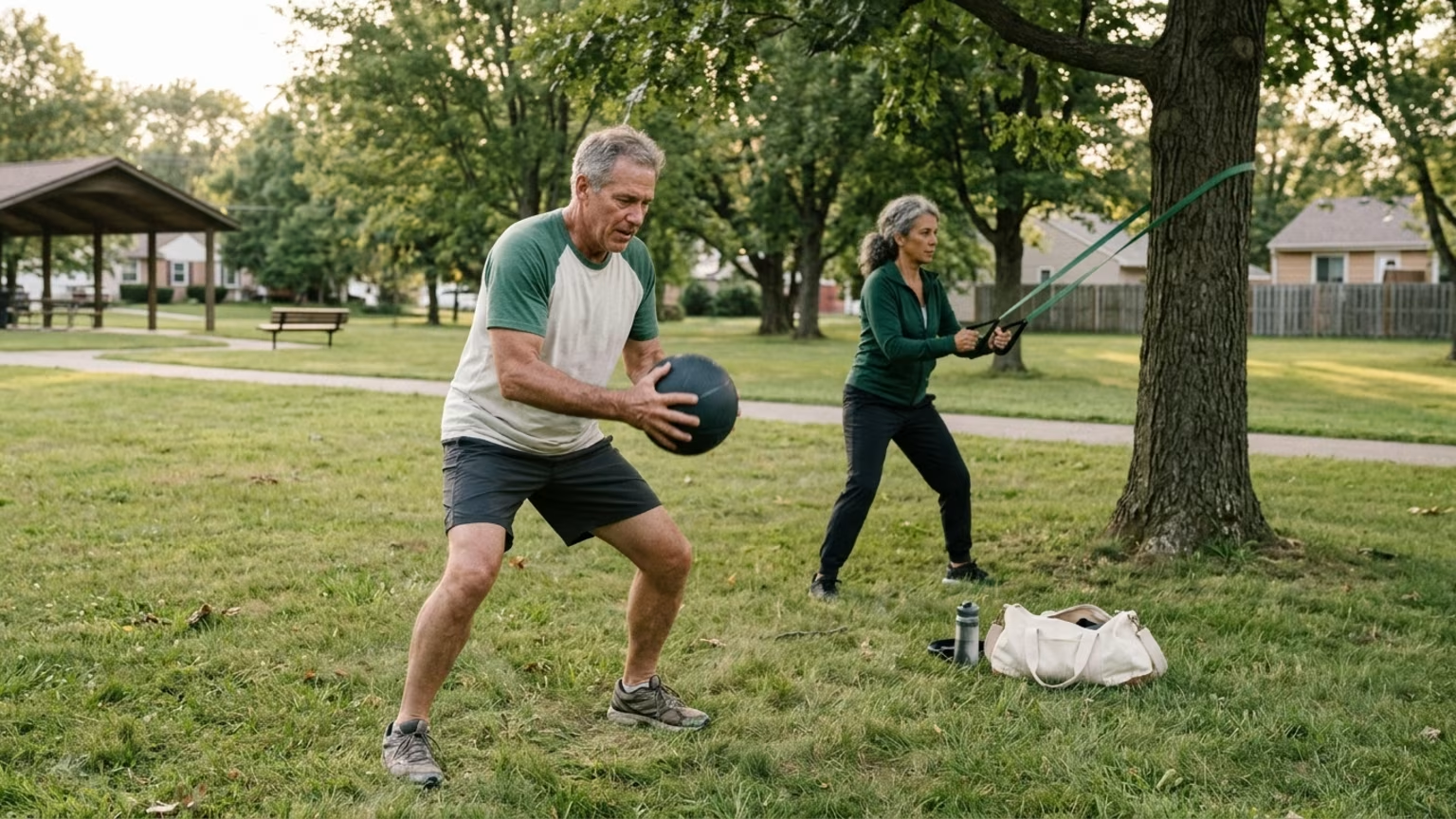

A reported vascular benefit puts power training on the agenda for golfers over 50. Here is how to separate the health finding from golf evidence.




Yahoo Health reports that a University of Missouri study found greater improvements in blood-vessel function after 16 weeks of faster lifting with lighter weights than after slower lifting with heavier weights. The participants were older adults.
For golfers over 50, that finding puts a different training goal on the agenda: producing force quickly. It offers a reason to discuss power with a qualified professional alongside the more familiar goal of building strength.
The useful starting point is understanding what those goals mean. Then comes separating the health finding from the evidence about golf performance.
Chris Gagliardi of the American Council on Exercise describes muscular power as the ability to produce force quickly. Yahoo’s article describes power training as lifting lighter weights faster. Its comparison with slower lifting using heavier weights puts the speed of movement at the centre of the discussion.
A strength question asks about the force someone can produce. A power question adds another part: how quickly they can produce it. These are related ideas, but they are not interchangeable training goals.
Gagliardi also says loss of muscular power is associated with falls and frailty. He connects it with functional decline too. These are expert comments reported by Yahoo rather than outcomes measured in the Missouri comparison.
That distinction gives the topic relevance beyond a heavier weight on the gym floor. The discussion is about physical capacity during ageing, with muscular power treated as a goal worth naming in its own right.
A separate report on ageing in golf describes an eight-week study involving 31 male golfers aged 55 to 79. In the exercise group, mean clubhead speed rose from 85.0 to 87.1 mph.
The program combined strength and flexibility work. That makes it a different training intervention from the faster lifting described in the Missouri report.
It also measured a different outcome. Clubhead speed is a golf-performance measure. Vascular function concerns how blood vessels work.
These findings belong in separate columns in our thinking, rather than being joined into a single promise. The Missouri report concerns a health outcome in older adults. The older-golfer report provides a concrete example of a clubhead-speed change after a combined exercise program.
Both are relevant to a broader training conversation. Each answers a different question.
For recreational golfers over 40, the useful connection is a broader view of training goals. Golf performance and healthy ageing can both matter to the same person. They still need their own evidence.
The Yahoo account leaves out the Missouri study’s sample size and exact participant ages. It also omits the specific vascular measures and the size of the difference between groups. That makes it difficult to judge how substantial or widely applicable the reported benefit was.
The comparison did not test golfers. It provides no direct evidence about golf mobility, clubhead speed, injury prevention or playing longevity. The separate older-golfer study was small and involved men. Its combined program cannot identify which training component produced the speed change or establish that power training caused it.
Those are the boundaries around the findings. Neither report establishes that golfers should replace strength training with faster lifting. The Yahoo article also supplies no golf-specific exercise prescription or loading progression.
For a golfer thinking about the years ahead, the practical interpretation is straightforward: discuss strength and power as distinct goals. Do not treat a blood-vessel finding as a promise of longer drives.
Golfergy’s broader coverage of controlled movement and strength offers background for that conversation. The aim is to bring clearer questions to training decisions rather than chase a single headline.
Yahoo’s practical advice focuses on good form and appropriate support. It recommends considering a certified trainer when new to lifting. It also advises checking with a doctor before starting a new routine, particularly with heart conditions or joint and balance concerns.
Within that guidance, there are several useful subjects to raise. These are discussion points rather than an exercise routine.
A golfer may be interested in general health or golf performance. Naming the goal helps keep the evidence attached to the right outcome.
For example, a question about blood-vessel function belongs with the Missouri report. A question about clubhead speed belongs with golf-specific evidence. A qualified professional can discuss those aims without treating them as the same result.
The finding gives golfers a reason to ask whether power-oriented work belongs alongside strength work in their own training discussion. It does not require choosing one label and abandoning the other.
A useful question is: “How should strength and the ability to produce force quickly fit my goals?” That keeps the conversation focused on the individual rather than copying the study’s broad description.
For related reading, Golfergy’s guide to assessing strength and power keeps those qualities in view as separate parts of a training conversation.
The health concerns named in Yahoo’s guidance deserve individual attention. A doctor is the appropriate person for medical questions. A certified trainer can be part of the discussion about exercise and form.
The source-supported next step is professional input, not a faster repetition performed without context. There is no need to turn a promising finding into a self-directed test on the gym floor.
This approach also leaves room for an honest answer. A professional discussion may focus on the golfer’s goals and health concerns before any particular style of lifting is selected. The research headline starts the conversation. It does not finish the decision.
Yahoo’s account gives power training a place in the healthy-ageing conversation. The reported vascular improvement is a reason to ask informed questions about faster force production alongside strength.
For Golfergy, the useful translation is steady and practical: understand the goal before choosing the method. Qualified guidance matters when that choice becomes personal.
The open research question is how power-oriented training relates to the outcomes older golfers value most. Better movement, golf performance and continued participation each deserve direct study rather than an assumed benefit.
Follow Golfergy for practical insights on performance, mobility, recovery and healthy ageing. Stay connected for new articles, research-led guidance and ideas to help you play better for longer.



An 85-study review linked becoming active with lower mortality. Here is the careful takeaway for golfers over 40 returning after a lapse.


A doctor's bone health advice puts strength training alongside daily movement. Here's how it relates to golfers over 40 and where the evidence stops.

A research-led strength framework for golfers over 40, connecting lower-body, upper-body and trunk capacity with the demands of a full round.
Explore practical resources on performance, recovery, mobility and golf longevity.
Read the Blog