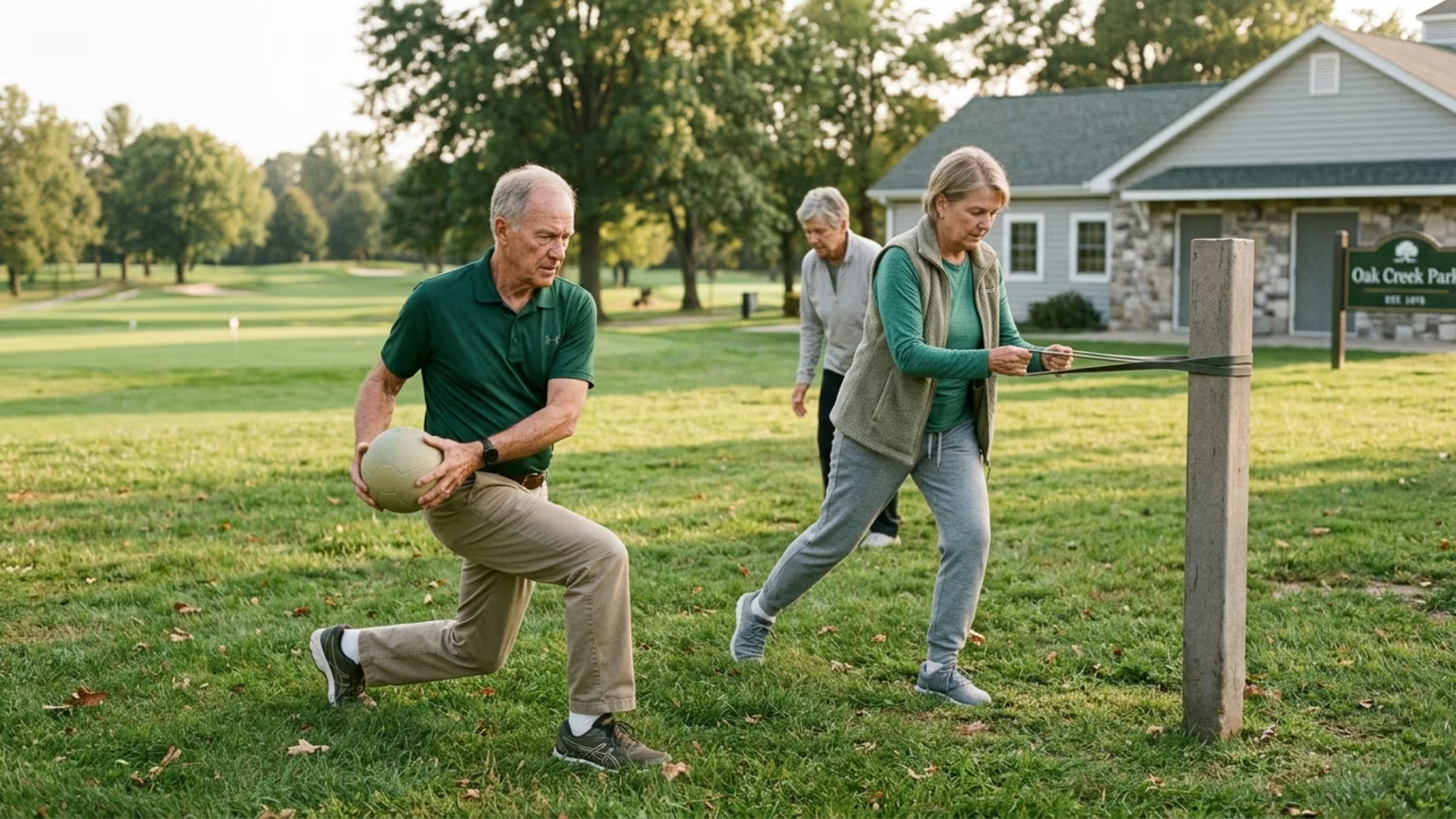

Learn the difference between flexibility and mobility, and discover why golfers over 40 need usable, controlled range of motion for a safer and more powerful swing.




Flexibility is simply the passive range of motion available at a joint, while mobility is your ability to actively control that range. For older players, this distinction completely changes how we prepare the body for golf. You might be able to sit on the floor and reach past your toes comfortably. That passive flexibility means nothing if you lack the strength, balance and coordination to control your body during a fast swing. A golf-specific physical program must account for controlled movement rather than treating basic stretching as a complete solution.
A golfer does not necessarily need extreme flexibility to play well. The most relevant goal is building sufficient sport-specific mobility for the rotational movements required by the swing. Physical limitations often stem from a lack of motor control rather than tight muscles alone. Identifying this difference helps players avoid wasting time on stretches that provide no functional benefit.
When we only focus on stretching, we neglect the nervous system. Your brain will restrict your range of motion if it senses that you lack the strength to stabilize a joint safely. Pushing past this neurological safeguard through forced stretching can actually make you less stable over the ball. Training for active mobility teaches your body how to generate force safely across your entire available range.
We see the gap between passive flexibility and active mobility every time we play an 18-hole round. A golfer might feel perfectly loose while sitting in the clubhouse lounge. However, standing on an uneven lie with a mid-iron requires the body to stabilize the lower half while rotating the upper half. Players lacking usable mobility will often lose their posture, stand up through the shot or slide their hips. The swing breaks down because the golfer cannot control their available range under real physical demands.
Our team learned this lesson the hard way. I used to stand on the first tee doing long, static hamstring stretches because I thought it was the right way to warm up. I would actually feel weaker on my first drive. Research later showed me that dynamic movements, like leg swings and torso twists, prime the nervous system much better. Changing my five minute warmup completely transformed my opening tee shots.
Active mobility gives you better command over the golf club when the pressure is on. When you can control your hips and spine independently, you stop relying on your arms to manufacture speed. This mechanical efficiency reduces fatigue as you make the turn toward the back nine. A stable, mobile body translates directly to a more consistent strike on the ball.
As golfers pass age 40 and 50, they naturally lose muscle mass and motor control. Many players respond by stretching aggressively to recapture their youthful swing mechanics. However, stretching alone should not be viewed as a reliable way to restore lost distance. Building strength and explosive ability shows a much stronger relationship to swing performance than simply increasing flexibility.
Older players should maintain usable movement rather than chasing arbitrary flexibility targets. A golfer with hyper-flexible joints who lacks stability is highly susceptible to swing faults. Physical restrictions in one area inevitably shift mechanical stress to more vulnerable joints.
When the hips or upper back lose active mobility, the lower back frequently becomes the site of compensation. Recreational golfers commonly experience lower-back issues alongside elbow, foot and shoulder complaints. If you want to keep playing comfortably, you must build strength alongside your flexibility.
Losing structural integrity in your midsection forces your smaller joints to absorb the violent forces of the downswing. Maintaining a solid foundation of muscle mass helps protect those smaller joints from cumulative wear and tear. Your exercise routine should prioritize resilience over becoming a human pretzel.
Golf-specific assessments commonly evaluate hip rotation, thoracic mobility, ankle mobility and upper-extremity capacity. ACT Health supports this integrated screening model for golf performance rather than isolating a single muscle group. Evaluating these distinct areas helps interpret physical limitations in relation to swing characteristics. A movement screen should always inform your technical coaching rather than replacing it.
Clinical experts advocate for looking beyond the immediate area of discomfort. Examining hip, thoracic and lumbar function together is highly recommended when evaluating recurring back pain. Treating the painful area automatically as the original cause often misses the actual mechanical failure. If your hips cannot rotate smoothly, your lower back will twist excessively to complete the motion.
The recovery process also demands a cautious approach to isolated flexibility goals. A review published in the International Journal of Sports Physical Therapy states that validated numeric hip- and ankle-mobility thresholds have not been established for returning to golf after ACL reconstruction. Clinicians should instead address meaningful asymmetry and compensatory movement on an individual basis. You need an individualized exercise selection rather than a universal stretching target.
Professional guidance remains critical when addressing persistent discomfort. A physical screen cannot establish the root cause of pain by itself. Golfers may display restricted rotation because of previous surgery, weakness or poor balance rather than tight muscles. Seeking a proper evaluation prevents you from aggravating an underlying issue with inappropriate exercises.
Identifying where your swing is restricted is the first step toward lasting improvement. Performing mobility movement checks helps you observe whether your hips, thoracic spine, shoulders or ankles are causing compensations. Always compare your left and right sides to spot meaningful asymmetries. Once you identify a restriction, select the smallest active intervention that addresses the limitation directly.
The simplest habit to build usable mobility is changing your pre-round routine. A gradual warm-up should progress from light activity to controlled, increasingly faster practice swings. Start with dynamic movements like standing upper-back rotations and reverse lunges. Move slowly, increase your range comfortably and gradually dial up your swing speed.
Your second foundational habit involves adding controlled rotation drills away from the course. Sit tall in a chair, stabilize your pelvis and practice rotating your rib cage to each side without leaning. Focus entirely on turning your upper back without moving your hips. Training golf mobility after 40 should center on building the rotation you actually need.
You can also evaluate your upper body mechanics by raising your arms overhead while standing tall. Observe whether your ribs flare outward or your lower back arches significantly to complete the motion. Rehabilitation research published in PubMed emphasizes shoulder-blade endurance and upper-extremity stability in shoulder-function recovery. Strengthening your scapular muscles supports safer shoulder mechanics during a fast backswing.
Finally, pay attention to how your lower body transfers force. Check your ankle mechanics by performing a controlled knee-to-wall movement while keeping your heel firmly planted. If your heel lifts early, your body will struggle to maintain balance during weight transfer. Addressing these minor stability issues builds a much stronger foundation for your swing.
Progressive conditioning, balance training and active control will always outperform passive stretching on the golf course. Building a resilient body takes time, patience and a willingness to train smart. Incorporating a proper 15-minute mobility routine protects your joints over the long term. Playing better for longer requires you to build strength and control within the ranges of motion you already possess.
Follow Golfergy for practical insights on performance, mobility, recovery and healthy ageing. Stay connected for new articles, research-led guidance and ideas to help you play better for longer.



Learn how limited hip rotation adds stress to your lower back during the golf swing. Use these low-impact drills to build control and protect your spine.


A practical 10-minute pre-round golf mobility routine using brisk walking, controlled dynamic movements and progressive practice swings to ready your body for play.

A recent 12-week study shows how adults aged 45 to 65 can preserve lean tissue during weight loss. Read practical muscle protection advice for golfers.
Explore practical resources on performance, recovery, mobility and golf longevity.
Read the Blog