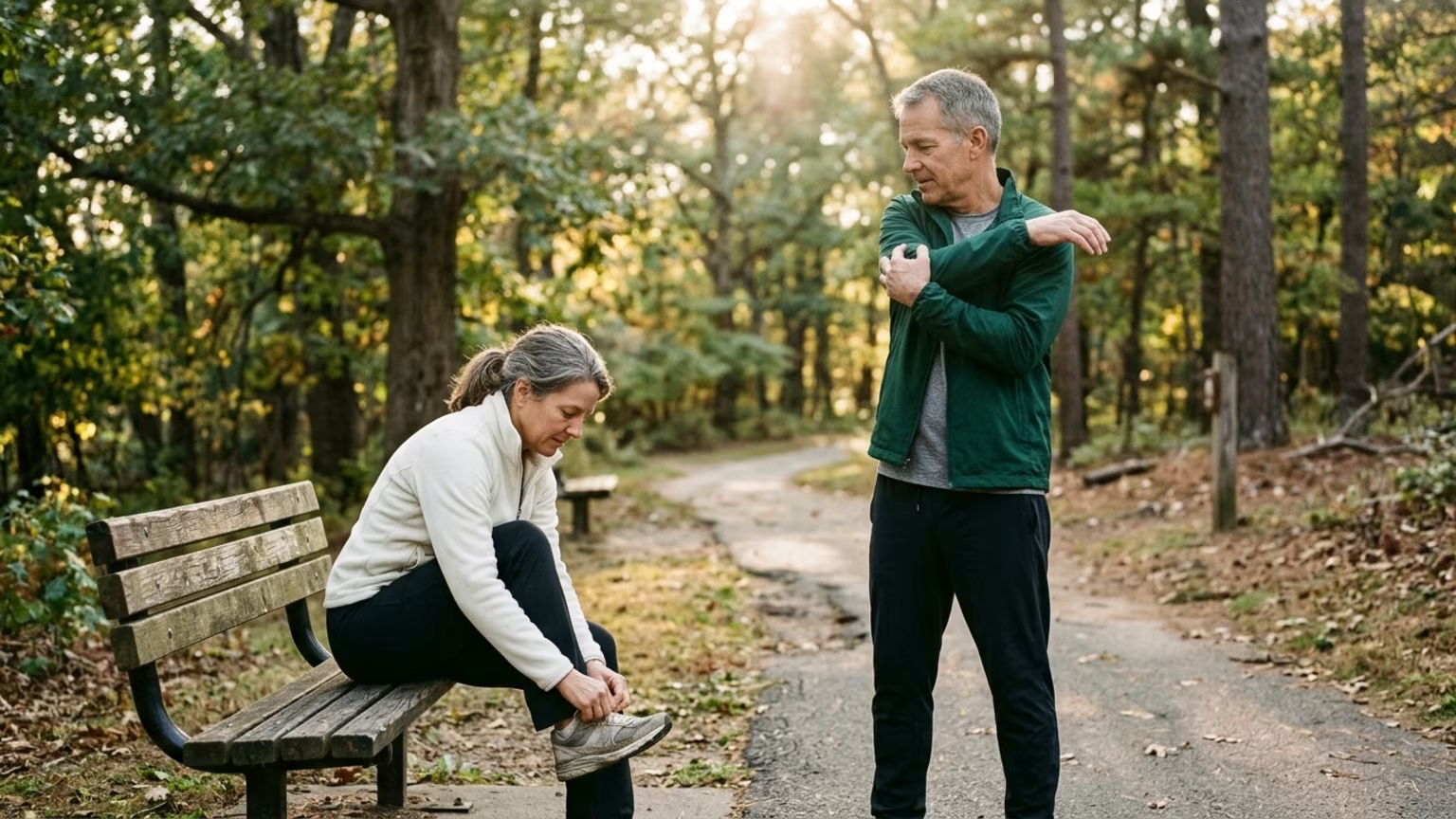
Learn how supported single-leg strength and balance practice fits golf preparation, with realistic expectations for swing control and uneven lies.




Single-leg strength is your ability to produce force through one leg. Single-leg balance is your ability to stay controlled while that leg supports you. Together they describe a useful training goal: developing strength and control one side at a time.
For golfers, the point is not to become good at standing on one foot for its own sake. It is to make these qualities part of preparation for a game that includes rotation and uneven ground.
A golf-fitness summary of a 2007 trial reports that a training program improved clubhead speed and functional fitness in older golfers. That finding offers a useful starting point for discussing balance within a broader approach to golf fitness.
Across a full round, balance matters in different settings. There is the rotating swing itself. There is also the task of setting up for a shot on sloping ground. Single-leg practice focuses attention on the strength and control available from one side of the body.
Golf-fitness guidance connects single-leg control with steadiness through the swing and on uneven lies. The practical connection is a training goal: develop the ability to manage a position rather than simply produce more force.
This does not mean turning the golf swing into a one-footed exercise. The practice position and the playing movement serve different purposes. Off-course work isolates a challenge. Golf brings that capacity into a more complex movement.
Think of an uneven lie as a reason to value control rather than chase a bigger turn. That fits Golfergy's broader focus on managing the turn you already have. The aim is useful preparation for the game you play, not an impressive-looking balance drill.
If you are moving through your 40s or 50s, make your present movement control the starting point. An age label is not an exercise plan. The useful question is which qualities deserve attention within your overall preparation.
Sports Medicine Weekly reported a 2023 comparison in which older recreational golfers had better static and dynamic balance than sedentary peers. They also had higher grip strength. Static balance concerns holding a position. Dynamic balance concerns control during movement.
The evidence has several boundaries worth keeping together. The 2007 trial was small and combined training elements, so its results do not isolate single-leg work. The 2023 comparison was observational and cannot establish that golf caused the differences between groups.
Neither finding tracks natural balance changes through the 40s and 50s or explains the bodily mechanisms behind those changes. The available golf-specific evidence also does not establish that single-leg exercises improve uneven-lie performance or confidence. It provides no validated progression rule or readiness threshold for practising on uneven ground.
These findings are not evidence that one exercise prevents falls or injuries. The practical direction is narrower: treat strength and balance as capacities to develop within broader preparation. Personal decisions about exercise selection and support belong with a qualified physical therapist or exercise professional.
The most accessible starting point is controlled, supported practice. Keep each task small enough that attention stays on one movement rather than a collection of swing cues.
The foundational habit is balance work that challenges one side at a time while support remains available. Focus entirely on controlling the supporting leg. The purpose is to practise that task rather than turn it into a test of how much difficulty you can tolerate.
This is a simple training focus, not a demand to copy someone else's routine. Supported practice gives the session a clear purpose: work on control in a manageable position. There is no need to add a golf club or a complicated turning sequence to make the goal relevant.
Keep the distinction between strength and balance clear. They are related training targets, but the words are not interchangeable. Golfergy's guide to separating strength from stability and balance provides a broader framework for thinking about each quality.
The second habit is supported strength work that challenges one side at a time. Here the emphasis is on developing force while keeping the movement controlled. This complements balance practice without treating the two tasks as identical.
The research supports that broad training goal rather than a universal exercise prescription. It does not supply a personal starting load or session schedule. Keep exercise selection individual instead of borrowing the volume of a research program or another golfer's routine.
A useful focus remains small: control the leg doing the work. Adding several technical thoughts at once moves attention away from that basic task. A foundational session does not need to resemble a full golf swing to have a clear purpose.
A defensible progression starts with supported balance and strength work, then moves toward more golf-like practice as control allows. Think of this as a direction for development rather than a fixed calendar. The thread running through it is maintained control.
Keep the roles of training and playing distinct. Single-leg work targets a physical capacity. Golf-specific practice applies movement in the setting of a shot. Uneven-lie practice belongs in that second category rather than serving as an automatic next step for a balance exercise.
This also keeps expectations grounded. The goal of a training session can be practising strength or control without requiring an immediate change in ball flight. A useful habit earns its place within the wider picture of physical preparation for a durable swing, not as a substitute for that picture.
Developing strength and balance one side at a time belongs within the broader goal of Playing Better for Longer.
Follow Golfergy for practical insights on performance, mobility, recovery and healthy ageing. Stay connected for new articles, research-led guidance and ideas to help you play better for longer.


Learn how legs, hips, trunk and upper body work together in the golf swing, with simple movement examples and age-aware guidance.

Learn how strength differs from power in the golf swing, what older-golfer studies show, and why controlled training matters more than chasing effort.

Understand how strength relates to swing speed, what older-golfer studies show, and why lifting alone is not a distance shortcut.
Explore practical resources on performance, recovery, mobility and golf longevity.
Read the Blog