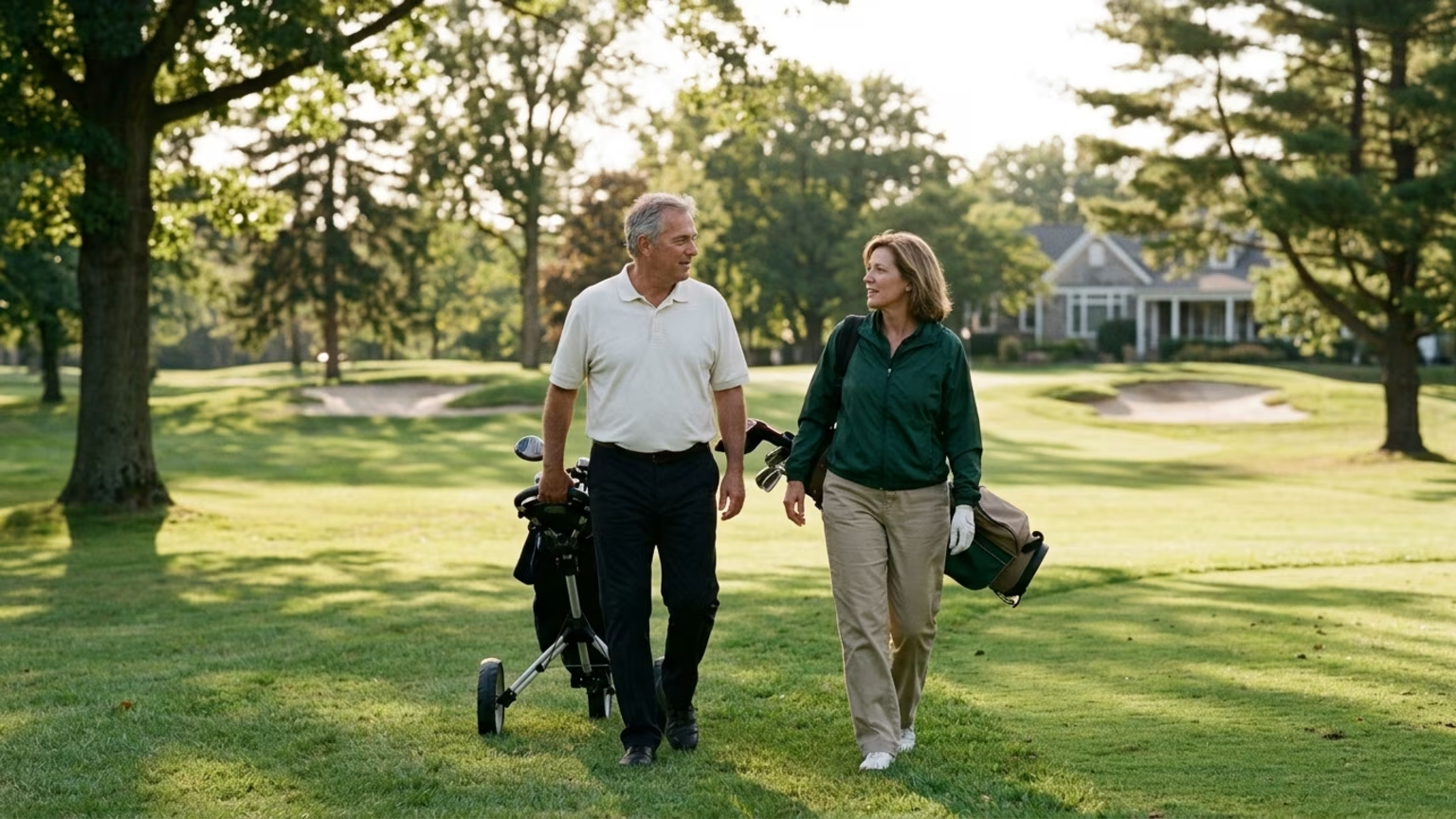
A practical strength framework for golfers over 40, built around everyday goals, sensible progression and a careful look at limited golf research.




A faster swing is too small a goal for strength training after 40. It deserves a place in the conversation, but it should not own the whole conversation.
Carrying your bag, walking a hilly course and getting up from the ground belong on the list of capabilities you want to keep. That does not mean a particular workout has been proved to improve every task. It means your training goals should reflect more than the number on a launch monitor.
When the advice is “train for more speed” or “stretch until you can turn farther,” the missing question is simple: what else does this golfer need?
Neither speed nor flexibility is a bad goal. The mistake is treating either one as a complete plan. A longer turn says nothing by itself about your goal of carrying a bag comfortably. A clubhead-speed result does not answer your questions about walking hills.
For an experienced recreational golfer, health history and current ability also belong in the discussion. Advice that ignores those details does not become suitable just because someone calls it golf-specific.
That is where Golfergy takes a broader view. We believe training should serve the game you actually play and the everyday capabilities you value. The useful question is not whether an exercise looks like a golf swing. It is whether the training goal makes sense for you.
The planning problem is often a mismatch between the result being chased and the task that matters. Wanting more distance is a clear goal. Wanting to finish a round feeling capable is a different one, and it deserves its own discussion.
Before looking for another swing-focused routine, name the task you want to keep doing. Perhaps that is walking a sloping fairway. Perhaps it is managing your bag or rising from the ground without making that task the hardest part of your day.
These are goals to discuss, not tests that diagnose a weakness. They give the conversation a practical starting point without pretending that every restriction has the same cause.
Our guide to movement you can control provides a related way to think beyond simply seeking a bigger turn.
A golf-focused research summary reports that an eight-week strength-and-flexibility program improved strength, range of motion and clubhead speed in golfers aged 55 to 79. That is encouraging support for including physical conditioning in the conversation about longer playing years.
The trial was small and is described through a secondary summary. That summary provides neither numerical gains nor enough detail to reproduce the exercises and progression. The combined program also does not isolate the contribution of strength training alone.
The available findings do not establish injury prevention or guaranteed swing-control gains. They also do not directly test whether a program makes carrying a bag, walking hills or getting up from the ground easier.
The practical response is to use those tasks as personal goals rather than promised results. Strength can be part of a sensible golf-conditioning discussion without being sold as the answer to every problem.
Golfergy's preferred approach is a repeatable habit: name the capability you value before choosing the training challenge. Then organize the discussion around lower-body capacity, upper-body strength and trunk control.
This is a framework for planning with appropriate guidance. It is not a tested exercise menu or a weekly prescription.
Walking hills and rising from the ground are useful lower-body goals to bring into a training discussion. Be specific about which task matters to you rather than using “stronger legs” as the entire brief.
Keep the focus on one movement at a time. If you are working with a professional on a movement related to rising, give that movement your attention instead of trying to change your whole body at once.
The aim is a manageable starting point that matches your ability. There is no need to borrow a demanding routine simply because it was written for golfers.
Carrying a bag is a useful goal for the upper-body discussion. Treat it as something you want to remain capable of doing, not as an outcome that the cited golf trial has already demonstrated.
Describe the task clearly when discussing a plan. Your goal might be handling your own equipment rather than producing a particular gym result.
That keeps exercise selection connected to your priorities. Upper-body work can have a place in the framework without every movement needing to copy the shape of a swing.
For the trunk, make control the subject of the conversation rather than asking only for a larger turn. A useful question for a qualified exercise professional is which manageable movement would let you practise that aim.
Keep the movement focus narrow. If the session concerns turning your trail hip, focus on that turn rather than trying to rebuild your entire swing at the same time.
This is a way to organize attention, not a claim that one movement will fix your swing. It also leaves room for the plan to reflect your starting ability rather than an idealized golf position.
Progression should follow ability rather than a deadline. Begin with manageable movements and increase the challenge only as ability allows. The research here does not supply a fixed loading rule to copy.
Keep the original task in the conversation as training develops. That helps preserve the purpose of the plan without turning a clubhead-speed reading or a gym number into the only goal.
Sustainability matters to Golfergy's approach. A plan should fit your playing life rather than compete with it. Our article on fitting strength work around your golf continues that planning discussion.
Exercise selection and progression are personal decisions. Golfers with pain, health concerns, recent surgery or other limitations should seek guidance from an appropriate qualified healthcare professional before adopting a program. A qualified exercise professional can help translate suitable goals into a plan matched to individual ability.
Next, look for movement guidance that keeps attention on one controlled action rather than presenting a long sequence to copy. Golfergy's reading on a focused hip-rotation sequence is a related topic to take into that discussion.
For broader reading, add The Importance of Strength Training As We Age to your list.
Keep the same question in view as you read or watch: which capability is this meant to support? A useful strength plan starts with a clear purpose, not simply a harder exercise.
Follow Golfergy for practical insights on performance, mobility, recovery and healthy ageing. Stay connected for new articles, research-led guidance and ideas to help you play better for longer.


A research-led look at strength, balance, mobility and trunk control, with a flexible planning framework for golfers over 40.

Understand golf mobility after 40 with a comfortable-turn self-check, hip and shoulder guidance, and a clear look at flexibility and swing speed.

Salk's exercise atlas maps tissue responses in young mice. Here is how golfers over 40 can put the findings and future recovery research in perspective.
Explore practical resources on performance, recovery, mobility and golf longevity.
Read the Blog