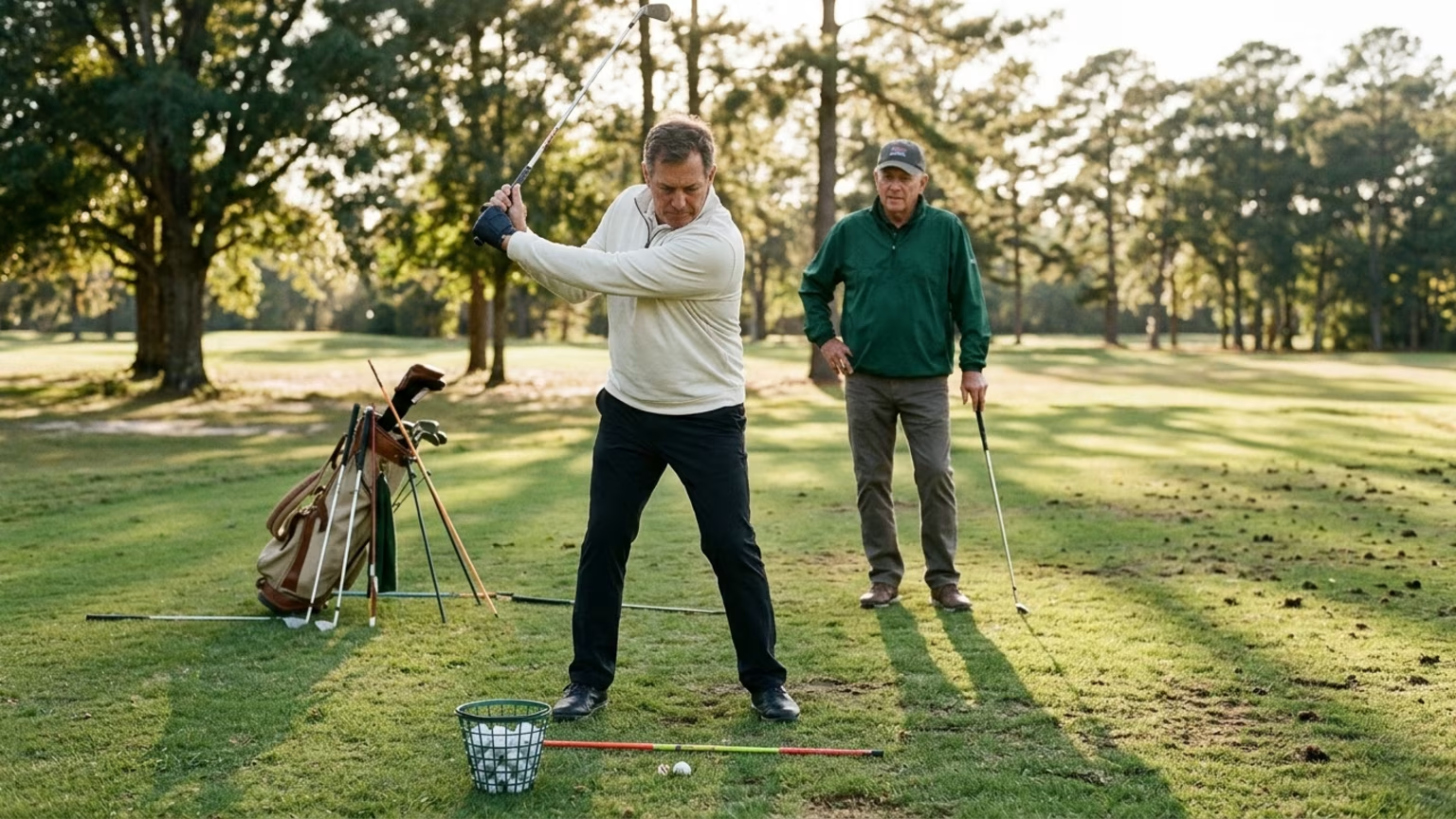

Understand how hips, trunk and shoulders share a golf turn, with gentle ways to notice restrictions and work within a comfortable range.




Golf rotation is the combined movement of your hips, pelvis, trunk and shoulders as you turn through a swing. A useful turn is not simply how far your shoulders travel back. It is how the available movement fits together.
A golf physiotherapy article summarizing a systematic review of 92 golf-biomechanics studies describes body-segment movement and timing as important to swing mechanics. That shifts the practical question from “How much shoulder turn can I get?” to “Where is my turn coming from?”
For the mature recreational golfer, sharing rotation across the body is a more useful starting point than copying the shoulder position in a model swing. The goal is to understand your movement before asking for more of it.
During a standing backswing, the pelvis and hips can move along with the trunk and shoulders. The shoulder line is therefore only part of the picture. Watching it alone does not show how much movement came from each region.
On the first tee, a bigger-looking turn can be tempting. Across the rest of the round, a more useful reference is whether the movement remains comfortable. This is a practical target rather than a demand to reach the same position on every swing.
A turn can feel restricted around the hips or pelvis. It can feel different through the trunk or shoulders. Those descriptions are more useful starting points for a conversation than the broad statement that your whole body is “tight.”
The lower-body base belongs in that conversation too. Notice how your ankles and stance feel without assuming that an ankle restriction explains a shoulder-turn problem. The research does not establish that connection for an individual golfer.
Thinking about the hip movement available in your own turn keeps the discussion grounded in what you feel. The question is how the parts contribute, not which joint should be pushed farther.
The age-related question deserves a careful answer. These sources do not establish how rotation changes naturally after 40 or 50, or explain the biological reasons for those changes. A birthday alone should not become a prescribed swing limit.
The wider evidence also has boundaries. The golf-mobility article is a secondary account of a review whose study methods varied, making one ideal movement pattern difficult to prescribe. A separate golf-injury article summarizing a systematic review describes links between specific swing variables and low back pain as limited and inconsistent.
Movement screens are not medical diagnoses. Nor do these sources establish that increasing mobility independently prevents injury, adds distance or extends playing years.
The practical response is to work from your present movement rather than demand a position remembered from years ago. That does not mean assuming you must accept a smaller turn. It means finding out what feels available now and getting individual help with anything that needs interpretation.
For Golfergy, sustainable habits matter more than chasing a model position. A comfortable turn is a sensible starting point for that approach.
Physical therapist Chris Olshavsky describes combining movement screening with video swing analysis. His assessment looks for mobility, strength or balance factors that may influence swing mechanics.
The useful detail is the combination. A movement observation is considered alongside the golf swing rather than treated as an isolated score. That gives a professional a way to discuss what you feel in relation to what happens when you swing.
A published explanation of TPI movement screening makes a related point. It describes assessing how an individual’s available movement may affect the swing rather than teaching one swing style to everyone.
A useful question for an instructor or physiotherapist is: “Does the restriction I notice show up in my swing?” That keeps the conversation focused on your movement rather than a target shoulder position.
The research supports gentle observation and using a comfortable range as a reference. These are modest starting habits rather than a treatment plan.
Begin with an easy standing turn. Focus only on how your trunk turns rather than trying to make the movement larger.
Then compare that feeling with a comfortable seated trunk turn. Notice whether the movement feels different. Neither position needs to become a contest to reach farther.
Compare left and right gently. Keep attention on one movement at a time. You can also notice whether your pelvis moves along with your trunk rather than trying to force the two apart.
Useful notes might describe:
These descriptions give a golf instructor or physiotherapist something specific to discuss. If either position feels uncomfortable or difficult to interpret, ask a qualified professional what it means for your movement.
The second habit is to stop using extra shoulder travel as the automatic measure of success. Use a comfortable turn as the reference instead.
Keep your attention on one area at a time. For example, notice only how your trail hip turns rather than trying to change your hips and shoulders together. The purpose is to observe its contribution without forcing a larger movement.
Bring that observation into a conversation about your swing. An instructor or physiotherapist can help relate what you notice to the movement they assess.
If a movement causes pain, stop treating it as a flexibility challenge. Seek individual advice from a qualified health professional rather than pushing farther to complete the comparison.
Let comfortable movement be shared across the body, so your golf turn serves the goal of Playing Better for Longer.
Follow Golfergy for practical insights on performance, mobility, recovery and healthy ageing. Stay connected for new articles, research-led guidance and ideas to help you play better for longer.


Understand how hips and spine share your golf turn, why restrictions may change that pattern, and how to focus on comfortable, controlled movement.


Understand how hips, upper back and shoulders share a golf turn, with gentle ways to notice movement differences without chasing a fixed backswing angle.

Understand how your hips and mid-back contribute to a golf turn, with practical habits that put comfort ahead of extra backswing length.
Explore practical resources on performance, recovery, mobility and golf longevity.
Read the Blog