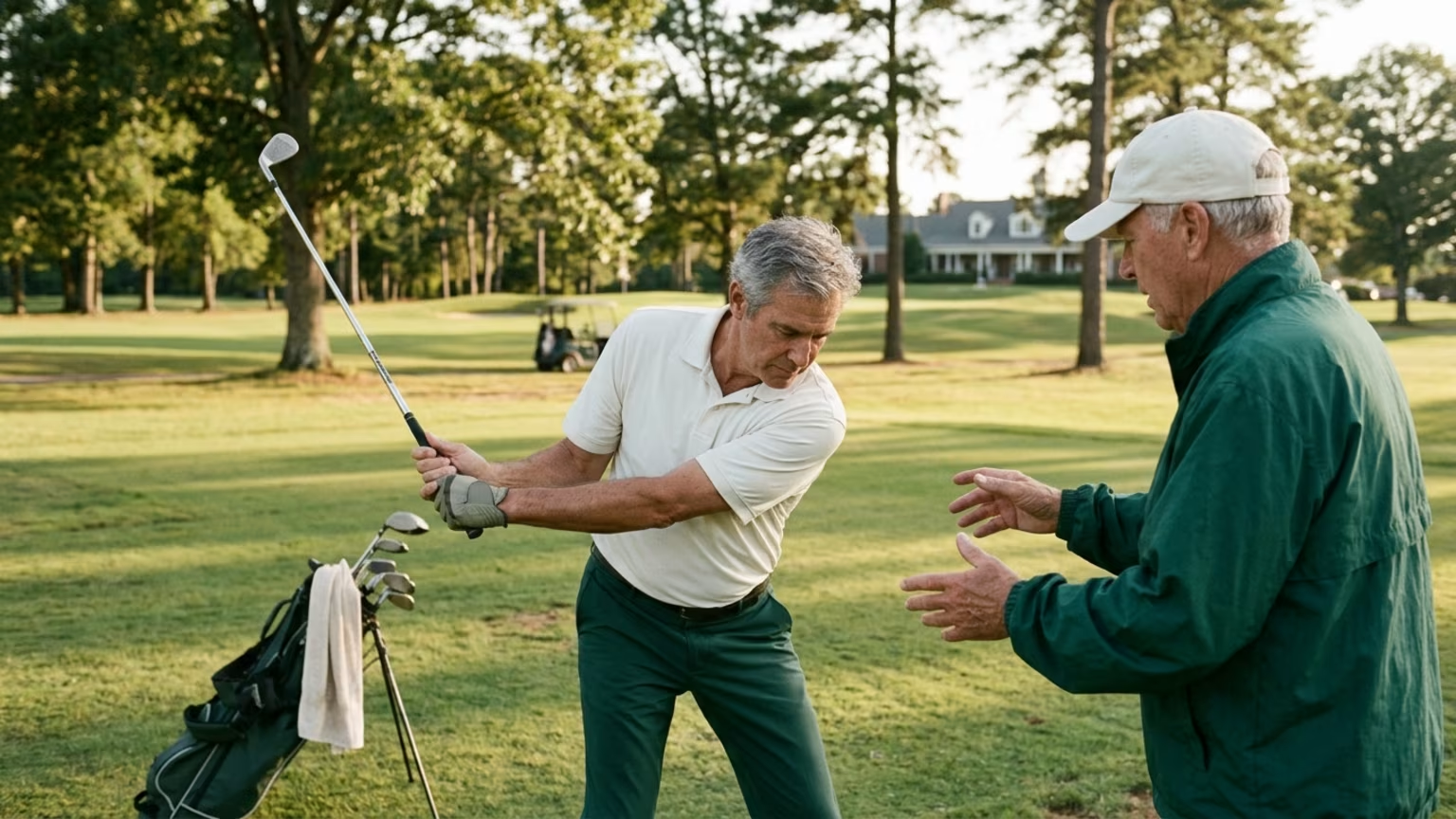

Build a more repeatable golf turn by considering hips, trunk and shoulders together, with practical habits and a clear view of the evidence.




A coordinated golf turn is the way your hips, trunk and shoulders work together through the swing. It is not simply how far your shoulders turn or how long your backswing looks.
Your hips and pelvis belong in that picture. So do your trunk, shoulders and arms. A golf-performance article describes the swing as linked movement among these segments rather than an isolated shoulder-rotation task.
That article also summarizes a review covering 92 studies of golf-swing biomechanics. The review examined pelvis, trunk and joint movement. This gives a useful starting point: look at the relationship between body parts rather than judging your turn by shoulder position alone.
At Golfergy, the practical aim is a turn that fits the golfer and can be repeated. This shifts the question from “How much can I turn?” to “What movement can I repeat?”
On the opening tee, a longer backswing is an easy target to see. Coordination asks a different question: how are your hips, trunk and shoulders contributing to the same swing? The picture includes your arms rather than treating them as separate from the turn.
At the top of the backswing, think about the whole motion you used to get there. A photograph of your shoulder position leaves out how the rest of your body moved. The research summary’s focus on movement and timing supports looking beyond a single position.
Across a full round, use comfort and repeatability as practical reference points. Does the turn feel like something you can produce again? Or does its final part feel like a position you are trying to reach rather than a motion you can repeat?
Those questions keep attention on the movement you have available instead of making backswing length the only target. On the back nine, the same questions remain useful without setting a new rotation target for every shot.
This is also a useful distinction when discussing your swing. “I want a longer backswing” names a position. “I want a turn I can repeat comfortably” gives the conversation a different goal.
For a broader view, our guide to connecting the parts of your turn keeps the discussion centered on coordinated movement. That offers a starting point for a coaching conversation beyond simply asking for more shoulder turn.
For golfers past 40 or 50, a change in available movement raises a fair question: should the swing change too? These review summaries do not explain how or why natural ageing changes mobility. They also do not establish how much range an individual golfer should lose at either age.
The broader evidence has limits too. A systematic-review summary reports limited and conflicting evidence linking specific swing mechanics with low-back pain. The biomechanics summary notes that differences in research methods make one ideal movement pattern hard to prescribe. Neither establishes that a longer backswing causes injury.
The PGA Tour’s report on its Cleveland Clinic collaboration offers another reference point. It describes monitoring players’ mobility and range against their individual baselines. A clinician explains that the goal is not necessarily perfect symmetry but understanding what is normal for each player and noticing meaningful changes.
That is an elite-player example rather than proof of outcomes for recreational golfers. A comfortable, repeatable turn is also a practical editorial goal rather than a validated clinical threshold.
The useful lesson for ageing golfers is to notice meaningful change without automatically assigning it to age or a single joint. Your current movement deserves attention on its own terms. A birthday does not provide a diagnosis or a backswing target.
The starting point does not have to be another stretching drill. These two habits turn the discussion toward your movement and the questions worth asking about it.
The first habit is to make comfort and repeatability the aim of a practice conversation. Keep the question small: “Can I repeat this turn without trying to force its final part?” Use the answer as an observation rather than a demand to add range.
Keep the discussion focused on one movement question at a time. If the question concerns your pelvis, keep attention there before adding more instructions about the shoulders and arms. Then discuss how that movement fits with the rest of your swing.
This does not require you to decide which body part is at fault. The research framing is about interacting segments. Bring that whole-swing perspective into the conversation rather than assuming that one rotation measurement needs correcting.
If the desired movement is not comfortable, a swing adjustment or individual assessment may be more appropriate than forcing it. Our article on finding usable rotation without chasing a larger turn offers related reading.
The second habit is to notice when your familiar movement changes. Compare the turn with your own usual experience rather than another golfer’s range. Useful observations include a change in comfort or a movement that has become harder to produce.
The PGA Tour report describes personalized recovery, strength and stability programs that are adjusted through the season. Its value for this discussion is the individual approach. It is not a reason to copy a tour player’s program.
For a recreational golfer, that means taking a clear observation into the right conversation. A coach can address a swing-change question. Persistent or concerning symptoms belong with a qualified health professional rather than a diagnosis based on swing appearance.
Be specific about what has changed without deciding the cause yourself. “This part of my usual turn now feels uncomfortable” gives a professional something to discuss. “My hips must be causing my back pain” jumps beyond what the evidence establishes.
Coordinating your turn around your own movement, rather than chasing more rotation, keeps the focus on Playing Better for Longer.
Follow Golfergy for practical insights on performance, mobility, recovery and healthy ageing. Stay connected for new articles, research-led guidance and ideas to help you play better for longer.



Look beyond a flexibility score to understand golf mobility, strength, balance and coordination, with practical ways to observe your own turn.


Learn how static and dynamic balance differ, how foot pressure moves through the swing, and two simple ways to observe your control.

Look beyond flexibility with a practical golf fitness priority check and a clear guide to what studies in older golfers actually measured.
Explore practical resources on performance, recovery, mobility and golf longevity.
Read the Blog


