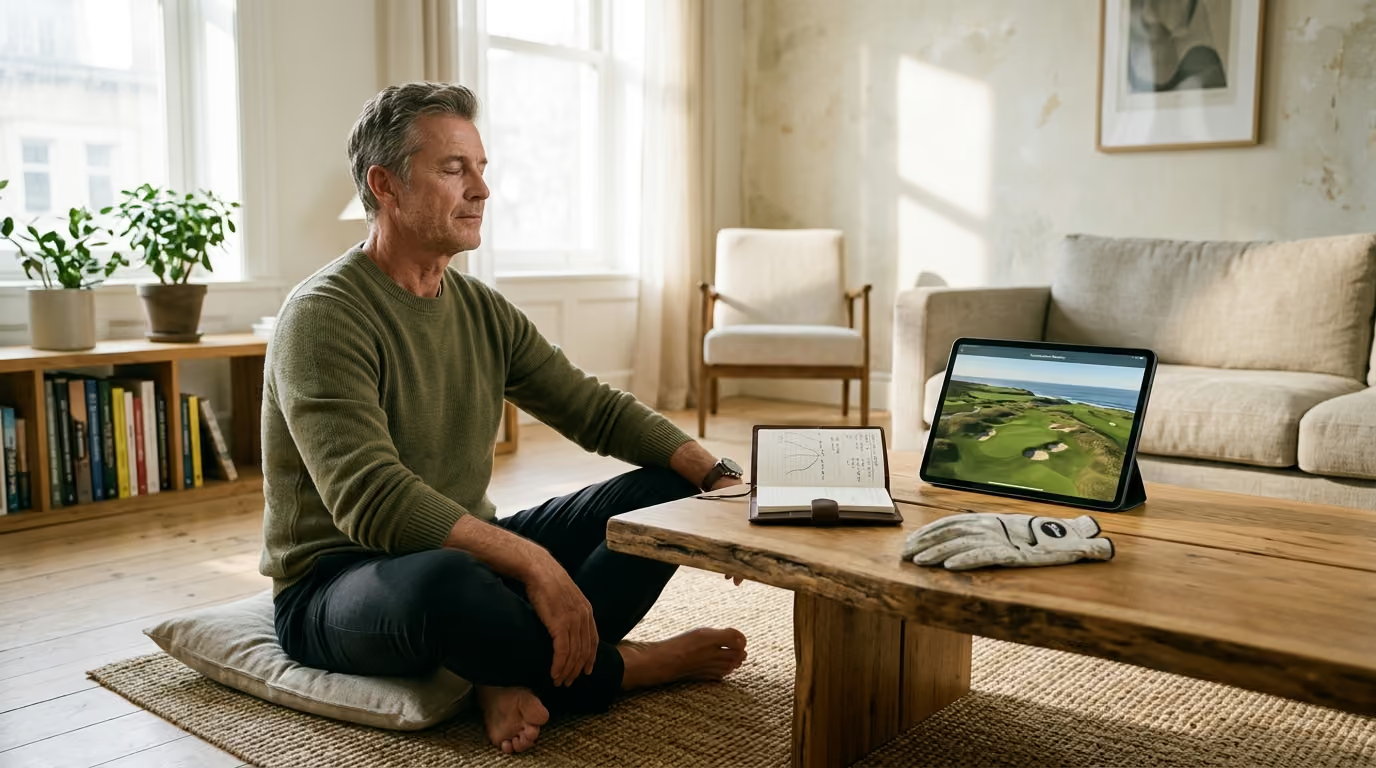

Standing over a narrow fairway with hazards on both sides triggers swing tension that off-course mental rehearsal and neural visualization can prevent.




Mental visualization in golf is often misunderstood. Many golfers think it is just a form of positive thinking, or daydreaming about lifting a trophy. True visualization is not a magic trick, nor is it a simple wish for a perfect shot. It is a structured, biological method of training your brain to coordinate your muscles without ever holding a club.
By practicing mental imagery in a quiet room, you build physical pathways in your brain. This resource explains how to use off-course mental rehearsal to maintain your coordination, protect your brain as you age, and shoot lower scores.
Imagine standing on the tee of a long, narrow par-four. You need a straight drive to avoid deep sand on the right and water on the left. The wind is blowing directly into your face, and your lower back feels slightly stiff from the car ride to the course.
As you look down the fairway, your mind begins to race. You might think about your back swing, your wrist angle, or the water hazard. This mental clutter leads to physical tightness. Your shoulders shrug upward, your grip pressure increases, and your breathing becomes shallow.
When you swing with this state of mind, your body locks up. You pull-hook the ball into the water, and your back twinges with pain. The physical issue here did not start in your muscles. It started in your brain, because you lacked a clear, stable mental blueprint for the shot before you started your swing.
You can learn more about managing your body and mind on the course by visiting our guide on golf performance.
For decades, scientists have studied how the human brain controls movement. One of the most important concepts is the Functional Equivalence Theory. This theory was established by neuroscientists like Jeannerod. It states that mental imagery and physical movement use the exact same areas of your brain.
When you sit in a dark room and visualize your golf swing, you are not just thinking. Your brain activates your motor cortex, your sensory systems, and your emotional centers. The brain treats the imagined swing as if it is actually happening.
This mental practice builds the neural pathways that control your physical swing. It creates a physical blueprint in your nervous system.
[Visualizing a Swing] ---> [Activates Motor Cortex] ---> [Sends Weak Electrical Signals] ---> [Strengthens Neural Pathway]
Research shows that visualizing muscle movements can actually increase physical strength. Studies have found that mental practice alone can produce up to 50 percent of the strength gains seen in physical training. This happens because the brain sends weak electrical signals to the muscles during imagery. These signals prepare the nervous system for action.
To get the most benefit, you must understand the difference between visual and kinesthetic imagery. Both are important, but they work in different parts of your brain.
Visual imagery is what you see in your mind. It activates the occipital and posterior lobes of your brain. You can visualize from two different viewpoints.
An internal viewpoint means you see the shot through your own eyes, looking at the ball and the fairway. An external viewpoint means you see yourself from the outside, like watching a video of your swing. Both viewpoints help build your mental blueprint.
Kinesthetic imagery is what you feel in your body. It activates the parietal lobe and the somatosensory regions of your brain.
This type of imagery involves feeling the weight of the club head, the tension in your hands, and the turn of your hips. For mature golfers, kinesthetic imagery is highly valuable for maintaining coordination.
As we get older, our mental blueprints can become less clear. Using mental practice helps older adults develop motor plans that look identical to those of elite players. This helps you maintain a smooth swing even when you cannot practice on the range every day.
Mental rehearsal is not just good for your golf score. It is also an excellent tool for healthy aging. As we age, our brains naturally lose some of their processing speed and physical coordination.
Engaging in complex mental practice helps protect your cognitive health. This concept is known as cognitive reserve. It is the brain's ability to improvise and find alternate ways of getting a job done when face-to-face with age-related changes.
Studies on older adults between the ages of 65 and 95 show that mental imagery has dramatic benefits. Researchers found that regular mental imagery sessions improved physical balance, walking speed, and overall cognitive status.
For individuals dealing with early memory loss, such as amnestic Mild Cognitive Impairment, mental imagery is a powerful tool. It helps people plan and carry out tasks much better than traditional memory exercises.
When you mentally practice golf, you are giving your brain a rigorous workout. You must coordinate spatial awareness, memory, muscle feel, and emotional control. This multi-layered mental work keeps your brain young, agile, and resilient.
You can read more about staying active and healthy as you age in our section on healthy ageing.
If you feel anxious or stiff on the first tee, you do not have time for a long mental session. You need a quick tool to calm your nervous system and clear your mind.
Your goal is to stop overthinking your entire swing. Instead, focus on one small movement. Do not try to control your hands, your shoulders, and your knees all at the same time.
First, take one deep, slow breath. Let your shoulders drop as you exhale. This action immediately calms your amygdala, which is the fear center of your brain.
Next, focus entirely on turning your trail hip. As you take your practice swing, feel your trail hip rotate back smoothly. Do not worry about where the ball will go. Focus your mind on that single, physical sensation in your hip.
This simple focus prevents your brain from getting overloaded with technical thoughts. It allows your natural, learned swing to take over. This quick reset is a reliable way to manage tension under pressure.
For more tips on physical preparation and injury prevention, view our resources on injury prevention.
To build strong neural pathways, you need a structured off-course routine. The best way to do this is by using the PETTLEP model.
This framework was created by sports scientists Holmes and Collins in 2001. It ensures your mental practice matches your physical swing as closely as possible.
P - Physical (Stand in your stance, hold a grip)
E - Environment (Imagine the grass, wind, and sounds)
T - Task (Focus on a specific shot, like a wedge)
T - Timing (Rehearse in real-time speed)
L - Learning (Update your images as your swing changes)
E - Emotion (Feel the real pressure of the shot)
P - Perspective (See the shot through your own eyes)
Here is how to set up your nightly routine using these seven elements.
Do not visualize while lying down in bed if you want to build maximum physical strength pathways. Instead, stand up in your room.
Wear your golf shoes, and hold a real golf club or a training grip. If you are older, standing up during mental practice also helps train your balance.
Make your mental setting as realistic as possible. If you are visualizing your home course, see the color of the grass.
Hear the sound of the wind in the trees. Smell the fresh-cut turf. This sensory detail makes the brain activation much stronger.
Do not try to visualize a generic swing. Choose a specific task, like a fifty-yard wedge shot over a bunker. Focus on the exact path of the club and the flight of the ball.
Your mental swing must take the exact same amount of time as your physical swing. Do not fast-forward or slow down the image.
If your real swing takes two seconds, your mental swing must take two seconds. Matching the timing is critical for building correct neural pathways.
As your physical swing changes, your mental images must change too. If your coach teaches you to turn your hips more, include that new feeling in your mental practice. Your mental blueprint must always match your current physical goals.
Do not pretend that you are completely calm if you are visualizing a high-pressure shot. Allow yourself to feel the excitement or the nerves.
Visualize yourself feeling the pressure, and then visualize yourself making a smooth, controlled swing anyway. This trains your brain to handle stress on the actual course.
Use an internal perspective. Look at the ball from your own eyes, rather than watching yourself like a spectator. Research shows that this internal viewpoint is better for building muscle coordination and spatial awareness.
To put this into action, find a quiet, dark room at home. Sit or stand comfortably, and close your eyes.
Start by taking five slow breaths to calm your mind. This breathing lowers your heart rate and prepares your brain to focus.
Next, mentally walk onto the first tee of your favorite course. Spend three minutes visualizing the hole.
See the target, feel the grip of the club in your hands, and feel your feet flat on the ground. Swing the club in your mind, matching the real-world tempo.
Finally, use Dr. Bob Rotella’s "Big Three" method. Before you open your eyes, mentally replay your three best shots from your last round.
If you did not play well, recall three great shots from your past. This simple habit reinforces your positive success circuits, helping you build confidence.
You can read more about physical preparation routines at our mobility section.
Many golfers try visualization but do not see results because they fall into common traps. Recognizing these mistakes will save you time and prevent frustration.
The first common mistake is trying to visualize shots that are completely unrealistic for your current skill level. If your average drive is 200 yards, do not try to visualize yourself hitting a 300-yard drive over the trees.
Your brain knows your physical limits. When you visualize something unbelievable, your brain creates inner resistance.
This causes a feeling of disconnect and self-doubt. Instead, visualize your best realistic shots. Rehearse a clean, solid 210-yard drive that lands in the middle of the fairway.
The second mistake is focusing on what you want to avoid. Many golfers stand over a shot thinking, "Do not hit it in the water."
Your brain does not process the word "not" very well. When you think about the water, your brain creates a mental image of the ball splashing into the lake.
This activates the motor pathways for that bad swing. Always focus your mind entirely on where you want the ball to go, never on where you want to avoid.
Incorrect Focus: "Don't hit it in the water." ---> Brain visualizes water ---> Activates bad swing pathways.
Correct Focus: "Hit the target on the hill." ---> Brain visualizes target ---> Activates good swing pathways.
The third mistake is rushing through your mental swings. It is common to let your mind jump straight from the address position to the ball flying down the fairway.
This "hollow" practice does not build the necessary motor pathways. You must visualize the entire transition, the downswing, and the follow-through in real-time speed. If you lose focus during the swing, stop, take a breath, and start over.
Your physical equipment can play a surprisingly large role in your mental practice. To make your visualization sessions as realistic as possible, you should use physical triggers that match your actual gear.
Your brain associates specific feelings with your golf equipment. For example, the texture of your club grip sends signals to your brain about control and tension.
If you use a midsize grip on the course, hold a club with that exact same grip size during your off-course sessions. This sensory input helps your brain activate the correct motor pathways.
You can also use your golf shoes to improve your mental practice. Wearing your golf shoes while standing on a carpeted floor helps you feel stable.
It allows you to feel how your weight shifts from your back foot to your front foot. This connection between your feet and the ground is critical for building a powerful, repeatable swing.
Additionally, consider using your sense of smell. You can use a small drop of grass-scented oil in your practice room.
This simple environmental trigger helps your brain transition into a focused state. It connects your indoor practice room to the outdoor course.
To learn more about physical conditioning and how to build full-body power, look at our strength training articles.
To make your visualization practice highly effective, you should create a mental yardage book for your home course. This is a step-by-step guide that helps you mentally play each hole before your round.
Start by writing down the details of each hole on a piece of paper. Note the targets, the hazards, and the best places to land your ball.
Hole 1: Par 4
Once you have your notes, spend five minutes mentally playing through the first three holes of your course.
Visualize standing on the tee box, choosing your target, and executing a clean swing. See the ball fly through the air and land on the fairway.
By mentally playing the course before you arrive, you reduce decision-making stress on the day of your round. This mental preparation allows you to play with more confidence and less physical tension.
A good session should last between five and ten minutes. You do not need to practice for hours.
Short, highly focused sessions are much better than long, distracted ones. Practice this routine three to four times a week to see the best results.
No, mental practice does not replace physical practice. It is designed to support and improve your physical training.
Mental rehearsal is especially helpful when you cannot get to the range, such as during the winter, when you are recovering from an injury, or when your schedule is busy.
Many people struggle to see sharp, clear pictures when they first start. This is completely normal.
If you cannot see the ball clearly, focus on your other senses. Focus on the feel of the club grip, the sound of the wind, or the physical sensation of your hips turning.
The physical feelings are often more important for building muscle pathways than the visual images anyway.
Yes, mental visualization is a powerful tool for injury recovery. When you are injured and cannot swing a club, your brain's motor pathways can begin to weaken.
By mentally practicing your swing, you keep those pathways active and strong. This mental activity helps you maintain your coordination, making it much easier to return to the course once your body has healed.
For more information about recovering from common golf injuries, please visit our section on recovery.
To learn more about our mission to help mature golfers play pain-free, please visit our about page. If you have questions about mental training or physical recovery, feel free to visit our contact page.
To read more of our latest articles on golf performance, longevity, and health, view our main blog page. You can also browse our full list of comprehensive guides on our resources page.
Your brain is the most important piece of golf equipment you own, so train it with the same care you use for your physical swing.
Follow Golfergy for practical insights on performance, mobility, recovery and healthy ageing. Stay connected for new articles, research-led guidance and ideas to help you play better for longer.


Explore practical resources on performance, recovery, mobility and golf longevity.
Read the Blog