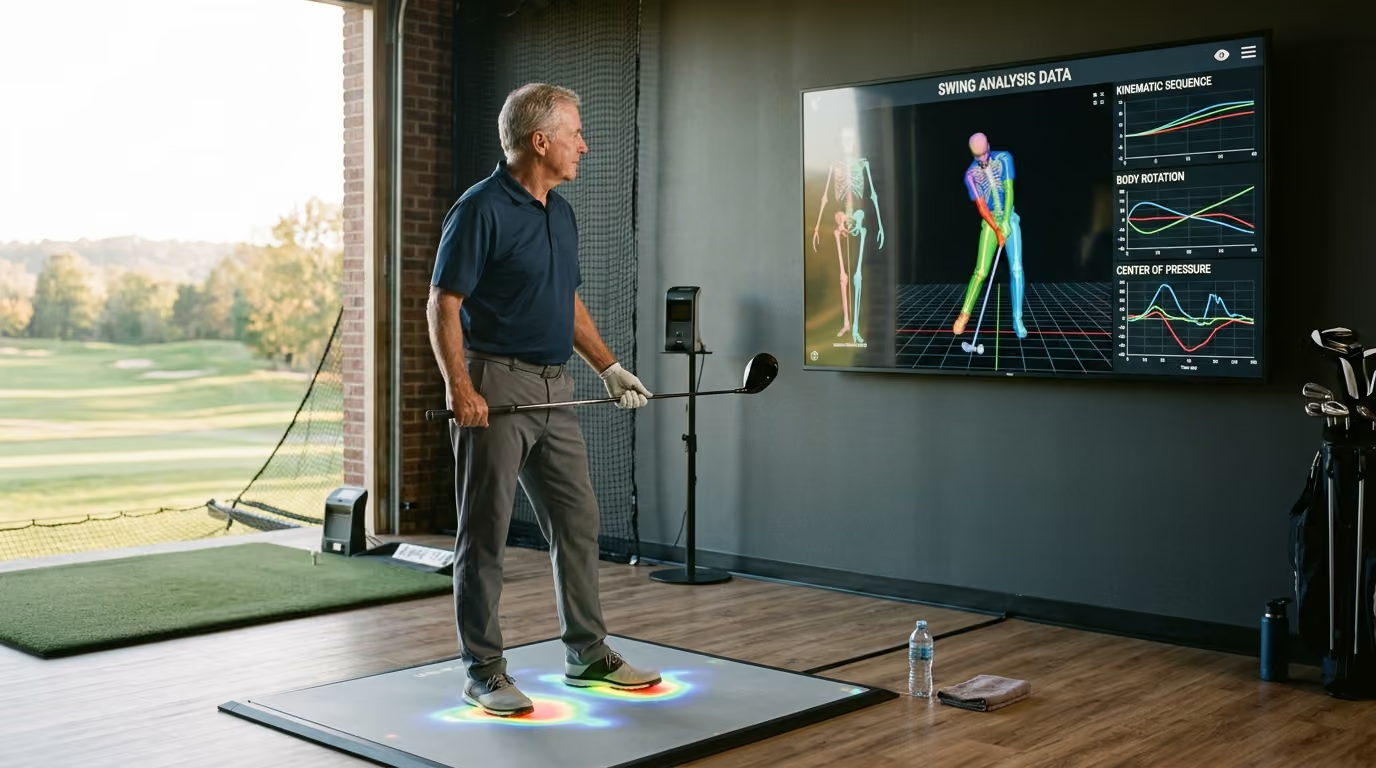

Consistent golf swing rhythm and reliable contact become easy to achieve when you train your brain to follow simple auditory timing cues.




Many golfers search for answers when their swing suddenly feels out of sync. They search online for terms like "how to fix an inconsistent golf swing tempo" or "why did I lose my golf swing rhythm." They often look for answers in physical positions, hand angles, or new drivers.
The real cause of a disrupted swing often lies in the brain. As we age, our internal timing systems change. These subtle neurological changes alter how we coordinate our muscles.
This guide explains how your brain controls swing timing. It offers practical tools to restore your natural rhythm. By using sound, you can train your brain to execute a smooth, repeatable swing.
You stand on the tee of the par-four fourteenth hole. The fairway is narrow, with water guarding the entire right side. You have played well so far, but physical fatigue is starting to settle in your legs.
Your mind registers the hazard, and a subtle anxiety takes over. You decide to swing a little harder to carry the water. You pull the club back, but your backswing feels incredibly fast and short.
You try to start your downswing before your body has fully turned. Your hands yank the handle downward, and the clubface strikes the ball with a steep, chopping motion. The ball slices weakly into the water, leaving you frustrated and confused.
This error did not happen because you forgot how to swing. It happened because your brain lost its sense of timing. The pressure of the hazard and physical fatigue disrupted your internal clock.
This loss of tempo causes your muscles to fire out of order. Your swing becomes a collection of jerky movements instead of one fluid motion. To solve this problem, you must look at how your brain processes rhythm.
Your swing depends on two major brain structures to control its timing. These structures are the basal ganglia and the cerebellum. Together, they act as the internal clock of your body.
The basal ganglia control the initiation of movement and the overall speed of your actions. The cerebellum coordinates the precise sequence of your muscles. It determines exactly when your hips turn, when your shoulders rotate, and when your wrists release.
As we age, these brain regions undergo natural, subtle shifts. This aging process can lead to increased temporal variability. This means the time it takes to complete a swing varies from shot to shot.
Your brain begins to process time with slightly less precision. This is why a swing that felt natural ten years ago now feels difficult to repeat.
[Auditory Cue: Metronome Beat]
│
▼ (Enters Ear)
[Auditory Cortex]
│
▼ (Primes)
[Motor Cortex] ──► [Basal Ganglia & Cerebellum] ──► [Smooth Muscle Contraction]
Fortunately, the human brain has an amazing capacity to adapt. You can stabilize your timing system through a process called auditory-motor entrainment. This occurs when your brain synchronizes its motor actions with external sounds.
When you hear a steady rhythm, the auditory neurons in your brain fire in patterns that match the sound. These neurons are directly connected to your motor cortex, which controls your muscles. The sound primes your motor system, making your movements more efficient.
This auditory priming provides a strict time constraint for your swing. It acts as an external guide that keeps your movements on schedule. By using sound, you bypass the need to constantly think about your physical positions. You focus entirely on matching your movement to the rhythm.
Many golfers assume they must swing exactly like elite players to get good results. Modern sports science shows this is not true. Our bodies adapt to physical changes by shifting how we coordinate our movements.
Research published in the Journal of Aging and Physical Activity reveals how our swing rhythm changes. Younger golfers typically use a complex coordination pattern. They exhibit a three-versus-two polyrhythmic pattern.
This means their clubhead force and their weight shift move at slightly different tempos. This complex timing helps younger players generate high clubhead speeds.
Older golfers naturally shift to a simpler rhythm. They use a three-versus-three rhythmic pattern. In this pattern, the body treats the entire swing as one single unit.
This strategy is called an integrated coordinative unit. Instead of separating the weight shift and the clubhead release, the body moves everything together. This shift is a highly effective way to compensate for age-related physical changes.
It allows you to maintain consistent clubhead speed while protecting your joints. It is vital for injury prevention as you continue to play. Trying to force a complex, youthful rhythm on an older body often leads to muscle strains and poor ball striking.
Accepting a simplified swing rhythm is a smart way to play better golf. It allows you to coordinate your muscles with less effort. This shift reduces the physical stress on your lower back and joints.
By coordinating your swing as a single unit, you can focus on a simple tempo. This simple tempo is much easier for your brain to repeat. It also makes your swing highly resistant to pressure and fatigue.
You can use simple auditory cues to restore your tempo during a round. These quick fixes do not require any special gear. They rely on your own voice and breathing.
The most effective quick fix is the spoken cadence drill. Before you address the ball, take a deep breath to release physical tension. Focus entirely on turning your trail hip as you start your rehearsal.
During your practice swing, say the words "one, two, three" out loud. Say "one" as you start your takeaway. Say "two" when you reach the top of your backswing.
Say "three" at the exact moment of impact. This simple vocal exercise forces your brain to sync your muscles with your voice. It prevents you from rushing the transition at the top of the swing.
You can also use a breathing pattern to control your tempo. Inhale slowly through your nose as you pull the club back. Let your breath out smoothly through your mouth as you swing down.
This breathing pattern keeps your throat and chest relaxed. It prevents the sudden, jerky movements that cause poor shots. It is especially useful when you feel nervous on a difficult tee shot.
Try to practice this vocal cue on the driving range first. Once it feels natural, you can use it silently in your mind on the course. This internal count acts as a shield against negative thoughts. It keeps your brain focused on rhythm instead of swing mechanics.
To build a truly repeatable swing, you need a structured training routine. Synchronized Metronome Training is an excellent method for this. This training teaches your brain to sync your movements with an external beat.
Research shows this training improves your angle of attack and smash factor. It helps you transfer energy to the ball much more efficiently. It is a highly valuable addition to your regular mobility and fitness routines.
To start this training, download a simple metronome application on your mobile phone. You will need a set of wireless earbuds to hear the beats while you practice.
Set the metronome to a tempo between forty-five and fifty-four beats per minute. This range is ideal for a smooth, relaxed full swing.
You will use a four-beat sequence to structure your swing. This is known as the 3:1 drill because your backswing is three times longer than your downswing.
Focus entirely on matching your physical movements to these clicks. If you strike the ball before the fourth click, you are rushing your downswing. If you strike the ball after the click, your transition is too slow.
Putting requires a faster, more continuous tempo to maintain a smooth stroke. Set your metronome to a range of sixty-five to seventy-five beats per minute.
You will use a two-beat sequence for your putting stroke. The faster tempo keeps your hands quiet and encourages a pendulum motion.
Keep this tempo identical for every putt you face on the green. To control how far the ball rolls, change only the length of your stroke.
For short putts, use a short, rhythmic stroke at seventy beats per minute. For long putts, use a longer stroke at that exact same tempo. This consistency is the secret to excellent distance control.
This drill helps you find your personal tempo zone. You will need nine golf balls and your metronome.
Set your metronome to forty-eight beats per minute. Hit three golf balls while trying to match this slow tempo perfectly. Focus entirely on keeping your hands soft at the top of the swing.
Next, raise the metronome to fifty-one beats per minute. Hit three more golf balls at this moderate tempo. Notice if your contact feels more solid or if you feel rushed.
Finally, raise the metronome to fifty-four beats per minute. Hit your last three golf balls at this faster tempo.
Compare the results of the three different tempos. Look at where your ball dispersion is tightest and where your strikes feel cleanest. This represents your personal groove.
Write this number down and use it as your baseline training tempo. It will help you build a reliable swing that stands up to pressure. You can find more helpful guides in our resources section.
Many golfers make predictable mistakes when they try to fix their swing timing. Understanding these errors can save you months of frustration.
Common Misconceptions & Realities:
[The Speed Misconception]
❌ Misconception: Aging means I need to swing faster to keep up.
✅ Reality: Older golfers often swing too fast, rushing the transition to chase power.
[The Independence Fallacy]
❌ Misconception: I can fix my swing path separate from my tempo.
✅ Reality: Changing your tempo directly alters your mechanics and swing path.
[The Distraction Barrier]
❌ Misconception: External clicks are too annoying to practice with.
✅ Reality: Cognitive interference fades in 2-3 sessions, leaving automated timing.
The most common error is trying to swing too fast to regain lost distance. Many aging golfers believe they are swinging too slow. In reality, studies show older golfers often reach their peak downswing force too early.
They rush the transition because they are trying to force power. This rushing causes the club to cast, which actually reduces clubhead speed.
Instead of trying to swing faster, focus on creating a complete backswing. Allow your body to turn fully before you start down. This patience at the top actually increases your power.
Another mistake is trying to separate your swing path from your tempo. Golfers often try to adjust their hand position while ignoring their timing.
These two elements are deeply connected in your brain. You cannot fix a physical error in your swing path if your tempo is chaotic.
When your tempo is consistent, your club will naturally fall into the correct path. Focus on the timing of your swing first. Once your rhythm is stable, physical adjustments become much easier.
When you first use a metronome, it may feel distracting. This is a normal reaction called cognitive-motor interference. Your brain is trying to process the sound while also thinking about your swing.
Do not give up after a few swings. Research shows this feeling of distraction fades after a few practice sessions.
Once your brain adapts, the sound no longer feels like a distraction. It becomes an automatic guide that simplifies your movement. Your swing will feel less complicated and much more natural.
Your golf equipment plays a major role in how your brain perceives tempo. The weight and flex of your clubs can either help or hurt your timing.
As your swing speed changes with age, your club shafts must change too. If your shafts are too heavy or too stiff, your brain will struggle to feel the clubhead.
You will feel forced to swing harder to make the shaft bend. This extra effort ruins your natural tempo.
Moving to a lighter, more flexible shaft can help. A lighter shaft allows you to feel the weight of the clubhead throughout the swing. This feedback is crucial for your brain to time the transition correctly.
The size of your grips also affects your swing timing. If your grips are too small, you will naturally squeeze the club too tightly.
Excessive grip pressure creates tension in your forearms and shoulders. This tension slows down your neural signals and disrupts your rhythm.
[Grip Too Small] ──► [Excessive Squeezing] ──► [Forearm Tension] ──► [Slowed Neural Signals] ──► [Disrupted Tempo]
Using slightly larger grips can help relax your hands. This relaxation allows for smoother muscle coordination. It is an easy way to improve your tempo without changing your swing.
Your shoes are your only connection to the ground. If your shoes do not provide enough traction, your brain will sense the instability.
Your brain will automatically slow down your swing to prevent you from falling. This protective reaction ruins your tempo and reduces your power.
Invest in high-quality shoes that offer excellent lateral support. Good traction allows you to transfer your weight with confidence. This stability is vital for maintaining a smooth, rhythmic movement.
To apply these insights to your game, use this checklist over the next week:
To play your best golf as you age, you must train your mind as well as your body. Using sound to guide your movement is a proven way to keep your swing smooth and reliable. By training your brain to move to a consistent rhythm, you can protect your joints and play with confidence for years to come.
Your swing rhythm is controlled by your brain's response to sound, not just your muscles.
Follow Golfergy for practical insights on performance, mobility, recovery and healthy ageing. Stay connected for new articles, research-led guidance and ideas to help you play better for longer.


Explore practical resources on performance, recovery, mobility and golf longevity.
Read the Blog