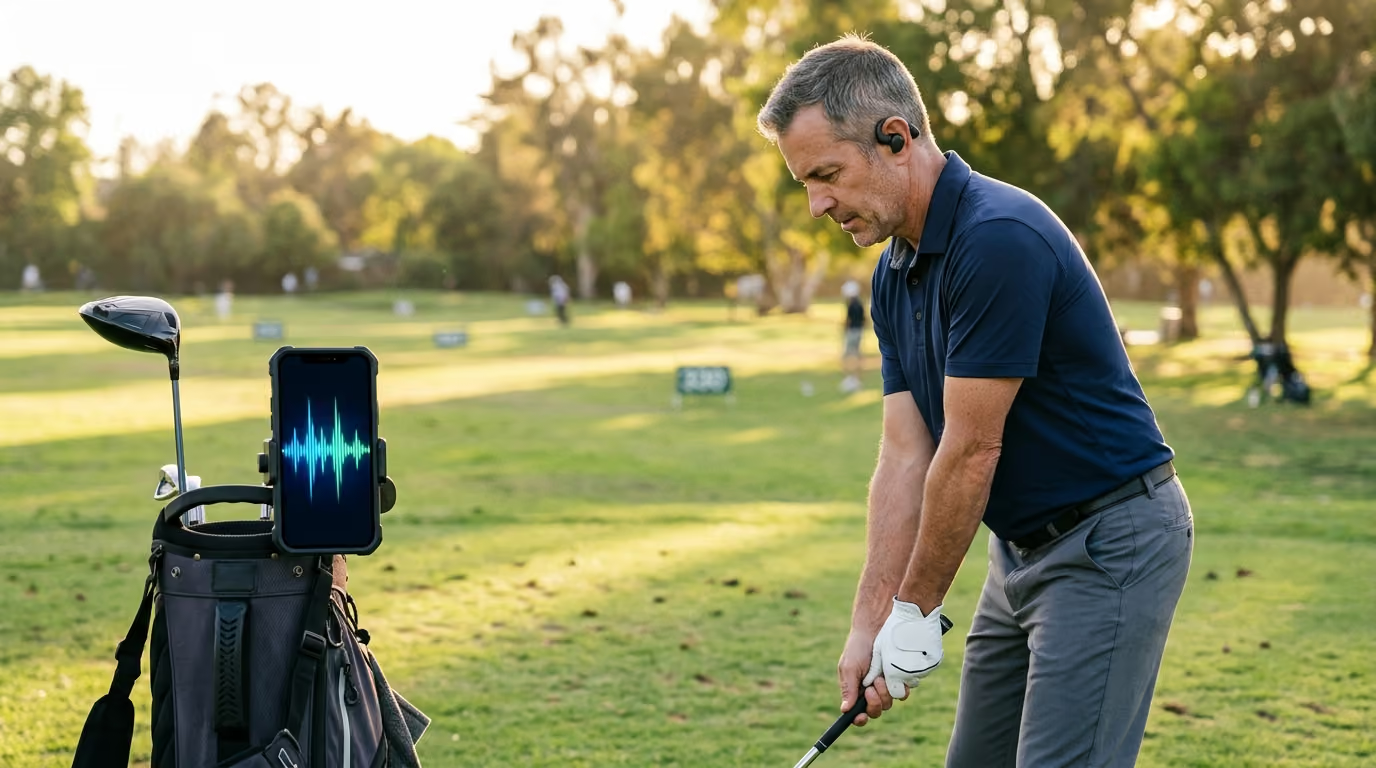

Deep mental recovery comes naturally when you use solitary golf rounds as active meditation to relieve daily stress and recharge your cognitive focus.




A solo round of golf is not a casual practice session. It is not a lazy afternoon where you hit three balls from every tee. It is not a hurried sprint to avoid other golfers. It is a structured walk that uses the golf course to reset your nervous system.
This type of round is an active meditation. It uses the physical demands of the sport to quiet a noisy mind. It turns the fairways into a space for mental recovery. It helps older golfers maintain their cognitive health as they age.
This guide provides a detailed blueprint for using golf to restore your brain. We will study the science of environmental psychology and look at clinical data on longevity. We will also provide step-by-step breathing routines to use on the course. This resource will help you use solitary play to protect your mental health.
A restorative solo round is a deliberate choice to play alone for your mental well-being. It is a structured practice that treats the golf course as a recovery space. You do not focus on your mechanical mistakes or your handicap. Instead, you focus on the connection between your body, your breath, and your surroundings.
To understand this process, we must look at Attention Restoration Theory. This theory was developed by Stephen and Rachel Kaplan, who are pioneers in environmental psychology. Their research shows that our brains have two types of attention. The first type is directed attention, which we use for daily tasks.
Directed attention requires effort and focus. We use it when we write emails, drive in heavy traffic, or look at computer screens. Over time, this constant focus causes directed attention fatigue. This fatigue makes us irritable, forgetful, and stressed.
The second type of attention is involuntary attention, which researchers call soft fascination. Soft fascination occurs when your attention is held effortlessly by natural elements. Examples include looking at leaves rustling in the wind, watching clouds move, or observing the texture of the turf. These natural sights do not drain your mental energy.
Instead, they allow your directed attention mechanism to rest and recover. The golf course is an ideal environment for soft fascination. It offers vast open spaces, green grass, and natural sounds that quiet the brain. Using solo golf as a tool for Golf Longevity, Performance & Recovery helps clear your mind.
Another key part of this process is the concept of being away. This does not just mean traveling to a new place. It means gaining a sense of physical and conceptual distance from your daily worries. When you play golf alone, you step into a world with different rules and challenges.
Your daily chores and work emails cannot follow you onto the fairways. You are fully immersed in a physical task. This distance is necessary for deep mental recovery. It allows your nervous system to escape the constant cycle of stress.
This is why playing alone is a form of active meditation. Passive meditation requires you to sit still in a quiet room. Many active golfers find it hard to sit still for long periods. Active meditation uses rhythmic movement to achieve the same mental state.
The steady pace of walking combined with the focus of hitting a ball keeps you present. You cannot worry about your bills when you are trying to chip over a bunker. The game forces a state of mindfulness that quiet rooms cannot easily replicate. This makes the solo round a powerful weapon against mental aging.
The benefits of playing golf alone are supported by strong scientific data. The British Medical Journal published a major consensus statement on golf and health. The researchers analyzed data from multiple global studies. They found that regular golf is associated with a forty percent reduction in mortality rates.
This reduction equals an increase of about five years in life expectancy. The study also showed that golf helps prevent over forty chronic diseases. These benefits are not just physical. According to research posted on our golf performance, recovery & longevity blog, golf is a multimodal mind-body activity.
It combines aerobic exercise, cognitive planning, and physical coordination. The USC Institute for Therapeutic Golf Science studied these cognitive benefits. They found that golf improves executive function in older adults. Executive function includes working memory, flexible thinking, and self-control.
A randomized controlled trial showed that golf training significantly improved logical memory in older adults. The trial also showed improvements in delayed memory compared to control groups. These memory improvements help protect the aging brain from cognitive decline. The physical movement of walking the course is the foundation of these benefits.
The green space of the course also plays a major role in brain chemistry. Exposure to green spaces is linked to lower levels of cortisol. Cortisol is the primary stress hormone in your body. High cortisol levels can damage brain cells over time.
Lower cortisol levels lead to reduced blood pressure and a calmer heart rate. Studies show that exercising in nature lowers stress much more than exercising in urban settings. When you walk the fairways alone, your nervous system shifts into a rest-and-digest state. This shift is key for long-term brain health and stress reduction.
It breaks the cycle of ruminative thinking that causes anxiety and depression. Your mind stops repeating past mistakes or worrying about future problems. Instead, your brain focuses on the immediate physical task of the game. This simple shift provides a powerful rest period for your mental faculties.
Solitary golf also encourages the brain to enter a flow state. Psychologist Mihaly Csikszentmihalyi defined flow as a state of complete absorption in an activity. In this state, you lose track of time and self-consciousness. Flow occurs when the challenge of the game matches your skill level.
Solo golf is uniquely suited for flow because there are no social distractions. You do not have to worry about your partner's score or wait for them to find a lost ball. You can move at your own pace and focus entirely on your own play. This deep focus triggers the release of dopamine and endorphins.
These brain chemicals improve your mood and reduce physical pain. They make you feel calm, capable, and motivated. This natural high is the ultimate reward of the meditative round. It leaves you feeling refreshed long after you leave the course.
To understand how to fix mental fatigue, we must look at how it appears on the course. Imagine you are playing the fourteenth hole on a late Tuesday afternoon. The sun is starting to sink behind the tall pine trees. The fourteenth is a long par four with a narrow fairway.
There is a deep sand bunker on the right side of the landing zone. You have played thirteen holes alone. You have walked about four miles. Your feet feel slightly heavy, and your lower back is tight.
Your focus is starting to slip. Instead of looking at the fairway, your mind is wandering back to your office. You are thinking about a difficult email you received this morning. You step up to the tee box with a quiet sense of fatigue.
You grip your driver too tightly. Your mind is noisy with swing thoughts and daily stress. You swing the club with a fast, jerky tempo. The ball slices deep into the trees on the right.
You feel an immediate flash of anger. Your chest tightens, and your heart rate rises. Because you are alone, there is no one to break your train of thought. Your inner critic begins to lecture you about your poor swing.
You feel the urge to hurry after the ball. You want to hit another shot quickly to erase the mistake. This is the moment where directed attention fatigue wins. Your brain has lost its ability to regulate your emotions.
Understanding how to use active recovery tactics on the course is vital here. Without a tool to reset, the rest of your round will be stressful. You will finish the game feeling tired rather than restored. Your physical movements will become tight and restricted.
This physical tension increases your risk of injury. It also guarantees that you will hit more poor shots. The cycle of frustration and poor play will continue. You must learn to recognize this mental fatigue before it ruins your round.
When you find yourself in the trees on the fourteenth hole, you need an immediate tool. You can use the 5-4-3-2-1 sensory grounding technique. This method brings your mind back to the present moment. It quietens your inner critic by forcing your brain to process sensory data.
First, name five things you can see around you. Look at the deep green of the pine needles. Notice the white dimples on your golf ball. See the shape of the clouds moving across the sky.
Observe the texture of the bark on the tree next to you. Look at the shadow of your clubhead on the grass. Second, notice four things you can physically touch. Feel the rough rubber of your club grip.
Touch the soft, cool leather of your golf glove. Feel the firm, dry turf beneath your shoes. Touch the cold metal of your belt buckle. Third, identify three things you can hear.
Listen to the wind rustling through the upper branches. Hear the chirp of a bird in the distance. Listen to the soft crunch of dry leaves under your feet. Fourth, notice two things you can smell.
Smell the fresh scent of cut grass on the fairway. Notice the earthy smell of the damp dirt in the woods. Fifth, identify one thing you can taste. Take a small sip of cold water from your bottle.
Focus entirely on the cool sensation in your throat. This simple grounding exercise takes less than two minutes. It interrupts the stress response in your brain. It lowers your heart rate and stops the urge to rush.
You are no longer thinking about your bad tee shot or your office work. You are simply standing in a quiet forest. Now, you can plan your next recovery shot with a clear head. This tool is always available to you when tension rises.
To get the full mental benefits of solo golf, you need a lasting routine. You cannot rely only on quick fixes. You should build a habit that structures your entire walk. This is the Breath-Anchored Walking Routine.
This routine divides your time between shots into two zones. The first zone is the Tee-to-Fairway Walk. During this walk, your goal is to let your mind rest. Do not think about your golf swing.
Do not think about your score. Focus entirely on the physical movement of your body. With each step, focus on pressing your trail heel into the grass. Feel your weight transfer from your heel to your toes.
This focus helps maintain the physical mobility needed for a rhythmic walking pace. Let your eyes wander to the trees and the birds. This uses your involuntary attention to restore your brain. The second zone is the Fairway-to-Ball Walk.
When you get within thirty yards of your ball, transition your focus. Begin using the 4-7-8 breathing technique. Inhale slowly through your nose for four seconds. Hold your breath gently for seven seconds.
Exhale completely through your mouth for eight seconds. Repeat this breathing cycle three times. This pattern triggers the vagus nerve. It tells your brain that you are safe.
It lowers your blood pressure and steadies your hands. Now, you enter the Pre-Shot Mindfulness Loop. First, visualize the shot you want to hit. See the ball flying through the air and landing on the target.
Second, feel the shot. Take one practice swing and focus entirely on the weight of the clubhead. Third, commit to the swing. Stand over the ball and take one final breath.
Focus entirely on turning your trail hip. Do not think about the outcome of the shot. Simply make the turn and let the club swing. After the shot, hold your finish for two seconds.
Watch the ball fly without judging the result. If the shot was poor, accept it. If the shot was great, enjoy it. Once you put the club back in your bag, the shot is over.
Return immediately to the Tee-to-Fairway walk. To track your progress, use a mental scorecard. This is based on the Vision 54 framework. Do not write down your strokes on this scorecard.
Instead, rate your commitment to your routine on a scale of one to five. Did you stay present during your breathing? Did you commit to your target before swinging? If you did, give yourself a five.
This shifts your goal from a numerical score to a focus score. It rewards you for managing your mind rather than just your ball. Over time, this routine builds mental toughness. It teaches your brain to remain calm under pressure.
It makes your solo rounds a true source of mental recovery. You can practice this routine during every solo round. It will soon become a natural habit.
Many golfers do not get the mental benefits of solo play because of common errors. The first mistake is the Rushing Trap. Solo players often feel like they are blocking the course. They worry about the group behind them.
They walk too fast and rush their pre-shot routine. This constant worry keeps their nervous system in a state of stress. Rushing your swing under stress can lead to injury, making proper injury prevention strategies highly useful on the course. To avoid this trap, you must learn to manage your space.
If a group is close behind you, simply wave them through. Sit on a bench, drink some water, and watch them play. This gives you a natural break and removes the pressure to run. It allows you to maintain your meditative pace.
The second mistake is the Practice Range Mindset. Some golfers treat a solo round as a practice session. They hit three tee shots when they make a mistake. They drop five balls in a bunker to practice sand shots.
This practice is fine for the driving range, but it ruins a restorative round. It keeps your brain in an analytical, self-correcting mode. You remain focused on swing mechanics rather than flow. A restorative round requires you to play the ball as it lies.
You must accept the consequences of every shot. This maintains the integrity of the game. It forces you to solve real problems on the course. It keeps your mind engaged in the present moment.
The third mistake is the Ego Trap. Without an audience, some golfers stop caring about their routine. They think the round does not count because nobody is watching. They swing carelessly and get frustrated easily.
Other golfers do the opposite. They become their own harshest critics. Without a partner to soften the mood, their inner dialogue becomes toxic. They beat themselves up over every missed putt.
You must treat yourself like a supportive playing partner. Talk to yourself with kindness and encouragement. If you hit a bad shot, remind yourself that it is just data. It is not a reflection of your self-worth.
Your equipment plays a significant role in your mental state. Physical discomfort directly triggers mental stress. If your feet hurt, your brain will struggle to find quiet. Your golf shoes are your most important piece of gear.
They must offer proper cushioning and arch support. For older golfers, spikeless shoes with wide toe boxes are often best. They allow your feet to spread naturally as you walk. This reduces foot fatigue and lower back strain.
Your grips are another critical factor. If your grips are old and slippery, you will squeeze the club too hard. This extra hand tension travels up your arms to your shoulders. It creates physical tightness that ruins your swing tempo.
It also signals to your brain that you are in a stressful situation. Replace your grips every season. Choose soft, tacky grips that allow you to hold the club with light pressure. Focus entirely on keeping your grip pressure light throughout your swing.
Your choice of golf bag also matters. Carrying a heavy bag on your shoulders can cause lower back compression. This physical fatigue drains your mental energy by the back nine. Use a high-quality pushcart instead.
A pushcart keeps your body in an upright posture. It allows you to walk with a natural stride. This posture keeps your lungs open for deep breathing. It preserves your physical energy for the end of the round.
You will arrive at the eighteenth green feeling fresh and relaxed. Your gear should support your physical comfort. This comfort is the foundation of mental peace.
Many people avoid solo golf because they fear being lonely. They worry they will look friendless to other players. This is a misunderstanding of solitude. Loneliness is a negative state of isolation.
It is marked by a feeling of emptiness and disconnection. Solitude is a positive state of self-engagement. It is the joy of being alone with your own thoughts. Research shows that spending time in solitude builds emotional resilience.
It allows you to process your emotions without social pressure. The golf course is the perfect laboratory for solitude. It offers a safe space to practice being comfortable with yourself. You do not need to entertain anyone.
You do not need to apologize for a bad shot. You can simply exist in the present moment. Sometimes, your solo round will be interrupted. The starter might pair you with three strangers.
Do not let this ruin your plans for mental restoration. You can use this as a social grounding exercise. Be polite, friendly, and supportive of their games. However, maintain your own internal rhythm.
Use the walk between holes to return to your silent breathing. You do not need to talk during the entire walk. Most golfers will respect your quiet focus. This teaches you to stay centered even in social situations.
It builds a boundary between your inner calm and external noise. This skill is highly valuable both on and off the course. It allows you to protect your peace of mind in any environment.
Playing alone means you move much faster than a foursome. Getting stuck behind a slow group can cause intense frustration. This frustration ruins your mental state. To solve this, change your pace of play.
Do not stand on the tee box staring at them. Instead, use the wait to practice your short game near the tee. You can chip a few balls in the rough or practice your putting setup. You can also use this time to sit quietly and do a breathing exercise.
Treat the delay as a tool to test your patience. If the delay is too long, ask if you can play through. If that is not possible, skip a hole and move ahead. Your mental peace is more important than completing every hole in order.
Walking eighteen holes is a great form of cardiovascular exercise. However, you must listen to your body. If you have joint pain or low mobility, start with nine holes. Use a pushcart to ease the physical burden on your joints.
Make sure you carry plenty of water and a small snack. Let someone know which course you are playing and when you expect to finish. Most modern courses have staff driving the fairways regularly. If you feel sudden pain or fatigue, do not push through it.
Call the clubhouse for a ride back. Walking solo should feel restorative, not punishing. You can find more safety and mobility advice in our golf performance & longevity resources.
It is completely normal for your mind to wander during a solo round. Do not get angry when this happens. Anger only increases your mental tension. Instead, treat your wandering mind with kindness.
When you notice a stressful thought, acknowledge it. Tell yourself that you will deal with it after the round. Then, gently bring your focus back to a physical sensation. Focus on the feeling of the wind on your face.
Look closely at the texture of the green. Use the sensory grounding routine to anchor yourself. With practice, your mind will spend more time in the present. This is a skill that builds over time.
Yes, solo rounds can significantly improve your competitive scores. Many golfers struggle in tournaments because they are distracted by other players. They watch their opponents' swings and get caught up in the drama. Solo play teaches you to focus entirely on your own game.
It builds a strong internal routine that you can rely on under pressure. When you play a tournament, you can use the same mental scorecard. You will focus on your commitment score rather than your leaderboard position. This reduces anxiety and leads to better decision-making.
By mastering the solo round, you build an unshakeable mental foundation.
Remember, your solo round is not a test of your physical skill, but a sanctuary for your mind to rest and recover through the quiet rhythm of the game.
Follow Golfergy for practical insights on performance, mobility, recovery and healthy ageing. Stay connected for new articles, research-led guidance and ideas to help you play better for longer.


Explore practical resources on performance, recovery, mobility and golf longevity.
Read the Blog