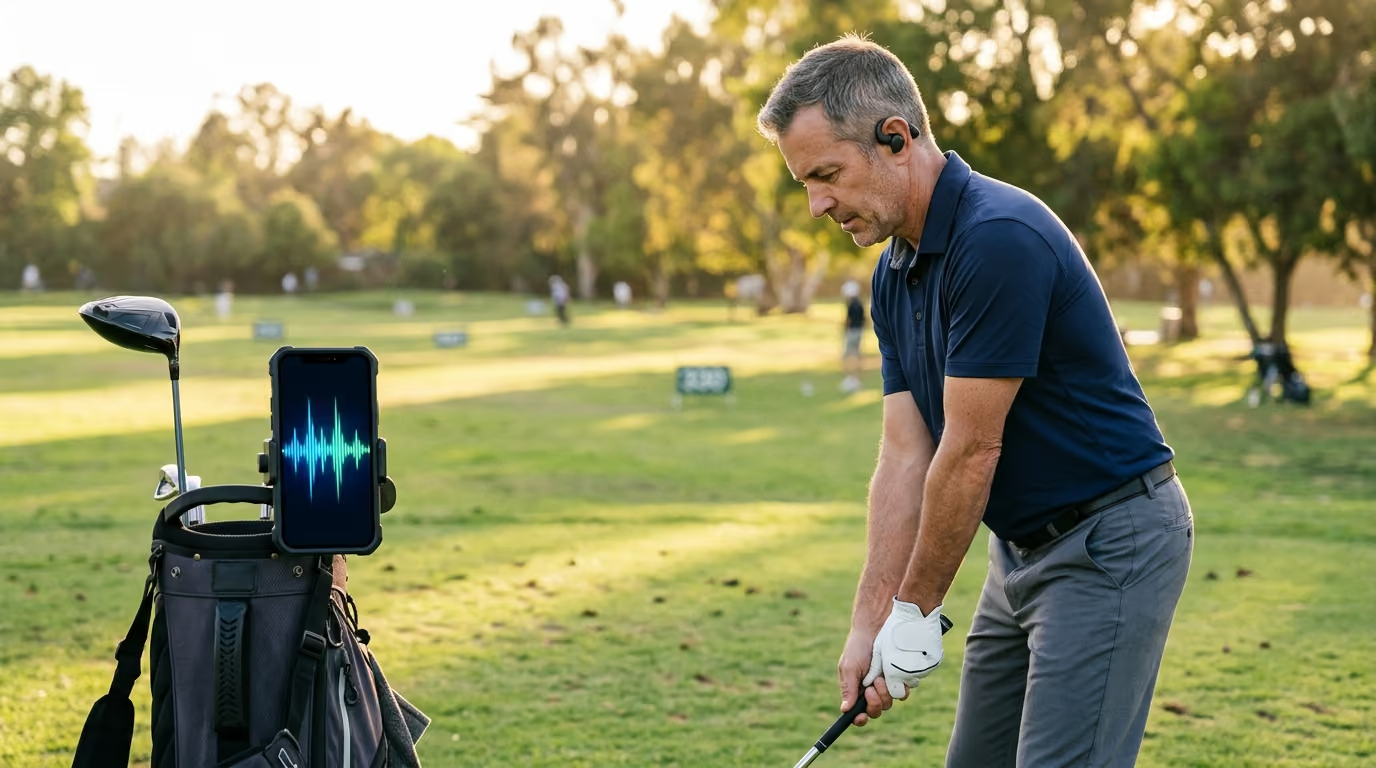
Two sensory systems share the inner ear and directly influence how golfers maintain their balance and swing tempo during play.




You stand on the tee box of the par four fourteenth hole. The wind rustles through the pine trees. Your playing partners are chatting quietly near the golf carts. You set your feet and look down at the ball.
Suddenly you feel a subtle sense of instability. It feels as if the ground beneath your feet is shifting. You cannot quite hear the wind direction anymore. You swing the club and make decent contact.
Yet you never hear the sharp click of the driver face. You watch the ball drift into the right rough. This scenario happens to many players as they get older.
Many golfers assume a bad shot is just a swing flaw. They do not realize that sensory changes affect their physical stability. A decline in your hearing can quietly alter your balance. This article will help you understand this connection.
To play consistent golf, you must move safely and efficiently. You can learn more about how physical health keeps you on the course by visiting our page on healthy ageing. Keeping your body in balance helps you play for many years.
The human inner ear is a complex sensory organ. It houses two systems that share a very small space. The first system is the cochlea. This spiral structure is responsible for your hearing.
The second system is the vestibular system. It consists of fluid filled canals. This system acts as your body internal level. It tells your brain where your head is in space.
These two systems share the same bony structure. They also share the same internal fluid. Because they are so close, changes to your hearing often impact your balance.
Damage to the tiny hair cells in the cochlea can happen as we age. This damage can spill over into the vestibular system. This is why a loss of hearing often leads to feelings of unsteadiness. It is not just about volume. It is about how your body moves.
The fluid in your inner ear moves when you turn your head. This movement bends tiny hair cells. These hair cells send electrical signals to your brain. Your brain uses these signals to keep you upright.
If your inner ear is damaged, these signals become fuzzy. Your brain receives conflicting messages. It might think you are falling when you are actually stable. This creates a split second of hesitation during your swing.
This hesitation is enough to throw off your timing. It can make you feel disconnected from the ground. Understanding this connection is the first step to fixing it. You can train your body to adapt to these changes.
Your brain has a limited amount of processing power. When your hearing starts to decline, your brain must work harder. It spends massive energy trying to decode sounds. Scientists call this listening effort.
When you listen intently to hear your partners, your brain works overtime. This leaves less mental energy for other tasks. Your brain cannot focus as well on motor control. Motor control is what governs your swing tempo.
It also governs your balance and your ability to read greens. If your brain is busy decoding sound, your swing rhythm will suffer. You might rush your backswing. You might lose your footing during the transition.
Balance relies on three primary systems. These systems are your vision, your vestibular system, and your proprioception. Proprioception is the ability to feel the ground through your feet. These three systems work like a tripod.
If one leg of the tripod becomes weak, the other two must work harder. If your inner ear is compromised, you will rely too much on your eyes. This visual reliance creates issues during the swing.
When you look down at the ball, your eyes are fixed. If you turn your head, your visual field shifts quickly. Without good inner ear support, this quick movement can cause mild dizziness.
This is why some golfers feel unsteady at the top of their backswing. To protect yourself from these physical setbacks, read more about injury prevention on the course. Staying balanced prevents falls and muscle strains.
Your eyes help you stabilize your surroundings. They lock onto the horizon to keep you upright. In golf, your eyes must focus on a stationary ball.
When your head rotates, your eyes must coordinate with your neck muscles. This coordination is called the vestibulo ocular reflex. When hearing changes affect your inner ear, this reflex can falter.
You may experience a brief moment of visual blur. This blur can make the ball look like it is moving. Your brain will struggle to time the contact.
The vestibular system acts as a biological gyroscope. It detects acceleration and gravity. It helps you maintain your posture when you stand on slopes.
Golf courses are rarely flat. You must stand on sidehill, downhill, and uphill lies. A weak vestibular system makes these lies very difficult.
Your brain cannot accurately map the slope. This leads to poor stance adjustments. You may end up falling back during your follow through.
Proprioception is your body sixth sense. It is the awareness of your limbs in space. It relies on receptors in your muscles, joints, and feet.
When your ears and eyes struggle, your feet must take over. They must feel every tiny change in the turf. This is why foot strength is so important for mature golfers.
You can train your feet to be more sensitive. This training compensates for inner ear issues. It keeps you stable even when your vision is compromised.
Research shows a direct link between hearing loss and balance issues. A study by Johns Hopkins Medicine examined this connection closely. Researchers found that even a mild hearing loss triples the risk of falling.
A mild hearing loss is defined as just twenty five decibels. For every ten decibels of additional hearing loss, the risk increases. The risk of falling goes up by one point four times.
This is a vital statistic for golfers over forty. Standing on uneven lies requires excellent balance. A small sensory change can make a sidehill lie feel highly unstable.
Hearing loss is very common in the golfing demographic. Roughly one in three people between sixty five and seventy four experiences hearing loss. This is the age group that plays some of the most golf.
There is also a link to cognitive performance. A major report from The Lancet Commission highlighted midlife hearing loss. They named it the largest modifiable risk factor for dementia. It accounts for eight percent of all cases.
Managing your hearing is not just about safety on the course. It is about keeping your mind sharp for strategy. A sharp mind helps you choose the right targets.
Another study from 2018 looked at postural sway. This study was published in the Journal of Vestibular Research. Postural sway is the tiny movement your body makes to stay upright.
The study found that people with hearing loss sway significantly more. This sway increases when acoustic cues are removed. If you cannot hear the turf or the wind, your body wobbles more.
This wobble directly ruins your ball striking consistency. Your brain needs sound to map your position in space. Without it, your swing path becomes unpredictable.
You do not have to let sensory changes ruin your day on the course. You can use simple adjustments right now. These adjustments will help you regain your stability immediately.
The first technique is called the Quiet Eye method. This was developed by sports scientists to improve motor control. Before you swing, focus on a single point on the ball.
Do not just look at the ball generally. Choose one specific dimple on the back of the ball. Stare at that dimple for three seconds before you start your takeaway.
Keep your eyes on that spot through the entire swing. After you hit the ball, keep your eyes on that spot for one more second. This visual lock stabilizes your brain.
It compensates for any weakness in your inner ear. It reduces the visual blur that happens during a quick head turn. This simple trick can instantly restore your ball striking.
Another quick fix involves your hearing aids. Many modern devices have wind noise reduction settings. Always turn this setting on before you tee off.
Wind noise can cause sensory overload. This overload distracts your brain from your pre shot routine. Reducing the wind noise helps you focus on the physical sensations of your feet on the ground.
If you do not wear hearing aids, consider using simple earplugs on windy days. This may sound counterintuitive. However, reducing the roar of the wind can actually calm your nervous system.
A calm nervous system is better at maintaining balance. It allows you to feel the ground more clearly. You will feel more anchored during your swing.
You can also slow down your pre shot routine. Take two deep breaths before you grip the club. This calms your nervous system and improves your spatial awareness.
Finally, pay attention to your breathing during the swing. Do not hold your breath. Exhale slowly as you set up to release physical tension.
To build lasting balance, you need a regular training routine. You can perform these exercises at home in just ten minutes. They focus on retraining your brain to use touch and vision.
The first exercise is the single leg balance test. Stand near a wall or a sturdy chair for safety. Lift your trail foot off the ground.
Hold this position for thirty seconds. Keep your focus entirely on turning your trail hip slightly to stabilize. If this feels easy, try closing your eyes for five seconds.
Closing your eyes forces your brain to rely on your feet. It builds stronger neural pathways for balance. This exercise directly improves your stability on uneven lies.
The second exercise is the foam pad putt. Place a soft foam pad on the floor. Stand on the pad with both feet and hold your putter.
Make slow putting strokes while standing on the unstable surface. Focus on keeping your head completely still. This teaches your body to stay centered when the ground feels soft.
You can also practice the split stance rotation. Step your lead foot forward and your trail foot back. Lower your hips slightly into a shallow lunge.
Hold this position while rotating your shoulders. Focus entirely on turning your trail hip during the backswing motion. This movement pattern is crucial for maintaining posture.
To support these balance exercises, you must maintain your overall physical conditioning. Building strength in your lower body will give you a firmer foundation. You can find targeted routines on our strength page.
Strengthening your legs and core makes balancing much easier. It protects your lower back from injury. It also helps you maintain your swing speed as you age.
You can also read more about general physical conditioning on the Golf Longevity, Performance & Recovery home page. Keeping your entire body fit is the best way to extend your playing years.
Start with the basic single leg balance. Do this on a hard floor. Keep your eyes open and focus on a spot on the wall.
Perform this three times per week. Once you can hold it for thirty seconds, move to a soft surface. You can use a folded yoga mat or a towel.
The final progression is to close your eyes while on the soft surface. Only do this if you have a wall nearby. Safety is always the top priority.
This progression retrains your proprioceptive system. It makes your feet highly sensitive to balance changes. You will feel much more secure during your golf swing.
When golfers feel unstable, they often make natural errors. These errors are attempts to find stability. However, they usually ruin swing mechanics and cause poor shots.
The first mistake is widening your stance excessively. When you feel off balance, you might spread your feet very wide. You think this wide base will keep you stable.
In reality, a wide stance locks your hips. It limits your hip rotation during the backswing. This loss of rotation decreases your clubhead speed and shortens your drives.
It can also lead to swaying. Swaying is when your hips slide side to side instead of rotating. Swaying ruins your contact and causes fat shots.
Keep your stance shoulder width apart for mid irons. This allows for both stability and rotation. Let your hips turn naturally around your spine.
The second mistake is stiffening your neck and shoulders. Golfers often hold their head rigid to stop dizziness. This stiffness creates tension throughout the upper body.
Tension ruins your swing path and tempo. It can also lead to neck strain or upper back pain. You want your head to remain steady but not locked.
Allow your head to rotate slightly during the backswing. This relieves pressure on your neck. It also allows for a fuller shoulder turn.
The third mistake is rushing your transition. Without the auditory cue of the club moving through the air, you lose track of time. You might start your downswing before your backswing is complete.
This rushed transition causes a steep downswing. It leads to slices and fat shots. Always allow your backswing to finish before you move down.
Count silently in your head to establish a rhythm. Use a simple "one, two" count. One is for the backswing, and two is for the downswing.
Keeping your body moving freely is key to avoiding these mistakes. Improving your joint range of motion can help you turn without losing your footing. To work on this, check out our guide on mobility training.
Your golf gear can help compensate for sensory decline. Making small changes to your equipment will improve your environmental awareness. It will also help you feel the ground better.
Start with your golf shoes. Many modern shoes have thick foam soles. While comfortable, these soles reduce your connection to the turf.
They act like cushions that block sensory signals. Your feet cannot feel the slope of the green. This feedback is vital if your inner ear balance is weak.
Choose shoes with a lower profile. These are often called low drop shoes. They keep your feet closer to the ground.
Consider using spiked shoes instead of spikeless models. Spikes lock you into the ground. They provide extra physical security during high speed swings.
They prevent your feet from slipping on wet grass. This extra grip gives your brain a sense of safety. You will swing with more confidence.
Next, examine your golf grips. Smooth grips provide very little sensory feedback. Switch to corded grips or textured grips.
These grips send strong tactile signals to your hands. This physical feedback helps you sense the clubface position. It replaces some of the auditory feedback you may have lost.
You can also change your golf ball. Use a high contrast ball, such as a yellow or matte finish ball. These balls are much easier for your eyes to track.
Easy tracking reduces visual fatigue during your round. It keeps your brain fresh for the final holes. It also helps you keep your eyes locked on the ball.
If you wear hearing aids, check their settings. Some devices have a specific outdoor or sports mode. This mode reduces wind noise while keeping speech clear.
You can also use physical wind covers. These are small foam sleeves that fit over the microphones. They block the wind from striking the sensor.
This prevents the loud whistling sound that distracts many golfers. It allows you to hear your partners and the ball strike. It keeps your sensory environment calm.
Always carry spare batteries or a portable charger. A dead hearing aid battery can ruin your focus. It can cause sudden disorientation on the back nine.
Keep your devices clean from sweat and dust. Use a dry cloth to wipe them down after each round. Proper maintenance keeps them working perfectly on the course.
Sensory changes do not just affect your physical swing. They also influence your mental game and your social life. Golf is a social sport played with friends.
When you struggle to hear conversation, you may start to withdraw. You might stop talking between shots. You might sit quiet in the golf cart to avoid embarrassment.
This social withdrawal increases performance anxiety. You focus too much on your physical struggle. This focus takes away from the joy of the game.
It can also lead to feelings of isolation. You may feel like you are playing alone, even in a group. This mental strain hurts your decision making.
There is also a safety concern on the course. If you cannot hear high frequency sounds, you may miss warning shouts. Missing a "Fore!" call can put you in danger.
Always tell your playing partners about your hearing limits. Ask them to give you visual signs if a ball is coming. This open communication reduces your stress.
Lower stress keeps your mind relaxed. A relaxed mind is important for peak performance. When you feel safe and connected, you play much better golf.
Recovery after a long round is also different when you experience sensory strain. Your brain works harder, which leads to deeper fatigue. To learn how to bounce back quickly, visit our section on recovery.
Taking care of your mental game is just as important as your physical swing. You can find more articles on mental performance and longevity on our Golfergy blog. Sharing your experiences with other golfers can build a supportive community.
To see how these concepts work, let us look at two common case patterns. These examples show how real golfers adapted to sensory changes. They demonstrate that you can maintain a high level of play.
John is a sixty eight year old golfer with high frequency hearing loss. He noticed he could no longer hear the sound of his club passing through the grass. He also could not hear the ball striking the face.
Without this sound, John began to rush his swing. His tempo became fast and jerky. He relied entirely on visual feedback, which made him feel dizzy.
John implemented the Quiet Eye technique. He focused on a single dimple for three seconds before swinging. He also switched to highly textured cord grips.
The physical feedback from the grips replaced the lost sound. His tempo returned to a smooth, natural rhythm. His ball striking consistency improved dramatically.
Mary is a fifty five year old who experienced Sudden Sensorineural Hearing Loss. This sudden change left her with mild vertigo. When she swung her club, the movement in her peripheral vision made her dizzy.
She began to widen her stance to stay balanced. This locked her hips and cut thirty yards off her drives. She felt frustrated and ready to quit.
Mary started a daily proprioception routine. She practiced standing on one leg with her eyes closed. She also switched to low profile golf shoes.
These changes improved her foot sensitivity. She no longer needed a wide stance to feel stable. Her hip rotation returned, and she regained her lost distance.
Adapting to sensory changes is a gradual process. You should not try to change everything overnight. Start by making one small adjustment to your routine.
For example, focus entirely on turning your trail hip during your balance exercises this week. Next week, try using the Quiet Eye technique on the driving range. Slow progress leads to lasting habits.
Have your hearing tested by a professional once a year. An audiologist can adjust your devices specifically for outdoor environments. This proactive step keeps you safe and competitive.
Do not let age related changes make you feel capable of less. Your body is highly adaptable. With the right training and gear, you can play great golf for decades.
For more tools to help you design a complete longevity plan, visit our Golfergy resources page. We offer guides on mobility, strength, and recovery tailored for mature golfers. Take action today to protect your game.
Managing your sensory health keeps your balance stable and your mind sharp, helping you play better golf for a lifetime.
When to revisit this resource: Revisit this guide before the start of the season or if you begin to feel unsteady on uneven lies.
Follow Golfergy for practical insights on performance, mobility, recovery and healthy ageing. Stay connected for new articles, research-led guidance and ideas to help you play better for longer.


Explore practical resources on performance, recovery, mobility and golf longevity.
Read the Blog