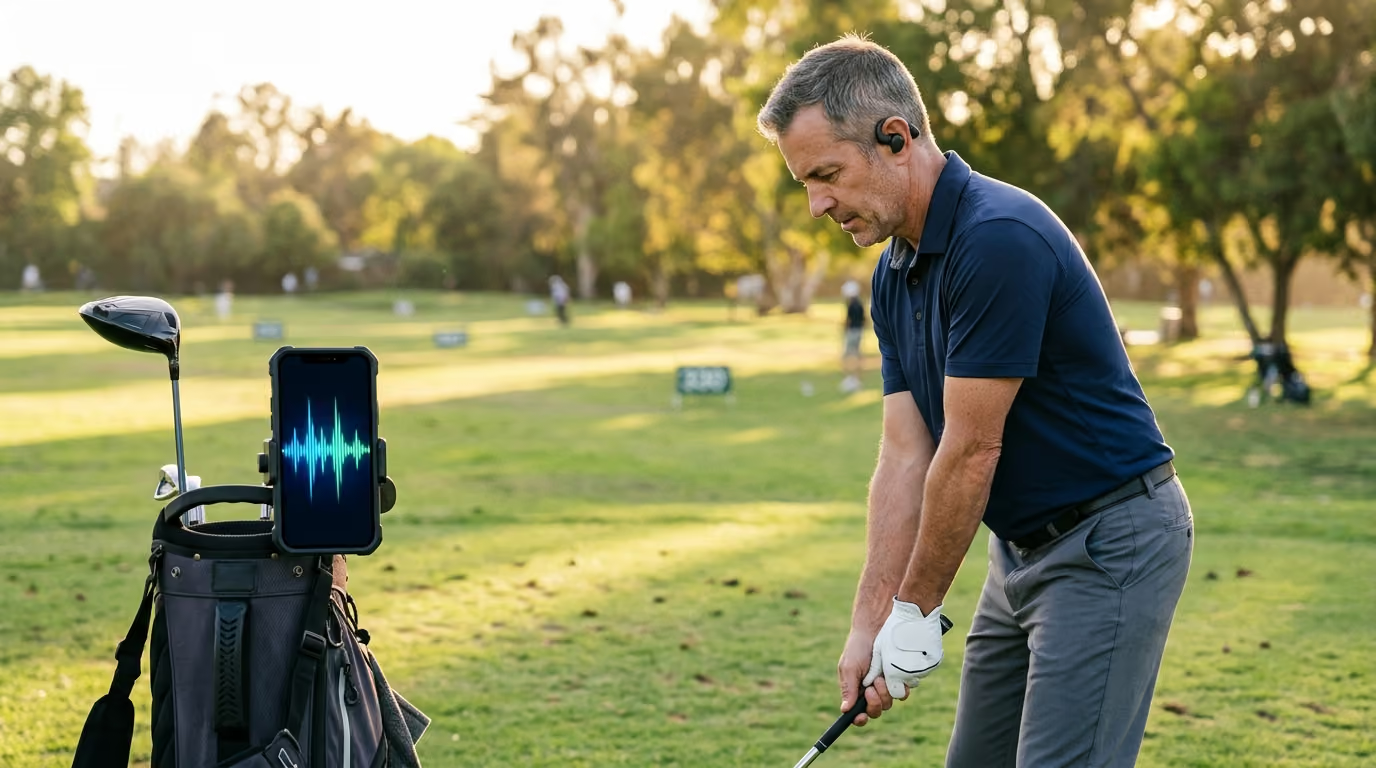

Most people view golf as a simple leisure activity, but lifelong play actually rewires neural pathways and strengthens brain tissue against cognitive decline.




You stand on the fourteenth tee box. Your legs do not feel particularly tired. Yet your mind feels slow. You look down at the fairway. It slopes severely from right to left. Your brain struggles to process the slope. You cannot quite feel where your feet are in relation to your hips. You take a quick swing. You slide your hips instead of turning them. The ball slices deep into the trees.
This is not just a bad swing. It is a moment of cognitive fatigue. Your brain has stopped processing the visual and physical clues from the course. Many players blame their muscles when their game falls apart on the back nine. In reality, the issue often starts in the nervous system. As we grow older, keeping our brain sharp is just as critical as keeping our muscles strong.
Golf is much more than a leisure sport. It is a highly complex mental challenge. It forces your brain to solve physical problems in real time. This resource will show you how golf acts as a protective shield for your brain. You will learn the science behind the golf swing and how it rewires your neural pathways. You will also find practical ways to keep your mind sharp on and off the course. For more insights on staying healthy as you play, you can visit our golf performance, recovery, and longevity blog.
To understand why this happens, we must look at how the brain ages. As we grow older, our brain networks often lose efficiency. This loss of efficiency can make physical movements feel less coordinated. It can also lead to slower decision-making on the course.
Research shows that long-term golf training actually reconfigures these neural pathways. A study in the scientific journal Scientific Reports examined how golf affects our brain networks. The researchers found that golf shifts the brain toward local specialization. This means specific regions of the brain become highly efficient at handling specific tasks.
This specialization is exactly what you need to control a complex movement like the golf swing. Instead of wasting energy across the whole brain, your nervous system directs power where it is needed. This shift makes your brain more efficient. It helps you maintain physical coordination even as you get older.
This process of rewiring is a form of neuroplasticity. Your brain remains capable of change at any age. By playing golf regularly, you force your brain to adapt to new movements. This keeps your neural networks flexible and resilient. It is a physical way to keep your mind young.
Golf does more than just reorganize your brain networks. It can actually change the physical structure of your brain tissue. This concept is called myeloarchitectonic plasticity. Scientists study this by looking at the microstructure of specific brain regions.
A study published in the journal BMC Neurology found that older golfers have structural changes in the left temporal pole. These changes were much more pronounced in golfers than in people who did not play golf. This region of the brain is critical for memory and personal knowledge.
Another study published in the Journal of Neuroscience looked at middle-aged adults who had never played golf. They practiced golf for forty hours over several weeks. Even in this short time, the participants showed increases in gray matter. The growth occurred in the sensorimotor regions of the brain. It also occurred in the dorsal stream.
The dorsal stream is the brain pathway responsible for visuospatial processing. This means your brain physically grows when you learn to control your swing. This growth helps protect you from age-related brain shrinkage. It shows that learning golf at forty, fifty, or sixty years old has profound physical benefits for your head.
A golf swing is one of the most complex movements in sports. Your brain must process several different types of information at once. This process is called multisensory integration. Your brain takes visual information from your eyes. It takes vestibular information from your inner ear. It also takes proprioceptive information from your joints and muscles.
Your brain must combine these signals instantly to keep you balanced while you rotate. If you want to move your body efficiently, you must maintain joint health. You can learn more about this on our golf mobility page.
This ability connects directly to a concept called field-independency. Field-independency is the cognitive ability to ignore misleading visual contexts. Imagine standing on a tee box where the ground slopes but the trees grow straight. Your eyes might get confused by the tilted ground.
A field-independent golfer can ignore the visual tilt. They rely on their internal balance system to make a good turn. Your brain must practice this skill to keep your swing consistent as you age. When you focus entirely on turning your trail hip, your brain is actively coordinate these internal balance signals.
Many golfers believe that riding in a cart is better for their game. They think a cart preserves energy so they can focus on their shots. Research shows this is a misconception.
A study published in BMJ Open Sport & Exercise Medicine compared walking golfers to those in motor carts. Golfers who walked reported significantly higher mental focus scores. They rated their focus at over six out of ten. The cart riders rated their focus at just five out of ten.
Walking also led to better scores on the scorecard. Walking golfers finished an average of one stroke better over nine holes. Walking provides a steady, rhythmic physical activity. This steady movement keeps your heart rate in a moderate zone.
It maintains a constant flow of blood to your brain. This blood flow delivers oxygen and nutrients to your prefrontal cortex. The prefrontal cortex is the area of your brain that makes decisions and maintains focus. Riding in a cart breaks this rhythm, which can lead to mental fog.
Physical exercise releases chemical messengers called exerkines into your body. Two of the most important exerkines for brain health are Brain-Derived Neurotrophic Factor and Interleukin-6. Brain-Derived Neurotrophic Factor acts like fertilizer for your brain cells. It helps grow new neurons and protects existing ones from damage.
Some forms of exercise only cause a temporary spike in this chemical. Golf seems to have a different, more sustained effect. Research indicates that Brain-Derived Neurotrophic Factor levels may peak twenty-four to forty-two hours after a round of golf.
This delayed peak suggests that golf provides a sustained neurological benefit. It is not just a quick boost while you are on the course. The mental and physical effort of golf triggers a long-lasting healing response. This chemical shield helps protect your brain from age-related cognitive decline.
It may even help combat conditions like preclinical Alzheimer's disease. Golf is considered a safe and feasible activity for seniors with early cognitive issues. It offers positive effects on attention and psychological wellbeing. For more on how to stay active as you age, explore our healthy ageing resources.
To get the most brain health benefits from golf, we can use a specific exercise model. This model is called the FITT-VP framework. It stands for Frequency, Intensity, Time, Type, Volume, and Progression. The American College of Sports Medicine uses this framework to design exercise programs. We can adapt this model specifically for golfers who want to protect their cognitive health.
Frequency refers to how many times you practice or play each week. To stimulate your brain, you need regular exposure to the sport. Two to three sessions per week seem to be the sweet spot for structural brain changes. Intensity is not just physical exertion in golf. It also refers to mental effort. Navigating a difficult course requires high cognitive intensity.
Time is the duration of your golf sessions. An eighteen-hole round takes four to five hours. This long duration builds mental endurance. Your brain learns to stay focused for extended periods. Type refers to the mode of exercise. The type of exercise must be coordinative. The golf swing is a perfect example of a coordinative activity. It requires precise timing and balance.
Volume is the total amount of golf you play over a month or a year. Consistency is more important than a single long session. Progression means increasing the difficulty of your practice over time. You should not just hit the same club on the range. You need to change targets and face new challenges. This constant variation keeps your brain in a state of learning.
Playing the same local golf course every week is comforting. However, it does not challenge your brain as much as playing a new course. When you play a familiar course, your brain runs on autopilot. You know exactly where to hit the ball. You know how the greens break.
Your brain does not have to work hard to solve problems. To maximize brain health, you should introduce cognitive loading patterns. This means making your brain work harder during play. Try playing a new course once a month.
A new layout forces your brain to analyze new visual information. It forces you to calculate distances and wind directions without memory clues. You can also vary your shots on the driving range. Do not hit ten seven-irons in a row.
Switch clubs after every single shot. This random practice forces your brain to retrieve different motor programs. It keeps your neural pathways active and strong. You can find more tips on structuring your practice in our golf performance and longevity resources.
Let us go back to that fourteenth tee box. Your focus is slipping, and your balance feels off. You do not have time for a full workout. You need a quick fix before you swing.
You can perform a simple gaze stabilization drill right next to your golf bag. This drill resets your visual and vestibular systems in less than a minute. It prepares your nervous system for the complex task of rotating your body.
Hold your thumb out at arm's length. Keep your eyes locked onto your thumb. Make sure your thumb is in clear focus before you move.
Slowly shake your head from side to side. Keep your eyes fixed on your thumb the entire time. Do this for fifteen seconds.
Next, move your head up and down while keeping your eyes on your thumb. Do this for another fifteen seconds. This simple movement calms your nervous system. It improves your joint awareness and prepares your brain for rotation.
To build lasting balance and cognitive health, you need a daily routine. This routine should target your brain's balance center. We will focus on three specific exercises. You can do these at home in your living room.
They take less than five minutes to complete. They target your inner ear, your eyes, and your joints. For help recovering from your practice, you can view our golf recovery articles.
Stand with your feet close together near a wall for safety. Close your eyes. Focus entirely on feeling the pressure under your feet. Now, slowly turn your head to the left. Focus entirely on turning your head. Hold for ten seconds. Then, slowly turn your head to the right. Hold for ten seconds. Repeat this sequence three times.
Hold your thumb at eye level. Move your thumb slowly to the right. Follow your thumb with your eyes, but do not move your head. Then, move your thumb to the left. This trains your eye muscles to move independently from your neck. Perform ten passes in each direction.
Stand in your golf posture. Place your hands across your chest. Take a deep breath in through your nose. As you exhale, slowly turn your chest to the right. Focus entirely on turning your trail shoulder backward. Hold this turn for three seconds. Return to the center and repeat on the other side. Do this five times on each side.
Golfers make several common mistakes when trying to improve their physical and mental health. Avoid these errors to get the most benefit from your time on the course.
The first mistake is relying on swing autopilot. Many players hit hundreds of balls on the range without thinking. They look at their phone between shots. This mindless practice does not stimulate your brain. It does not lead to the structural brain changes we discussed. You must remain mentally present for every shot to get the neurological benefits.
The second mistake is playing under too much stress. High-stress competitive conditions can trigger a cognitive decline in older players. If you are constantly worried about your score, your brain releases cortisol. High levels of cortisol impair your memory and decision-making. You should focus on the process of the game rather than the final score. Keep your rounds friendly and relaxed to protect your brain health.
The third mistake is ignoring physical fatigue. When your body gets tired, your brain has to work harder to maintain balance. Many older golfers try to push through pain or heavy fatigue. This increases the risk of injury and decreases mental focus. If you feel exhausted on the back nine, take a break. Sit down for a moment or drink some water. Do not force your brain to run on empty.
Your equipment choice can actually affect how your brain processes information on the course. Let us start with your golf shoes. Many modern golf shoes have very thick soles. These thick soles cushion your feet, but they also block sensory feedback.
Your feet are covered in tiny nerves that feel the ground. These nerves send signals to your brain about balance and slope. If your soles are too thick, these signals get muffled. Consider wearing shoes with thinner, more flexible soles.
This allows your brain to receive clear information from the ground. Your grips also play a role in brain health. If your grips are too small, you will hold the club too tightly. Tight muscles send tension signals to your brain. This tension triggers a stress response in your nervous system.
Larger grips can help reduce grip pressure. This allows your upper body to remain relaxed. A relaxed body allows your brain to focus on coordination rather than tension. Finally, consider using an electronic push cart. This is a great compromise between walking and riding. It allows you to walk the course and get the aerobic benefits. At the same time, it relieves you from carrying a heavy bag. This prevents excessive physical fatigue. It keeps your mind fresh for the entire eighteen holes.
You should return to this guide whenever you feel your balance slipping or your focus drifting on the course. If you notice that you are sliding your hips instead of turning them, come back to the vestibular drills. If you are preparing for a new season, review the FITT-VP framework to plan your practice. Keep these brain-based habits in mind to enjoy the game of golf for many years to come.
Your golf swing is not just a test of your muscles, but a direct reflection of how well your brain communicates with your body.
Follow Golfergy for practical insights on performance, mobility, recovery and healthy ageing. Stay connected for new articles, research-led guidance and ideas to help you play better for longer.


Explore practical resources on performance, recovery, mobility and golf longevity.
Read the Blog