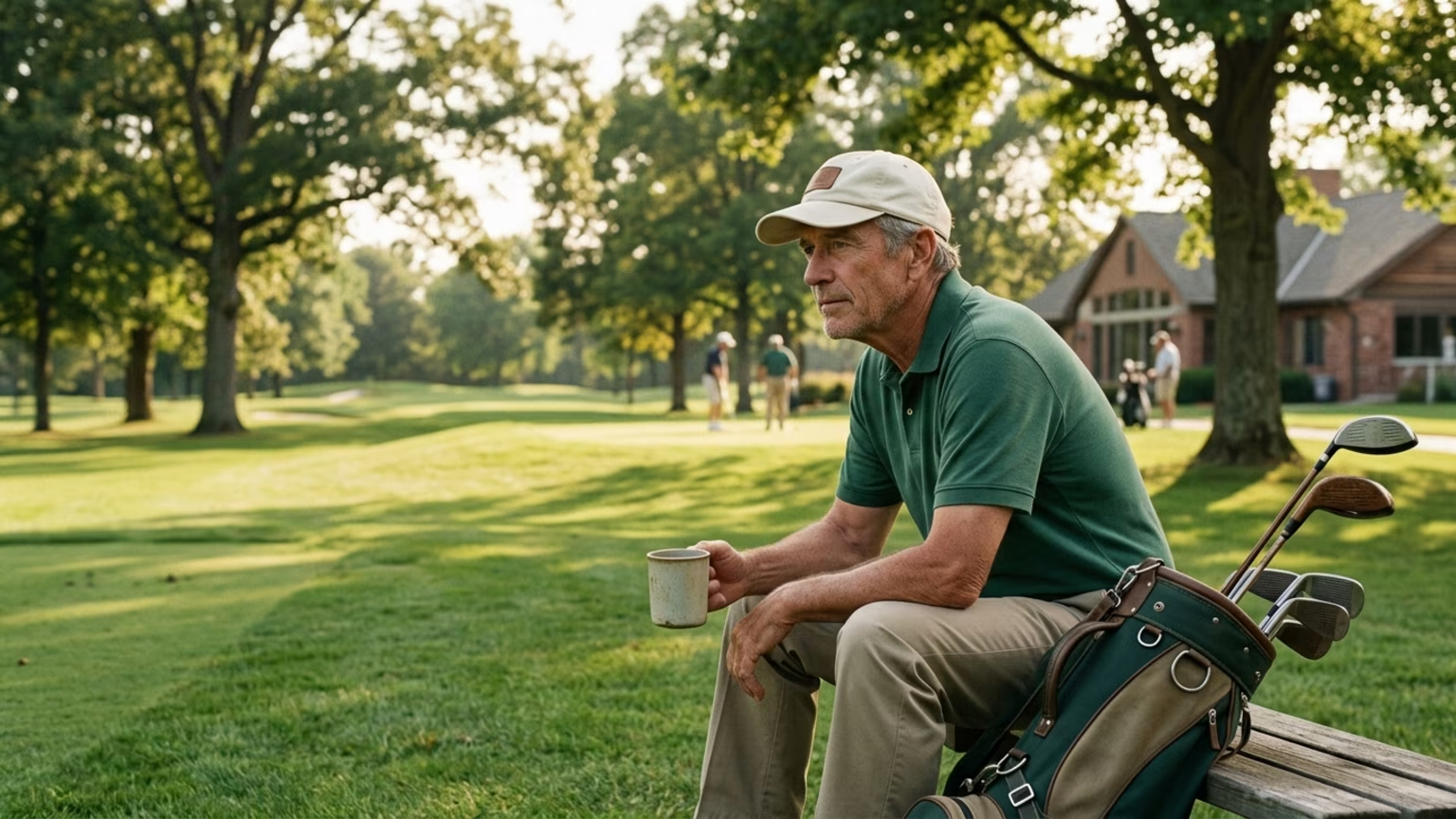

Discover what golf strength really means after 40. Learn how trunk control, pelvic stability, and force management help you play better for longer.




Golf strength is simply your body's ability to generate ground force, transfer it through your trunk, and safely brake the club at the finish. In a study of 32 male golfers, players with a history of mechanical low-back pain averaged just 286% of body weight in normalized trunk-extension torque. Pain-free players averaged a much stronger 362%. That gap matters because your trunk must absorb massive forces to safely slow down your swing.
True fitness for the sport goes far beyond maximal lifting numbers. Your midsection acts as a vital braking system that decelerates your body after impact. A weak braking system means your body struggles to slow down safely. Without that physical control, the risk of tissue stress increases significantly. Older players often focus entirely on increasing flexibility. However, protecting your spine through better trunk control is a far more effective strategy.
This mechanical concept shows up on every single hole you play. When you stand on the first tee, your lower body initiates the power phase. That energy moves up through your pelvis and into your upper trunk. If your trunk cannot hold its position, that energy leaks out before the club hits the ball.
The demand on your lower body is just as severe during a round. The same study of 32 golfers found significant differences in left-hip adduction strength. The low-back-pain group averaged 124% of body weight in left-hip adduction strength. The pain-free comparison group averaged 162%. Your lead hip must accept and stabilize your entire body weight as you swing through the ball.
By the back nine, a lack of trunk endurance becomes painfully obvious. You might notice your posture collapsing slightly as you swing. You might struggle to hold a balanced finish after hitting a drive. That loss of control is a direct result of your braking system tiring out. Many mature players blame their swing mechanics for these late-round misses. In reality, their physical ability to maintain posture has simply faded.
As we pass age 40, our natural capacity to generate power and maintain rotational endurance begins to shift. Muscles lose their fast-twitch characteristics without regular stimulus. The hips and trunk also lose their ability to contract and coordinate efficiently over repeated swings. This physical decline limits your ability to separate your upper body from your lower body.
Interestingly, strength differences do not always dictate driving distance directly. In the low-back-pain study, estimated driving distance averaged 206.8 metres for the symptomatic group. The pain-free group averaged 220.3 metres. However, that difference was not statistically significant. This highlights that targeted strength work is largely about joint protection and swing repeatability. Developing your body through targeted routines later in life prioritizes resilience over sheer distance.
At golfergy, we know that focused work can alter how an older body moves. A case report followed a 78-year-old amateur golfer who played three times per week. Over a 10-week individualized program, his seated trunk rotation improved from 48 to 65 degrees on the right. It improved from 60 to 75 degrees on the left.
While this single case lacked a control group and involved a surgical recovery period, the physical changes were notable. His TrackMan carry distance improved from 152.3 to 156 yards. His club speed moved from 75.9 to 76.7 mph. Perhaps most impressively for course play, his face angle improved from 6.2 degrees to 1.2 degrees.
Experts view the aging golf swing as a system of interconnected parts. Shane Thoreson, DPT, a golf specialist at the University of Utah, explains that the hips and thoracic spine are the primary joints designed for rotation. When these specific areas lose mobility, the lower back or knees are forced to compensate. Thoreson describes the core as both a conduit for force and a vital braking system.
This perspective aligns with modern sports science recommendations for recreational players. Research indicates that endurance may be more valuable for injury prevention than maximum absolute strength. You do not need to lift massive weights to protect your spine. You need a trunk that can stabilize your posture repeatedly across a four-hour round. Proper habits that build stamina for the course focus heavily on this exact kind of endurance.
Resistance-training literature also distinguishes between maximal strength and speed development. Heavy resistance training using loads above 80% of one-repetition maximum improves high-force production. Conversely, lighter loads of roughly 30% to 60% of one-repetition maximum are moved explosively to develop force at higher velocities. For recreational golfers, experts propose a steady progression from general strength toward these golf-specific power exercises.
Building the right kind of physical resilience requires focused loading. When I developed medial epicondylitis, commonly known as golfer's elbow, I thought I needed complete rest. Six weeks off the course did nothing to help. I finally learned that active recovery with a flexbar was the actual solution. It taught me that treating golf injuries requires loading the tissue properly, not just sitting on the couch and hoping for the best.
You can apply this exact principle of proper loading to your trunk and hips. Start with a simple bird dog exercise to build spinal stability and core endurance. Get on your hands and knees on a comfortable surface. Extend your right arm and left leg slowly. Focus entirely on keeping your lower back perfectly flat. This teaches your trunk muscles to brace your spine against unwanted movement.
Next, incorporate split squats to build lower-body stability and pelvic control. Take a staggered stance and lower your back knee slowly toward the ground. Focus entirely on turning your trail hip smoothly as you return to the starting position. Building this foundational leg strength gives your swing a secure base of support.
Once control is established, you can slowly introduce dynamic work. A clinical commentary cited an eight-week program of general resistance and plyometric medicine-ball work. That specific program improved clubhead speed by 4.1% and hitting distance by 5.2%. Consistent and safe loading creates tangible results when applied carefully.
You should always measure your progress by your repeatability rather than maximum numbers. Note whether you can maintain balance through the finish of your swing. Pay attention to whether your contact quality stays consistent late in a practice session. A stronger body simply gives you a larger margin for error on the course.
True golf fitness is never about matching the heavy lifting records of younger athletes. It is about building a physical system that can generate power and absorb force safely over time. The men in that study who lacked trunk-extension torque carried a history of pain for a very clear reason. Real golf strength is simply your body's ability to repeat a controlled movement so you can keep playing better for longer.
Follow Golfergy for practical insights on performance, mobility, recovery and healthy ageing. Stay connected for new articles, research-led guidance and ideas to help you play better for longer.


A new cellular study reveals how aging muscle affects your golf swing. Learn why older golfers need resistance training to protect their tissue capacity.


Golf Digest recently published a five-part single-leg fitness challenge. Learn what this movement reveals about your balance, strength, and golf longevity.

Elite tournament recovery relies on sleep hygiene and structured training. Golfers over 40 can use these exact methods to prevent late-round fatigue.
Explore practical resources on performance, recovery, mobility and golf longevity.
Read the Blog