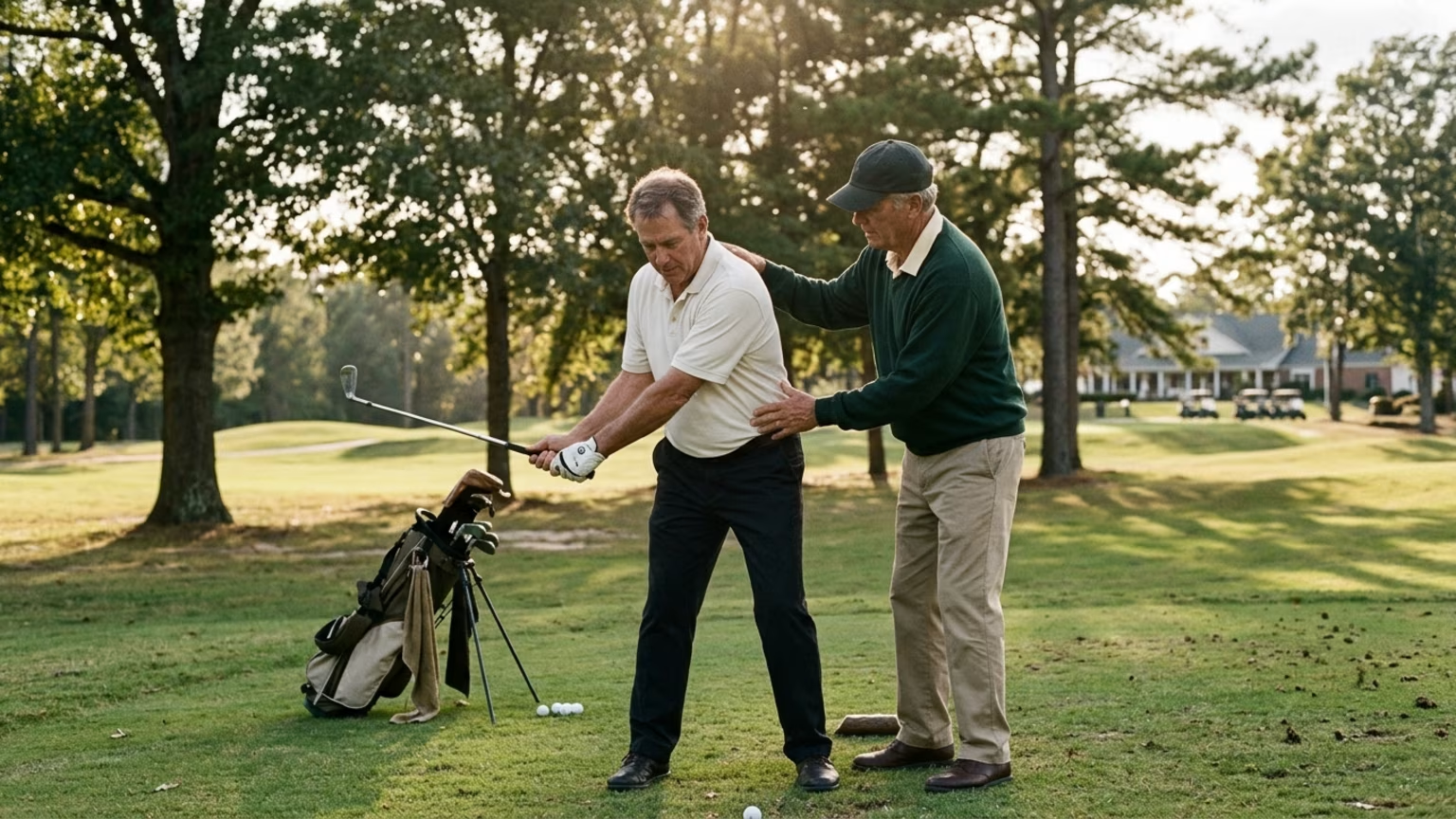
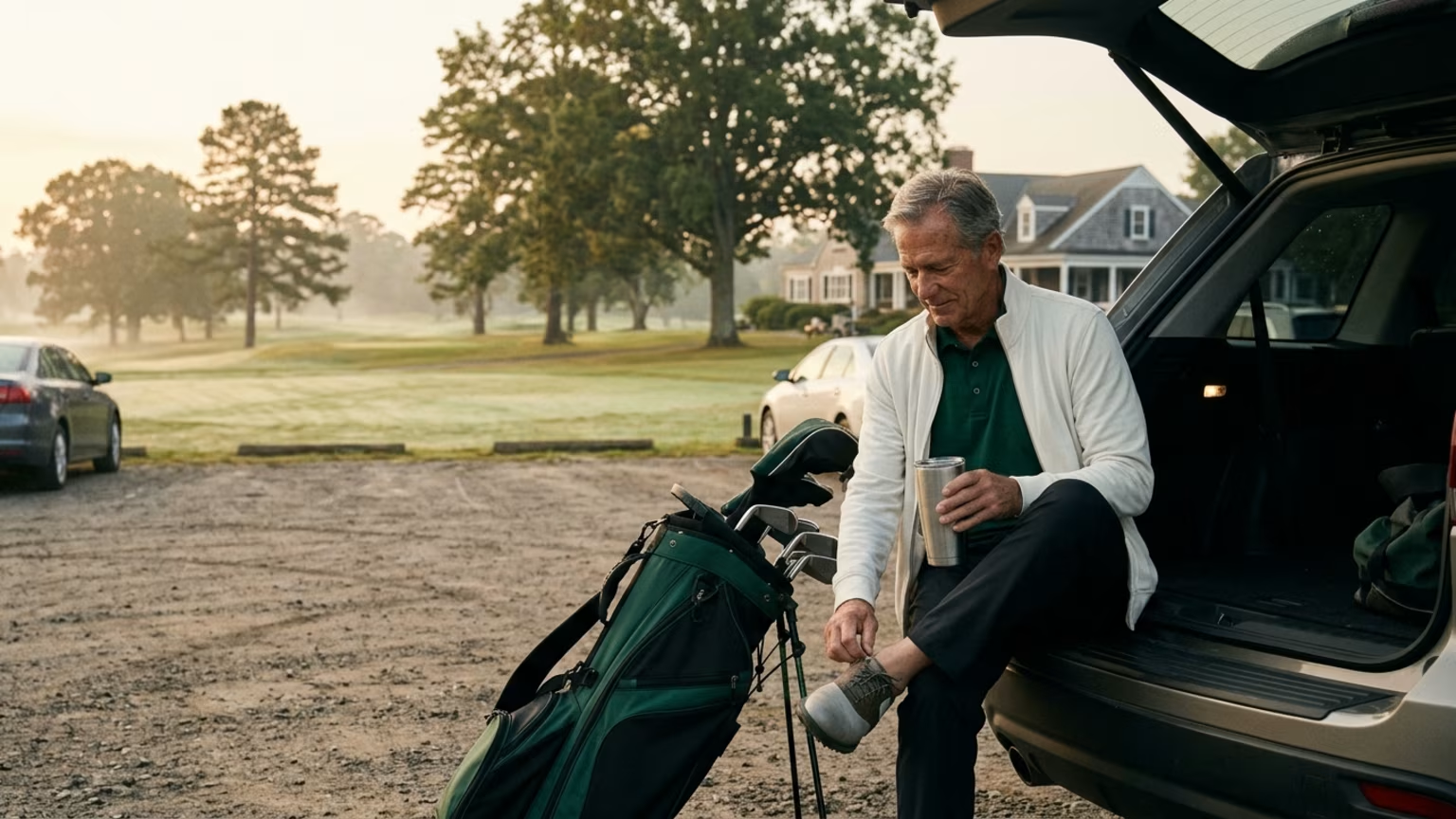
Move from walking to controlled movements and easy swings, with clear expectations about warm-ups, injury evidence and longer-term golf fitness.




A golf warm-up is simply a gradual move from rest into the walking, turning and swinging that a round requires. Its job is preparation for the activity ahead. Lasting gains in strength and mobility belong to ongoing training.
For an ageing golfer, the useful biomechanical idea is whole-body readiness. Rather than focus only on the club, think about the body movements that lead up to a swing. Sports Medicine Weekly's older-golfer guidance includes controlled shoulder, hip, trunk and ankle movements before practice swings.
That gives the journey from car park to first tee a clear purpose: move gradually toward the demands of golf rather than jump straight to full effort.
Think about a standard round as walking between shots and returning to the action of swinging. Preparation has a wider purpose than rehearsing the opening drive. The golf-facing guidance reflects that broader task by beginning with general activity before moving toward golf-specific movement.
The anatomical focus is broad too. Shoulders, hips, trunk and ankles all appear in the preparation sequence described by Sports Medicine Weekly. The sequence then becomes more specific through short-iron half swings before full swings.
This is a useful way to connect body preparation with the game itself. Walking belongs at the general end of the sequence. Controlled joint and trunk movements sit between walking and swinging. Practice swings bring the preparation closer to the action required on the tee.
What should that feel like? The aim is a gradual rise in movement and swing effort rather than an immediate demand for a full swing after sitting. Comfortable movement is the focus, not a test of how far a joint can move.
For more on that transition, Golfergy's guide to moving from desk-based postures toward golf keeps the connection between daily life and the course in view.
The useful starting point is to separate preparation for today's round from the longer-term work of maintaining physical capacity. The evidence supports that distinction more clearly than it supports a special warm-up tied to a particular birthday.
A 2026 scoping review mapped 964 warm-up studies and counted 18 in golf. It did not provide older-golfer subgroup evidence or detailed descriptions of specific golf routines. It therefore does not establish how or why movement changes after 40 or 50, or identify a tested universal routine for those ages.
The performance and injury findings also need clear boundaries. A golf physiotherapy summary of a 2019 systematic review covering 23 golf warm-up studies reported that dynamic and resistance-based warm-ups tended to support performance. Injury findings were mixed and inconclusive. The broader scoping review also cautioned that short-term test improvements do not necessarily translate into better competitive performance.
Direct injury outcomes were uncommon in the broader review. That limits the conclusions available rather than proving that warm-ups cannot prevent injuries. The practical expectation is readiness and possible performance support, not guaranteed injury prevention or a pain-free round.
Longer-term training has a different purpose. Sports Medicine Weekly describes an eight-week strength-and-flexibility programme in golfers aged 55 to 79 that improved strength, range of motion and clubhead speed. Those were reported effects of repeated training rather than a brief session before play. The scoping review likewise distinguishes an immediate preparatory warm-up from programmes that rely on repeated exposure and adaptation.
That distinction matters more than trying to recover every missing degree of movement beside the first tee. Golfergy's discussion of building strength and control for the golf turn belongs to the longer-term side of the picture. Personal decisions about recurring pain or a movement restriction belong with a qualified health professional.
The practical guidance follows a straightforward progression: general activity, controlled movement and then practice swings. These two habits organise that progression without adding fixed repetitions or a demanding exercise circuit.
Golf physiotherapy guidance describes light activity followed by gentle trunk and hip movement. Sports Medicine Weekly describes a similar progression from walking into controlled movements before swinging.
Walking is therefore part of the preparation rather than merely the journey to the practice area. It comes before the more specific movement work. The sequence does not begin with a full practice swing.
For the controlled-movement stage, keep attention on one small action at a time. Gentle hip movement is one task. A controlled shoulder movement is another. The cited guidance also includes trunk and ankle movements.
The focus remains comfortable motion. There is no need to turn this part of preparation into a test of flexibility or an attempt to solve every physical concern before teeing off.
Golfergy's guide to progressing from walking toward practice swings develops this same general-to-specific approach.
The swing stage begins below full effort. Sports Medicine Weekly specifically places short-iron half swings before full swings, while the golf physiotherapy guidance describes practice swings that gradually build in speed.
That gives the transition a clear direction. The early swing is smaller and easier. Swing length and effort then build toward the action needed for play.
Keep the focus on the movement being prepared rather than trying to prove readiness with the fastest possible practice swing. A half swing has a place in the sequence because the guidance starts below the full action.
This habit also keeps the roles of preparation and training separate. The practice swings prepare the upcoming golf action. The ongoing work of developing strength and range of motion remains a task for repeated training away from the immediate demands of teeing off.
For Golfergy, that is the practical priority: a sustainable approach that connects research with the movements experienced recreational golfers use on the course.
Prepare your hips and trunk for today's turn while building lasting physical capacity over time: that is the steady approach to Playing Better for Longer.
Follow Golfergy for practical insights on performance, mobility, recovery and healthy ageing. Stay connected for new articles, research-led guidance and ideas to help you play better for longer.


Early mitochondrial research offers golfers over 40 a measured view of exercise science, resistance and endurance activity, and the limits of mouse findings.

Learn how hip, upper-back and shoulder mobility fit a comfortable golf swing, with gentle movement observations and a focus on control.
UQ researchers propose a wider view of ageing weakness. See how muscle, movement and function relate to golf, and where the evidence stops.
Explore practical resources on performance, recovery, mobility and golf longevity.
Read the Blog