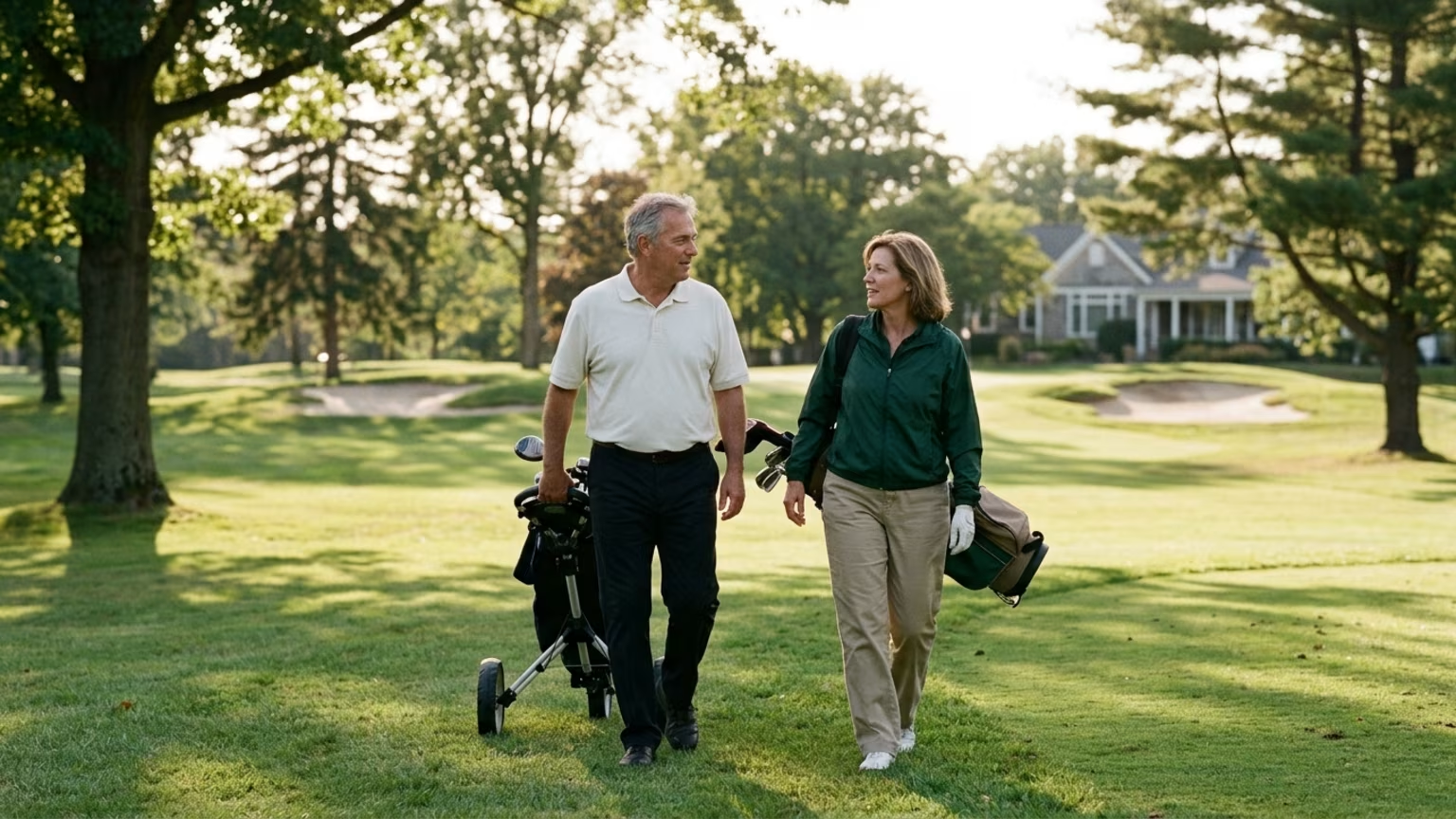
See how balance fits alongside strength and coordination in golf, with a supported practice example and a clear look at the evidence.




Balance is your ability to stay steady while standing or moving. For a golfer, it sits alongside leg strength, mobility and coordination. It matters when you settle over a shot and when you move across uneven ground. The aim is a body you can rely on throughout a round, not a harder drill for its own sake.
Golfergy takes the broader view: balance is part of golf readiness rather than a stand-alone answer. That keeps the focus on sustainable habits instead of promises about perfect swings or certain results.
Across a standard 18 holes, steadiness takes several forms. Walking along a slope is different from standing over a ball below your feet. Settling into your stance is different from turning through the shot. The course asks you to move, settle and move again.
Think of your legs as the lower-body base for that turn. Strength describes their capacity to work. Coordination describes how movements fit together. Balance concerns how steadily you manage the task, whether you are standing at address or moving between shots.
On an uneven lie, the experience might be uncertainty before the club moves. During the swing, it might be difficulty feeling settled through the turn. These are useful descriptions to bring into a conversation about your physical readiness. They are not interchangeable experiences.
That distinction matters for confidence. Feeling uneasy over a sidehill shot tells you something about your experience of that shot. It does not identify which physical quality needs attention. Confidence is a worthwhile goal, but it should not replace a clear look at the task that feels difficult.
This is where looking at your wider golf fitness becomes useful. Keep walking on uneven ground separate from settling into a stance and controlling a turn. That gives you a clearer way to describe the problem than saying that your balance is simply “bad.”
For golfers passing 40 and 50, age provides context rather than an individual assessment. The useful question is what moving around the course feels like now. Research involving older golfers offers some perspective, but it should be read with its design and participants in mind.
A secondary golf report describes a study of 18 male golfers averaging 70.7 years old. Of those participants, 11 completed an eight-week exercise program while seven were controls. The program combined flexibility and core stability with balance and resistance exercise. The report says the training group’s maximum clubhead speed rose from 127.3 to 133.6 km/h.
A separate secondary report summarizes a 2023 comparison of recreational golfers aged between 65 and 79 with sedentary peers. It reports higher grip strength and better static and dynamic balance among the golfers. In plain language, that includes balance while still and while moving.
The limits belong together. These findings do not map how or why balance changes as someone passes 40 and 50. The small exercise study cannot separate balance from the other training elements or represent every mature golfer. The comparison cannot establish that playing golf caused the differences between groups.
Neither report directly tested confidence, fall prevention on golf courses or performance from uneven lies. The supported movement described below comes from publisher guidance rather than a clinical protocol.
The practical interpretation is to keep several physical qualities in view. The exercise program was broad, with balance sitting beside other forms of conditioning. That fits Golfergy’s approach to keeping strength and mobility in the same plan, rather than treating one quality as the whole answer.
For an experienced recreational golfer, this also changes the goal. You do not need to compare yourself with the average participant in a study. Focus the conversation on the activities you want to manage and the situations that currently feel uncertain.
The golf-exercise publisher DRVN describes a supported single-leg balance option. Its example uses a counter or chair for light hand contact. Hand support is reduced only as the exercise becomes easier. The movement has one clear focus: standing steadily on one leg with support available.
The publisher’s example can be described in three simple parts:
Support is part of this practice, not something to dismiss as a poor result. The point of the example is a manageable movement beside something stable. Removing hand contact is not the starting goal.
Keep the distinction between practice and course demands clear. A supported hold beside a counter is one task. Standing on a sidehill lie is another. The slope is not an automatic next step for this movement, and there is no need to turn practice into a test of nerve.
This is the useful idea behind keeping balance practice supported off the course. Start with one clearly described movement rather than collecting more difficult variations. The wider conditioning discussion can still include leg strength and mobility without making this single task more complicated.
If persistent unsteadiness is part of your experience, discuss your exercise choices with a qualified healthcare professional. Individual medical or physical-therapy advice is more appropriate than responding by making a balance drill harder. Bring a clear description of where the uncertainty occurs, such as walking on uneven ground or settling over a shot.
Confidence can remain the goal without becoming a promised result. For Golfergy, the practical priority is steady action that respects your present ability and keeps the whole body in view.
A steady base supported by leg strength and coordinated movement keeps the goal clear: Playing Better for Longer.
Follow Golfergy for practical insights on performance, mobility, recovery and healthy ageing. Stay connected for new articles, research-led guidance and ideas to help you play better for longer.


A practical strength framework for golfers over 40, built around everyday goals, sensible progression and a careful look at limited golf research.


A research-led look at strength, balance, mobility and trunk control, with a flexible planning framework for golfers over 40.
Understand golf mobility after 40 with a comfortable-turn self-check, hip and shoulder guidance, and a clear look at flexibility and swing speed.
Explore practical resources on performance, recovery, mobility and golf longevity.
Read the Blog