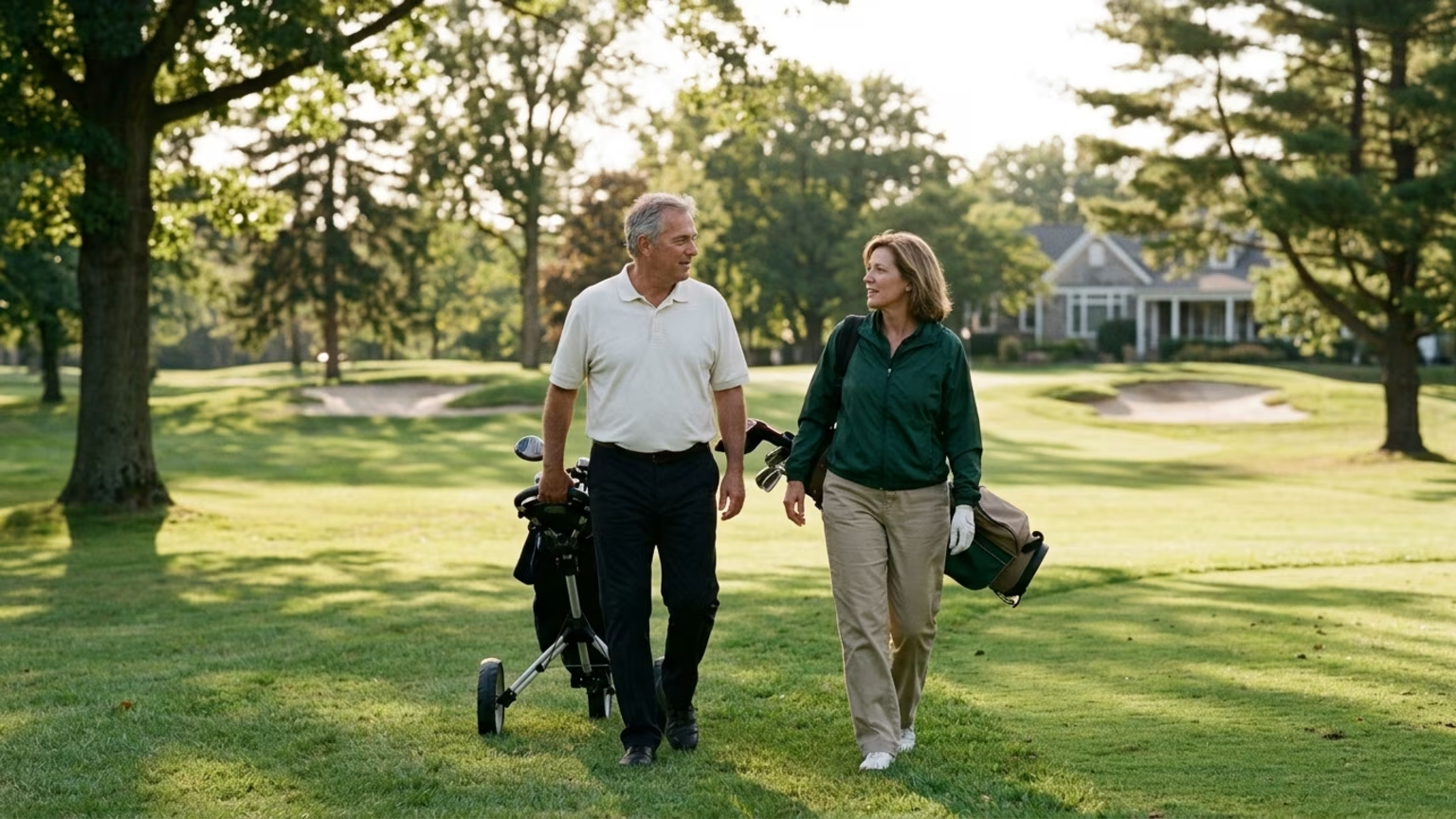
A grounded look at balance after 40, with supported single-leg practice and a clear place for strength training and golf practice.




Balance is your ability to stay steady while holding a position or moving. For golf, that means thinking about control as a separate part of your preparation, not treating it as another name for strength or swing technique.
A published routine for older golfers makes that idea concrete with a supported single-leg hold. The movement uses light hand support and asks the golfer to keep the standing hip from drifting. It is a small task with a clear focus: control the position rather than remove support as fast as possible.
Over a standard round, consider three different situations: standing over the ball, turning through a shot and walking between shots. They are different movement tasks. A stationary hold gives you something specific to practice without trying to copy every demand of golf.
At address, the practical question is whether the position feels settled. During the swing, the question becomes how controlled the movement feels. On a slope, it is worth separating the challenge of standing there from the technical challenge of playing the shot.
These questions keep the course context in view while leaving room to focus on a small task. The standing hip is a useful point of attention in the supported exercise because the routine specifically asks you to keep it from drifting. That is a more precise aim than trying to work on your entire swing at once.
Our guide to thinking about balance on uneven ground takes the course setting further. Keep the training task and the playing task distinct: a supported hold is not a rehearsal of a sloping lie.
For golfers moving through their 40s and 50s, noticing a change and explaining it are different jobs. Feeling less steady is an observation. Deciding that age is the cause requires more than a home exercise.
The published routine is exercise guidance rather than a controlled test of golf outcomes. It does not establish better swing consistency, safer walking or improved play on uneven lies. It also does not establish injury prevention or explain how natural aging changes balance at a particular age.
That leaves a practical role for observation without attaching a medical label. Note whether you use hand support and whether the standing hip drifts during the described movement. Bring concerns about changing balance to a qualified health professional for an individual assessment.
The published routine offers a simple starting movement and a gradual change in support. Keep the focus on one movement rather than trying to turn balance practice into an entire golf workout.
The routine describes the movement this way:
For an accessible self-check, pay attention to the task itself. Notice the hand support being used and whether the hip stays controlled. Treat those observations as a description of this movement, not a score to compete over.
The counter or chair is part of the exercise rather than something to discard immediately. The first focus is the standing hip. There is no need to add a club or try to reproduce a full swing within this small task.
The same routine suggests reducing hand support as the exercise becomes easier. That is the progression described by the source. The aim is a gradual change in support rather than a sudden move to a much harder version.
Keep the movement focused on that change. Adding several new demands at once would turn it into a different task. For personal decisions about the right level of challenge, seek qualified guidance rather than using this general example as an individual program.
Keep balance practice alongside strength training and golf practice. It belongs in the preparation picture rather than replacing the other work. Golfergy's guide to the different roles of strength and balance offers a broader way to think about those parts.
That fits Golfergy's focus on practical guidance for mature recreational golfers. A useful starting habit does not need to carry the whole job of golf preparation. Keep its purpose small and clear so it can sit beside the rest of your practice.
Treat balance as one part of your preparation alongside strength and golf practice, with the shared goal of Playing Better for Longer.
Follow Golfergy for practical insights on performance, mobility, recovery and healthy ageing. Stay connected for new articles, research-led guidance and ideas to help you play better for longer.


Build a practical golf warm-up from walking to comfortable mobility and fuller swings, while keeping preparation separate from long-term conditioning.


Shot Scope’s LM1 data offers age and handicap benchmarks for driver speed and carry. Here’s how golfers over 40 can read the figures.
Understand useful golf mobility, the limits of flexibility research, and two gentle movement checks focused on a comfortable, controlled turn.
Explore practical resources on performance, recovery, mobility and golf longevity.
Read the Blog