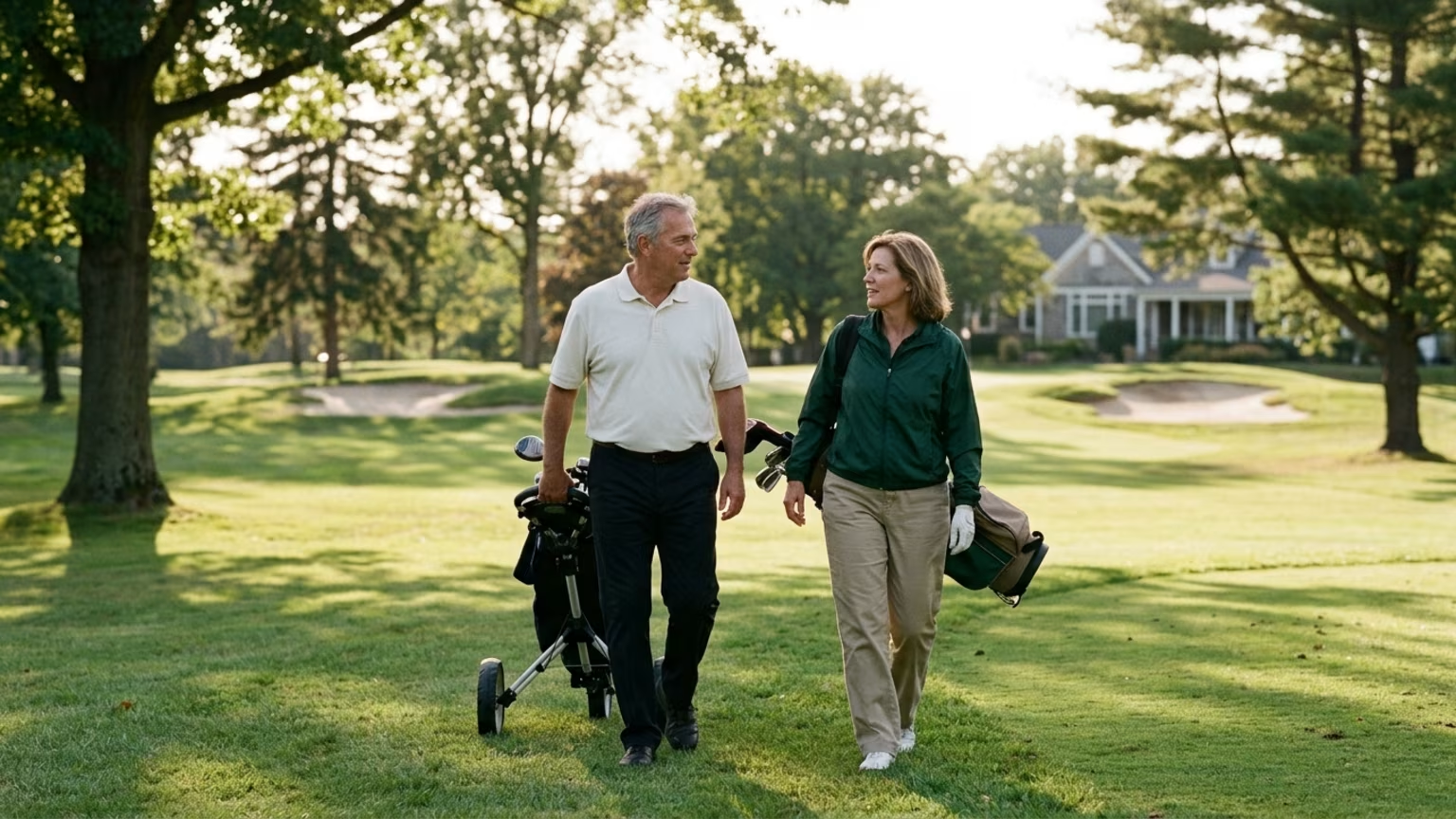
A research-led look at strength, balance, mobility and trunk control, with a flexible planning framework for golfers over 40.




Usable mobility is movement you can control, not just a position you can reach. For a golfer, that means looking beyond how far you turn. Strength, balance and control of your trunk belong beside flexibility in the training picture.
Flexibility can help you reach a position comfortably. It does not tell the whole story about your ability to move through that position repeatedly. A training plan built only around stretching leaves those other qualities outside the conversation.
The goal is not to replace every stretch with a weight. It is to give each physical quality a clear role. Golfergy’s approach puts practical movement and healthy ageing ahead of quick fixes or a single swing-speed target.
Start with a different question: rather than asking how to make your turn bigger, ask how to make your available movement more controlled. That is the thinking behind connecting mobility work to your swing.
Think about a standard round of 18 holes through the lens of reach and control. Reaching the top of a backswing is one part of the task. Managing the movement into and out of that position is another.
The research framework includes the legs and hips alongside the upper body and trunk. That keeps the conversation broader than shoulder flexibility or how far the club travels back. Trunk control means paying attention to how you manage rotation rather than simply pursuing more of it.
On the course, these qualities are easier to understand as questions than as gym scores:
These are conversation starters, not a medical screen or a set of pass-fail tests. They help separate the desire for a longer backswing from the broader goal of moving well through a round.
The same distinction applies from the opening drive to an approach on the back nine. A bigger turn is not the only training goal worth pursuing. A plan can also address the capacity to manage movement without making every exercise resemble a golf swing.
If the difference between restricted movement and poorly controlled movement feels unclear, taking a closer look at your movement can help frame a useful discussion with a qualified professional.
For golfers over 40 and 50, the starting point should be current ability rather than an age-based exercise template. The useful question is which qualities deserve attention now. Age should frame the conversation without becoming a diagnosis.
According to a published review summary, a 2024 systematic review and meta-analysis examined 20 studies of physical characteristics and driver clubhead speed. Several strength and power measures were associated with clubhead speed. Flexibility was not significantly associated with speed in the pooled analysis.
Those findings have clear limits. Associations do not prove that improving a measured quality will produce a particular speed gain. The flexibility finding does not make comfortable movement irrelevant. The review also does not explain how or why an individual golfer’s muscles and joints change after 40 or 50.
The practical takeaway is therefore broader than “get stronger” or “stretch less.” Strength and power deserve a place in the performance discussion. Mobility still has a role where it addresses an individual restriction. Balance and trunk control also belong in a balanced training framework.
That approach leaves room for different starting points. Someone uncertain about resistance exercise needs a different entry point from someone already comfortable with it. The same principle applies to balance practice and controlled rotation: match the work to current ability rather than copying another golfer’s programme.
Two habits provide a useful starting structure. Neither requires turning every session into a hard golf workout. Both keep the focus on manageable movement rather than a promised distance gain.
Give general strength work a place alongside mobility. The research summary’s suggested framework includes resistance exercises for the legs and hips, plus the upper body and trunk. The purpose is broader physical capacity and control of rotation rather than maximal lifting.
Keep attention on one movement at a time. A session does not need to become a rehearsal of every part of the swing. Where appropriate, lighter resistance offers a way to scale the work to the person doing it.
This is also where personal guidance matters. Pain, health conditions or uncertainty about exercise safety are reasons to discuss exercise choices with a qualified clinician. A qualified coach can help with questions about how training fits the golf swing.
The aim is a programme that suits the golfer rather than a golfer trying to keep up with a programme. That distinction matters more than choosing an exercise because it looks golf-specific.
Give balance and trunk-control practice their own place in the plan. The suggested framework allows for stable or supported options where needed. Progress belongs after controlled movement rather than ahead of it.
Mobility can sit beside that work without taking over the whole plan. Its role is comfortable and controlled movement where an individual restriction needs attention. More range is not automatically the next goal.
A useful organising habit is to give each activity a purpose. Resistance work addresses strength. Balance practice addresses control. Mobility work addresses movement restrictions rather than serving as a substitute for everything else.
Sample weekly framework, not a tested protocol: distribute these elements across the week instead of making every session demanding or golf-specific.
This outline is an editorial planning tool. It is not an established optimal schedule or an exercise dose for every golfer over 40.
The practical goal is a plan with a clear purpose and suitable exercise choices. For a wider view of how the pieces fit together, read about training physical skills beyond flexibility.
Build movement you can control, with strength and balance beside mobility, and keep Playing Better for Longer as the goal.
Follow Golfergy for practical insights on performance, mobility, recovery and healthy ageing. Stay connected for new articles, research-led guidance and ideas to help you play better for longer.


A practical strength framework for golfers over 40, built around everyday goals, sensible progression and a careful look at limited golf research.


Understand golf mobility after 40 with a comfortable-turn self-check, hip and shoulder guidance, and a clear look at flexibility and swing speed.

Salk's exercise atlas maps tissue responses in young mice. Here is how golfers over 40 can put the findings and future recovery research in perspective.
Explore practical resources on performance, recovery, mobility and golf longevity.
Read the Blog