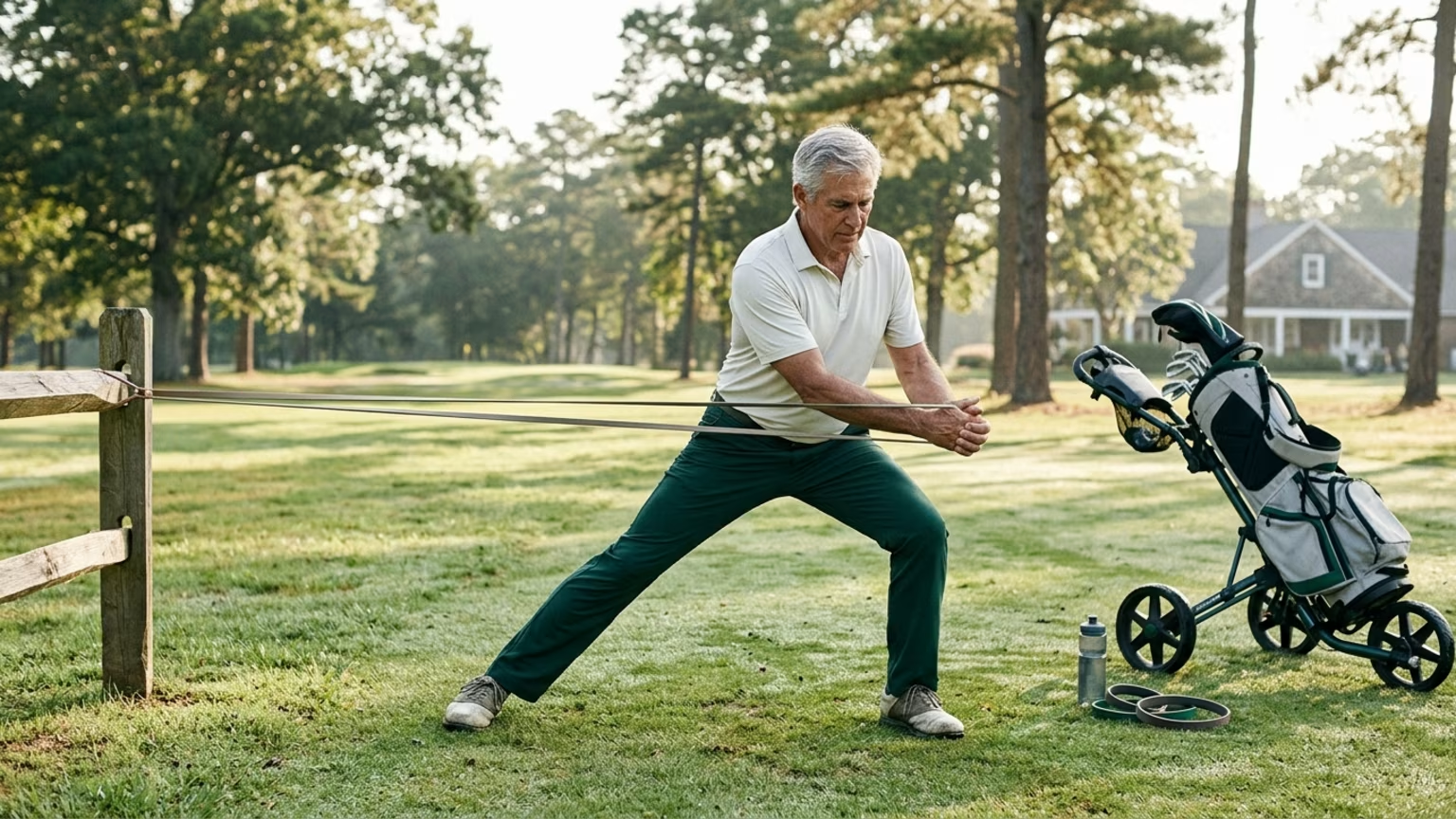

A durable golf swing relies on strength, mobility, and balance. Learn how physical training supports consistent mechanics and performance for mature players.




A durable golf swing is simply your body's ability to create force and control it. It relies on a practical blend of strength, mobility, and balance. Stretching alone is rarely enough to support the repetitive demands of the game over time. You need physical strength to produce reliable clubhead speed.
You need mobility to rotate comfortably without straining your joints. You also need balance to stay organized through the ball and hold your finish. These three elements work together to build a foundation that protects your body. Ignoring one pillar often places unnecessary stress on the others during your swing.
These physical traits show up constantly during a standard round of golf. Upper-body and lower-body strength help you move the club efficiently from the top of your backswing. When you have adequate strength, you do not have to swing out of your shoes to generate distance. Mobility allows your shoulders and hips to turn fully without forcing awkward compensations.
This freedom of movement keeps your spine safe when you swing. Balance is what keeps you stable when you hit from a sidehill lie. It helps you shift your weight smoothly during the transition into your downswing. If these physical foundations fade, your mechanics often break down on the back nine.
You might lose your posture through impact as fatigue sets in. Your rotation might shorten as your body instinctively tries to protect itself. This loss of stability can lead to poor contact and lost yardage late in the round. Building a physically resilient body helps you maintain consistent form from the first tee to the eighteenth green.
Without sufficient strength, you might try to manufacture power with your hands and arms. This often leads to erratic ball flights and frustrating mishits. When your legs and core are strong, they act as a stable engine for your swing. You can swing within yourself while still producing enough speed to reach long par fours.
A balanced body also recovers faster after a long day on the links. You will feel less stiffness in your lower back the morning after your round. This physical resilience lets you practice more often without taking days off to heal. It also makes walking the course much more enjoyable when your legs feel sturdy.
This is why managing the physical cost of repeated swings requires more than just a quick warmup. Golfergy focuses on these practical realities to help you stay on the course. We promise to provide practical advice that helps you play the game you love. A structured approach to your body keeps you in the fairway for years to come.
As golfers pass age 40 and 50, muscle mass naturally declines. A 2024 systematic review by Brennan and colleagues in Sports Medicine examined associations between physical characteristics and clubhead speed. A subsequent 2026 review reported moderate associations between upper-body strength and clubhead speed. It also found strong associations for lower-body strength and various jumping measures.
These findings show that strength and power are highly relevant for the mature player. Improving these qualities does not automatically guarantee a faster swing for every individual. The 2026 review noted a small pooled effect of core-inclusive training on maximal clubhead speed. The overall certainty of this evidence was rated low across nine separate trials.
The same 2026 review described a specific 8-week training intervention for older male golfers. This program involved 18 recreational players with an average age of 70.7 years. Eleven players joined the training group, while seven formed a control group. They combined core stabilization, balance exercises, and resistance circuits for three sessions per week.
The researchers noted that these sessions lasted 90 minutes each. The available sources do not establish an optimal dose for all golfers. The review also does not isolate the separate effects of mobility or balance on clubhead speed. The evidence does not strictly prove that these training approaches prevent golf injuries.
The research cautions against reducing golf performance to distance alone. Accuracy, approach play, and putting are equally critical for your overall score. Physical training should support your ability to execute these skills rather than just chasing maximum speed. A comprehensive approach helps you stay coordinated when you face delicate chips around the green.
Managing your body changes is simply part of being a mature athlete. You cannot stop the aging process from affecting your muscles and joints. You can change how you prepare your body for the physical demands of golf. Recognizing these shifts early gives you time to build a proactive fitness routine.
Addressing these physical changes requires a sensible and progressive approach. The older-golfer intervention did not rely on just one type of exercise. It started with basic movements before progressing to medicine-ball rotations and simulated cable swings. Building consistent athletic training strategies early can protect your mechanics.
Start by adding basic resistance work for your lower body. Try a simple chair stand or step exercise to build leg strength over time. Lower-body strength is closely associated with force production in the swing. Keep the movements smooth, and avoid heavy weights if you are just starting out.
Focus entirely on pushing through the floor to build stability. You can perform these leg movements safely at home without complex equipment. Consistent practice will train your nervous system to fire those muscles efficiently. This basic leg work pays off when you need to power through thick rough on the course.
Next, challenge your static and dynamic balance. Practice holding your finish position at home without a club. Pay attention to how your weight shifts, and try to remain perfectly still for five seconds. A 15-minute mobility routine that includes standing balance checks can help you stay grounded.
Poor balance often ruins swing mechanics before the club even strikes the ball. Training your body to recognize stable positions helps prevent early extension. It also gives you the confidence to swing freely without fear of falling off balance. Make these short checks a regular part of your weekly routine.
Finally, recognize that strength, balance, and mobility are complementary training domains. You cannot substitute one for another if you want a complete physical foundation. If you have any medical conditions, always consult a qualified professional before starting new exercises. The sources reviewed here do not supply a clinical screening protocol for those in pain.
Start slow and prioritize consistency over intensity when building your fitness habits. Small steps taken daily add up to significant physical improvements over time. The goal is to prepare your body for the unique torque of a golf swing. Patient progress will serve your game far better than rushed workouts.
Building foundational strength, mobility, and balance is how you play better for longer.
Follow Golfergy for practical insights on performance, mobility, recovery and healthy ageing. Stay connected for new articles, research-led guidance and ideas to help you play better for longer.


Build a practical golf warm-up from walking to comfortable mobility and fuller swings, while keeping preparation separate from long-term conditioning.


Shot Scope’s LM1 data offers age and handicap benchmarks for driver speed and carry. Here’s how golfers over 40 can read the figures.

A grounded look at balance after 40, with supported single-leg practice and a clear place for strength training and golf practice.
Explore practical resources on performance, recovery, mobility and golf longevity.
Read the Blog