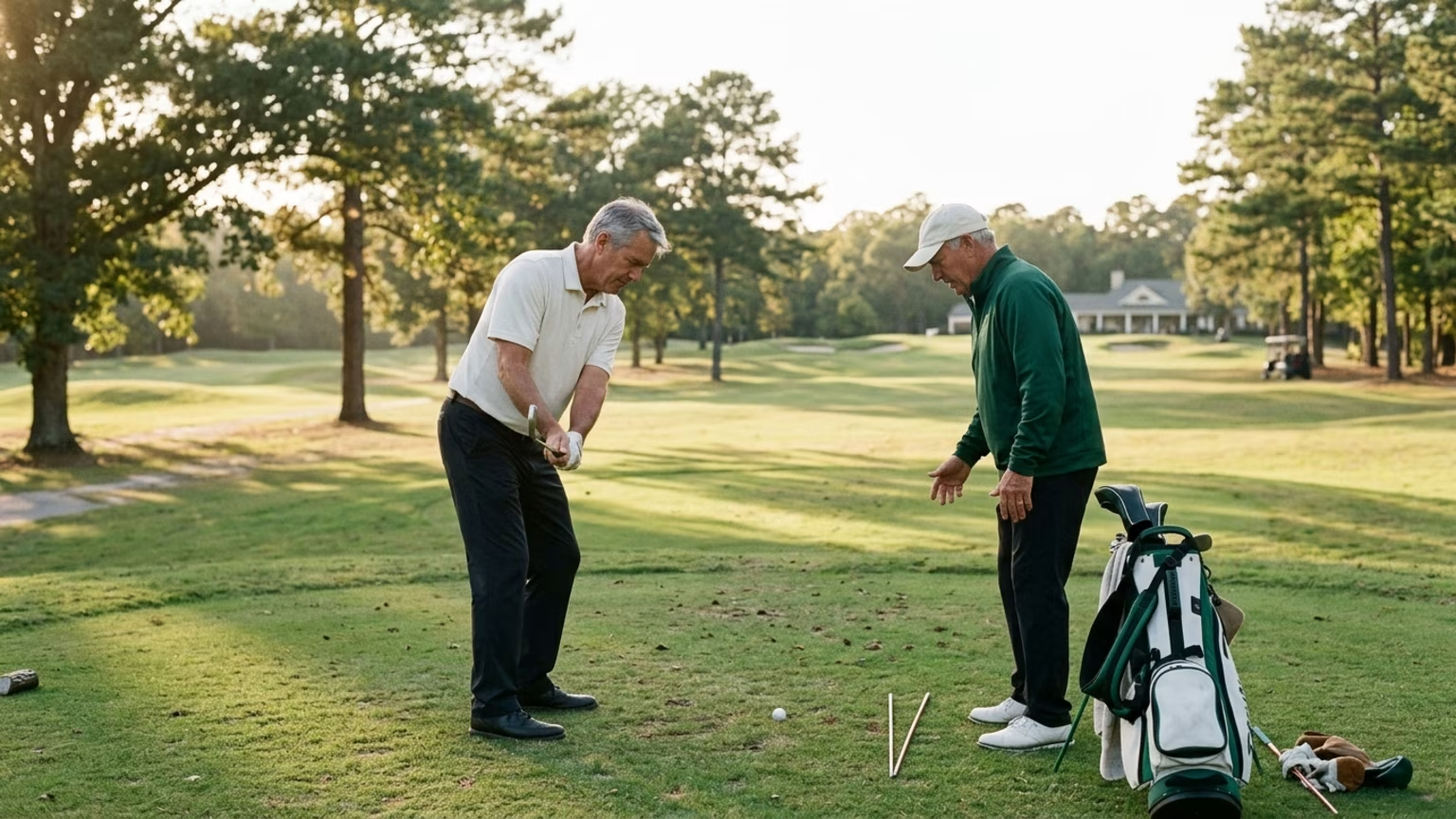

Learn how older golfers can build swing stability to control rotation and maintain posture. Understand practical training habits for a repeatable, safer swing.




Stability in the golf swing is simply your body's ability to control rotation and maintain posture while in motion. It is the physical engine that allows an older golfer to repeat a reliable swing under load. Many players confuse stability with sheer rigidity or tension. They try to brace their midsection as tightly as possible before taking the club back.
True control is about coordinating the legs, the pelvis, and the trunk seamlessly. It is a trainable skill that dictates how well you manage force on the course. You need a stable center to turn your shoulders without swaying off the golf ball. When your body is stable, you can swing with intent without losing your balance.
This coordinated physical effort creates a safe environment for your aging joints. It helps experienced players protect their lower back during high-speed rotation. A stable golf swing feels effortless because no single muscle group is overworked. The strain is distributed evenly across your entire musculoskeletal system.
This reduces the risk of mid-round fatigue and post-round soreness. Cultivating this bodily control is entirely possible for players over forty. It simply requires a shift in how you approach your physical preparation.
When you step onto the course for a standard 18 holes, stability dictates your consistency. It starts from the ground up on every single tee box. A solid base allows for proximal-to-distal force transfer during the actual swing. This means power moves smoothly from your larger center muscles out to the clubhead.
Without dynamic lumbopelvic stability, you cannot hold your spine angle through impact. You feel this physical demand most clearly when navigating uneven lies. Hitting from a steep sidehill lie requires your trunk muscles to control your rotation. Your body must resist gravity while maintaining a precise posture over the ball.
If you lose control of your hips, your swing path changes immediately. This lack of bodily control often leads to unpredictable contact and bad misses. By the time you reach the back nine, physical fatigue tests your swing mechanics. Players with poor stability start standing up out of their golf posture.
They sway instead of turning, which creates inconsistent ball striking. Building this physical capacity is a core part of improving your balance mechanics. The goal is to keep the same coordinated movement on the eighteenth hole as you had on the first. Good stability keeps you centered over the ball from the fairway to the rough.
It prevents your lower body from sliding toward the target too early in the downswing. When your hips stay stable, your hands have room to deliver the clubhead squarely. This translates to fewer lost golf balls and less frustration during your weekend rounds. It is the unseen foundation of every great senior golf swing.
Physical changes past the age of 40 alter how you manage athletic force. Muscles naturally lose some of their capacity for rapid power generation. Older players often compensate by swaying their hips or over-swinging to generate speed. This poor movement places excessive stress on the lower back and reduces consistency.
Maintaining a proper posture requires targeted physical effort as these natural traits decline. A systematic review and meta-analysis recently examined these exact physical demands. The review included nine controlled trials with 220 golfers, whose average age was 37.21. It found a small improvement in clubhead speed after core-inclusive training.
However, the authors rated the evidence for this overall improvement as low certainty. The review supports a modest speed finding, but it does not establish independent injury-prevention effects. Research on older recreational players shows how integrated training approaches can help. MyGolfMedia reports that one eight-week study tested 31 men aged 55 to 79.
The trial placed 19 men in a training group and 12 in a control group. The training group’s average clubhead speed rose from 85.0 to 87.1 mph. These older golfers focused on a mix of balance and resistance work. Core training alone is not a complete solution for an aging golf body.
The best pooled evidence points to modest benefits from combined training routines. A rigid abdominal brace cannot replace the need for healthy hip rotation. This integrated approach reflects the foundational fitness pillars for mature players. You must train the entire physical system to protect your mechanics over the long term.
Stability requires training your body to resist unwanted motion during the golf swing. One trial summarized in the review used a program that progressed carefully over time. It moved from stabilization and balance work to more dynamic rotational exercises. For an experienced golfer, the defensible takeaway is to train control across the entire body.
You should not simply chase maximal rotation without building a secure base first. A very approachable starting point is the single-leg balance hold. Stand near a wall for safety and lift one knee to hip height. Focus entirely on keeping your planted foot stable and your hips completely level.
Hold this position for several seconds before switching to your other leg. This basic hold trains your lower body to support your weight on one side. The floor bridge is another excellent movement for building basic pelvic control. Lie on your back with your knees bent and your feet flat on the floor.
Press through your heels to lift your hips until your body forms a straight line. Hold this top position briefly while focusing on your glute muscles. This teaches your pelvis to remain stable while your lower back stays protected. Once you build basic control, you can attempt later progressions from the clinical trials.
The cited study included medicine-ball rotations, wood chops, and simulated cable swings. These are examples of exercises used in a study, not a validated universal prescription. Incorporating these movements fits well within a short daily mobility practice for active players. People with persistent pain should seek individualized coaching before adding loaded rotational work.
The true goal is to train your body to manage rotational forces safely. Focus on smooth movements rather than heavy weights or extreme ranges of motion. Every single repetition should prioritize strict posture and controlled, even breathing. A steady approach to physical fitness keeps you on the course.
Small daily habits build the resilience needed for a lasting golf game. Ultimately, building foundational stability is about protecting your body so you can keep playing better for longer.
Follow Golfergy for practical insights on performance, mobility, recovery and healthy ageing. Stay connected for new articles, research-led guidance and ideas to help you play better for longer.


A practical look at golf strength after 40, with research on older golfers and simple habits for connecting training goals to a coordinated swing.


How legs, trunk and upper body share the work of a golf swing, with simple planning habits and a measured look at evidence for older golfers.

Understand mobility versus stability in golf, what older-golfer research reports, and two modest habits for comfortable movement control.
Explore practical resources on performance, recovery, mobility and golf longevity.
Read the Blog



