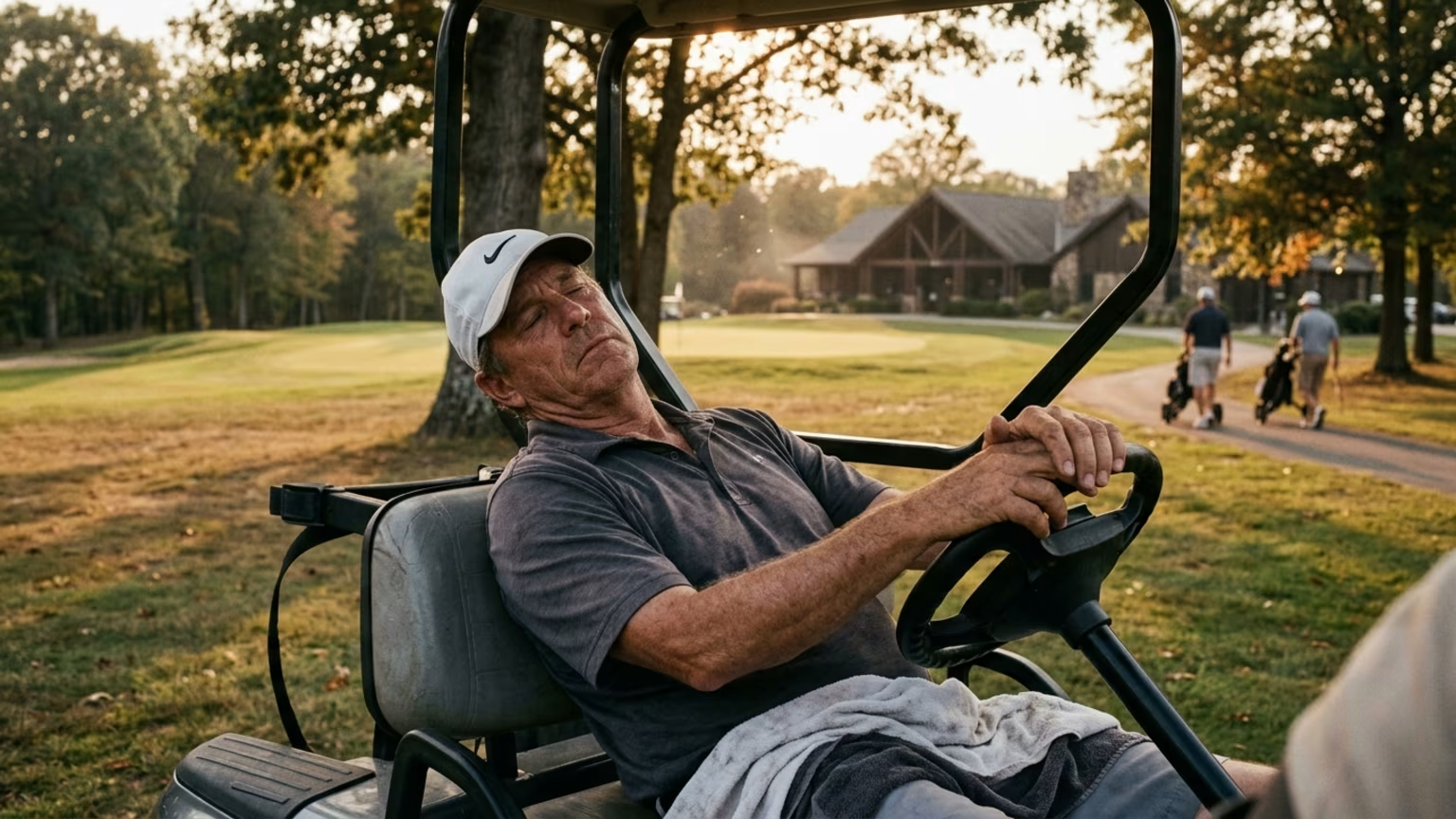

A McGill University study shows how a 20-minute workout or 90-minute nap can preserve memory and cognitive focus for golfers dealing with severe sleep loss.




In August 2026, when McGill University researchers published a peer-reviewed paper on severe sleep loss, they outlined two distinct strategies for preserving memory. The experiment kept 54 healthy young adults awake for 30 consecutive hours in a controlled laboratory setting. Researchers wanted to understand how a 90-minute nap or a 20-minute bout of moderate exercise might protect cognitive function. This public-health finding holds specific weight for golfers who occasionally face early tee times after tossing and turning all night.
A poor night of rest can derail a round before you even reach the clubhouse. The body feels stiff, the mind feels sluggish, and focus is nearly impossible to maintain. Recreational players often try to fix this by chugging multiple cups of coffee on the drive to the course. The McGill findings suggest a more biological approach to managing the damage.
Sleep deprivation severely limits the brain from forming new episodic memories. Episodic memory controls your ability to retain events and process new information. Missing out on deep rest slows down your neural processing dramatically. You might struggle to recall recent coaching instructions or remember how a specific green breaks.
The McGill team used electroencephalography to track how the brain responds to different interventions. This imaging technology monitored electrical activity in real time. They found that a long nap creates a brain state primed for new learning. Napping actively reduces the effects of neural fatigue and sleep pressure.
A brief exercise session takes a different route entirely. Exercise helps the brain process information more efficiently with its remaining resources. This means the interventions work through completely different neural pathways to reach a similar cognitive result. Both options help manage neural fatigue before a physically demanding round begins.
For a golfer, understanding these pathways changes how you view morning tiredness. You are not just dealing with heavy legs or a stiff lower back. You are dealing with a brain that cannot properly encode course-management decisions. Recognizing this biological reality helps you adjust your expectations on the first tee.
The 54 healthy young adults in the trial were monitored closely in a controlled laboratory setting. Participants were randomly assigned to a 20-minute cycling session, a 90-minute nap, or a control condition. After completing their assigned activity, they took an image-based memory test. Researchers then tested their recall three days later.
Across the two active groups, memory performance was about 22 percent higher on average than the control condition. Senior author Marc Roig stated that brief exercise might help preserve our most vital cognitive abilities. This preservation matters when people cannot stop working to obtain more sleep. The authors called for implementation studies in safety-critical occupations like shift work, mining, and transportation.
It is helpful to view this 22 percent figure as an average relative difference between groups. Individual responses will always vary based on personal health metrics. The outcome measured was episodic memory for images rather than specific golf performance stats like driving accuracy. First author Madhura Lotlikar described the exercise option as accessible, inexpensive, and easy to implement.
Experienced golfers over the age of 40 face natural changes in their sleep architecture. A bad night of rest compounds the physical demands of walking 18 holes. While the study focused on healthy young adults, older players deal with stricter recovery timelines. Poor rest makes the morning warm-up feel sluggish and mentally draining.
Episodic memory plays a massive role in course management and swing consistency. You need clear mental processing to select a club based on prior experience. You rely on memory to stick to a conservative plan for hazards. If severe sleep loss clouds your decision-making, you risk throwing away strokes before you hit your opening drive.
The cognitive fog of a poor night often leads to sloppy technique. A fatigued mind struggles to maintain focus on small mechanical cues. Golfers who force their way through a round without addressing this cognitive deficit usually fade on the back nine. Acknowledging the problem is the first step toward salvaging your scorecard.
Furthermore, older adults sometimes rely on medications that interact with fatigue. Dehydration from a restless night can make joint stiffness feel much worse in the morning. Combining a tired brain with a stiff body creates a perfect storm for poor scoring. Taking a few minutes to assess your physical readiness is a non-negotiable step.
If you wake up exhausted before an early tee time, you have two practical choices based on the research. If you have the luxury of time, a 90-minute nap in a dark room is a tested strategy. You must allow a buffer afterward to wake up, rehydrate, and safely reach the golf course. A short power nap was not tested in this specific experiment.
For most players, a 20-minute movement session is far more realistic. When I developed medial epicondylitis, commonly known as golfer's elbow, I thought I needed complete rest. Six weeks off the course did nothing to help. I finally learned that active recovery with a flexbar was the actual solution.
It taught me that treating golf injuries requires loading the tissue properly, not just sitting on the couch and hoping for the best. The same logic applies to managing a tired brain before your tee time. A proactive approach is much better than sitting passively in the clubhouse while hoping the fatigue magically disappears. During a light aerobic session, you can focus entirely on turning your trail hip to safely raise your core temperature.
A proper morning reset should start with several minutes of easy movement. You can then transition into moderate cycling or brisk walking. Finish with a short cool-down before packing your clubs. A proper morning reset should serve as a whole body preparation routine rather than a heavy workout.
Understanding how to balance light movement with rest helps you make smarter choices. Avoid heavy strength work or all-out intervals that will leave you physically depleted. Your goal is cognitive alertness and physical readiness. Save the intense training for days when you have slept well.
The researchers explicitly stated that exercise cannot replace sleep. A short workout or a long nap serves as a backup plan when adequate rest is impossible. Consistent nighttime sleep remains the absolute primary objective for long-term health and athletic longevity. Learning about nightly rest architecture will do far more for your game than any emergency morning routine.
Another misconception is that pushing through a grueling morning workout will shock the body awake. The McGill study used moderate cycling for a very specific 20-minute window. Older golfers should never attempt a maximal workout while dizzy, dehydrated, or experiencing shortness of breath. You should always follow advice from a clinician if you have underlying cardiovascular conditions.
Finally, do not confuse the study outcomes with guaranteed physical improvements on the course. The McGill study did not measure injury risk, balance, or musculoskeletal recovery. A pre-round spin on a stationary bike might clear your head and protect your memory. It will not automatically add ten yards to your drive or cure a faulty swing path.
Many amateur players assume that more physical effort will cancel out their fatigue. This belief leads to aggressive stretching routines that can strain cold muscles. You are far better off treating a tired morning as a day for conservative course management. Accept your limited physical capacity and rely on smart strategy to shoot a decent score.
Your ability to manage fatigue dictates how well you perform across an entire golf season. Sleep loss happens to everyone, but your response to that deficit is completely within your control. You can either let a bad night ruin your round, or you can implement a smart movement strategy to regain your focus. A calculated approach to pre-round recovery keeps you on the course and out of the physical therapy clinic.
What adjustments will you make to your mobility routine this season to steer clear of this hazard?
Follow Golfergy for practical insights on performance, mobility, recovery and healthy ageing. Stay connected for new articles, research-led guidance and ideas to help you play better for longer.


Rest or move the day after 18 holes? Use fatigue, soreness, symptoms and your playing schedule to guide a flexible recovery day.


Compare foam rolling, massage, compression, heat and cold for golfers, with comfort benefits kept separate from performance and injury claims.
A measured guide to stiffness during and after golf, with gentle movement options, sustainable habits and NHS-backed back-pain warning signs.
Explore practical resources on performance, recovery, mobility and golf longevity.
Read the Blog