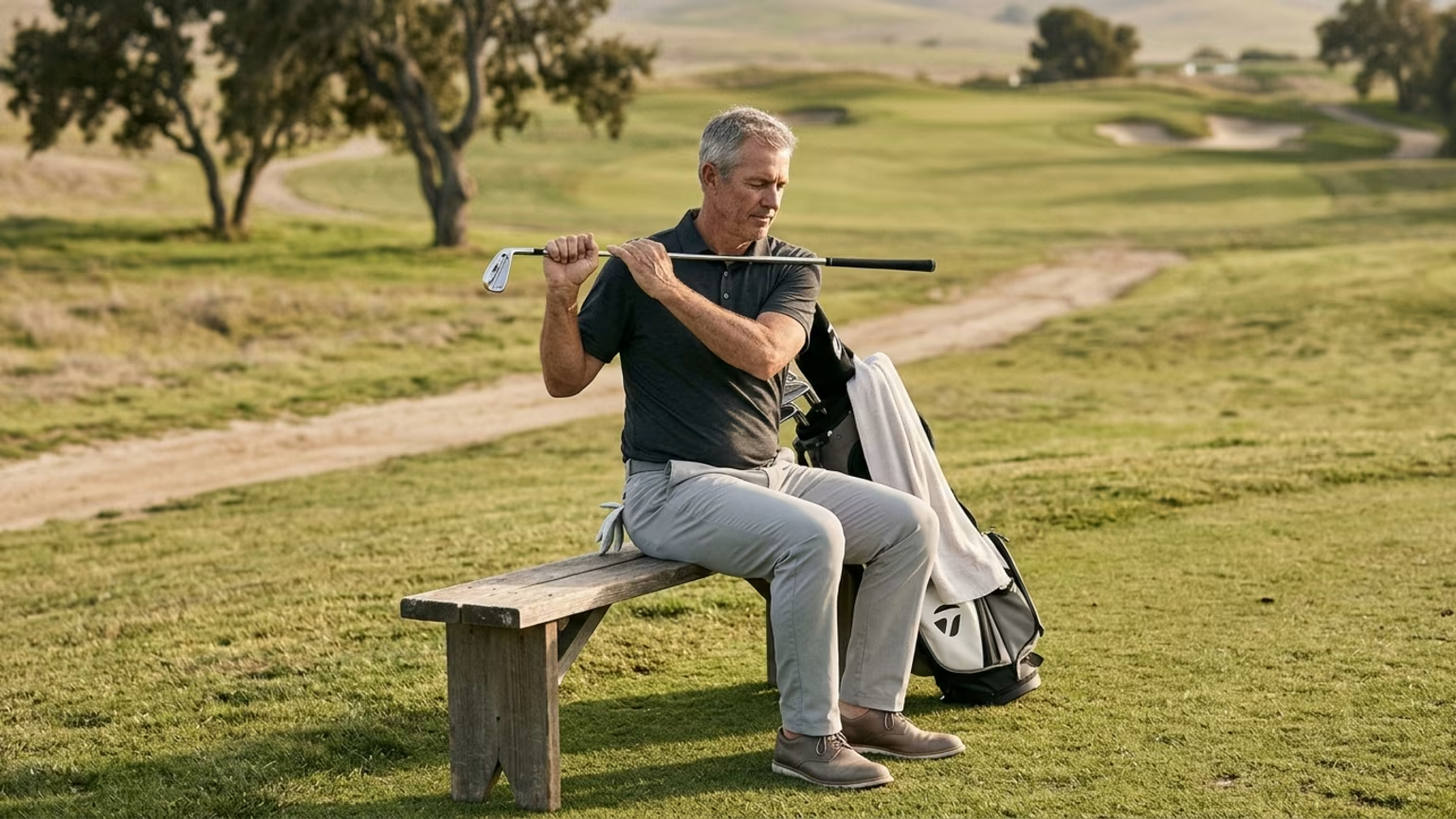

Learn functional movement checks for thoracic, hip, and ankle mobility to build strength and control in your golf swing without forcing extreme flexibility.




You step off the 18th green after grinding through a windy afternoon, and your lower back feels like it is locked in a vice. You head to the clubhouse, rubbing your stiff lead hip while hoping a cold drink eases the tension. You tell yourself tomorrow is the day you finally start a stretching routine. The instinct is completely natural, but throwing generic flexibility exercises at a golf-specific problem rarely works.
Golfers over 40 usually find themselves choosing between two distinct recovery paths. The first path is passive static flexibility, which focuses on forcing joints into deeper ranges of motion while the muscles are completely relaxed. The second path is usable swing mobility, which pairs functional range of motion with the strength and coordination needed to swing a golf club.
The conflict arises because aging joints naturally lose some elasticity. Players feel stiff and assume they need to stretch more aggressively to regain their youthful rotation. However, golf requires dynamic control of your body mass while swinging a club at high speeds. The choice comes down to chasing a general feeling of looseness versus building the specific stability your swing demands.
Passive flexibility has undeniable appeal for the aging golfer. It feels great after a tough round and helps restore baseline tissue length. Sitting on a mat and letting gravity pull you into a deep stretch can temporarily relieve tightness.
However, more range is not automatically better for your golf game. Excessive passive flexibility without underlying strength might not actually improve your mechanics. It can sometimes make a golfer feel less stable over the ball. A player may be able to stretch a joint quite far when relaxed on a mat. If they lack the strength to control that range, the joint cannot support the extreme forces of the downswing.
When I developed medial epicondylitis, commonly known as golfer's elbow, I thought I needed complete rest. Six weeks off the course did nothing to help. I finally learned that active recovery with a flexbar was the actual solution. It taught me that treating golf injuries requires loading the tissue properly, not just sitting on the couch and hoping for the best.
A mild stretch sensation is very different from sharp pain or joint locking. Aging players often mistake joint restriction for muscle tightness. They try to push through the stiffness on a yoga mat. Golfers with significant arthritis or recurrent back pain should seek assessment from a qualified health professional rather than repeatedly testing a painful range.
Usable mobility focuses on controlled movement rather than forced stretching. Golf-performance sources describe the ankles, hips, and thoracic spine as important contributors to rotation and balance. The exact amount of rotation needed varies widely based on individual anatomy and technique.
Let us look at a few functional checks that evaluate this usable control.
A golf-biomechanics source describes the lead ankle as needing progressive dorsiflexion during the downswing while the foot remains stable against the ground. You can check this capacity with a simple weight-bearing lunge test. Face a wall, keep the heel down, and gently drive the knee toward the wall over the second or third toe. Compare the distance achieved on both sides rather than treating a single score as a diagnosis.
A practitioner source also links heel lift during a deep-squat screen with possible ankle or calf restrictions. This same source reports that early-extension patterns are commonly seen alongside ankle mobility or pelvic-control limitations. If your ankle cannot handle the load, your pelvis often moves closer to the ball to compensate. Stop if the lunge movement causes pain rather than a mild stretch in the calf.
The thoracic spine manages a significant portion of your torso rotation. Practitioners commonly warn that limited mid-back rotation can encourage compensatory movement elsewhere. The lower back often takes on this extra stress when the mid-back refuses to turn.
You can test your thoracic control with a seated rotation check. Sit upright with your feet supported, cross your arms, and keep your pelvis facing forward. Rotate slowly to each side and watch for leaning or a large difference between left and right. This check reveals if you can turn your upper body without borrowing movement from your lumbar spine. A golfer who cannot rotate comfortably should begin with a smaller range.
Your hips must load during the backswing and clear smoothly through impact. Golf-physiotherapy sources identify restricted lead-hip internal rotation as one possible contributor to lumbar compensation. A restricted hip can force the lower back to twist excessively during the finish. Working on targeted hip mobility for golf can help protect the spine.
You can check this with a supported 90/90 position on the floor. Sit on a cushion with your legs at comfortable 90-degree angles and keep your torso upright. Gently rotate toward the front and rear legs while comparing left and right sides. Reduce the movement immediately if you feel pinching or sharp pain. You can use your hands on the floor for support if needed.
Balance in the golf swing is not simply the ability to stand on one leg. It is the ability to control your center of mass while the club accelerates. Insufficient ankle motion may make your pressure shifts feel abrupt or unstable. Insufficient hip control may lead to excessive pelvic rotation or swaying.
A useful finish check connects mobility to the actual swing. Make three half-speed practice swings and try to hold the finish for three seconds. You should be able to arrive balanced with most pressure on your lead side. If your balance deteriorates quickly, reduce your swing length before adding mobility drills or resistance.
Which approach does a better job of keeping you on the course for the next ten years? Usable mobility wins this battle easily. A complete longevity-focused program should combine aerobic activity with strength and balance work. Relying on mobility drills alone leaves your joints vulnerable to the violent forces of the golf swing.
One practitioner recommends a smart three-step progression for aging players. First, restore passive mobility. Next, build strength in the newly available range. Finally, train coordination so the golfer can actually use it during the swing. This approach builds a foundation for an age-proof golf swing that holds up under pressure.
Golf provides excellent walking and outdoor activity. Still, building joint stability requires dedicated, targeted effort. If you find yourself constantly losing posture during your swing, you likely need a solid mobility plan that emphasizes stability over pure stretching.
Choose passive stretching to relax tight muscles after a long round, but choose active usable mobility for long-term swing health. Knowing your physical limitations allows you to adapt your warm-up and protect your joints. Keep your movement checks simple, listen to your body, and focus on building strength within your available range. Consistent, controlled movement is the true secret to playing great golf well into your later years. Here is to better movement and lower scores with golfergy.
Follow Golfergy for practical insights on performance, mobility, recovery and healthy ageing. Stay connected for new articles, research-led guidance and ideas to help you play better for longer.


The 2027 PGA Show is expanding its Performance Zone. Learn why the golf industry's shift toward fitness and recovery matters for players over 40.

Brooks Koepka called his 2026 PGA Tour return pathetic after struggling with his putting. Learn how older players can track performance to maintain consistency.

Learn why dynamic stability and neuromotor fitness matter for older golfers. Find practical habits to adapt to uneven lies and protect your aging joints.
Explore practical resources on performance, recovery, mobility and golf longevity.
Read the Blog