An XPRIZE stem cell trial for frailty highlights the value of mobility. Learn why older golfers must build walking endurance to protect their game.




In August 2026, Longeveron was named one of 20 finalists in the XPRIZE Healthspan competition. The Miami-based biotechnology company received a $1 million milestone award for its work. Longeveron developed laromestrocel for clinical testing after licensing technology from the University of Miami. Researchers at the University of Miami Miller School of Medicine helped build the scientific foundation for this investigational cell therapy.
XPRIZE Healthspan is a $101 million competition aimed at extending the healthy and fully functional period of human life. Physician Joshua Hare is the director of the University of Miami Interdisciplinary Stem Cell Institute and a scientific co-founder of Longeveron. He noted that the XPRIZE catalyzed humans landing on the moon and is now attempting to catalyze treatments for aging. Hare stated that reducing aging-related frailty might translate to extending the healthspan of older adults.
Longeveron plans to use the milestone award to support a randomized clinical study. The planned research will evaluate the effects of laromestrocel on physical, cognitive, and immune function. Enrollment for this new study is expected to begin in the summer of 2027. Finalist teams are expected to submit their data for independent judging in 2029, and the winner of the potential $81 million prize will be announced in 2030.
The planned XPRIZE study is distinct from the completed Phase 2b trial. The earlier research primarily supplied evidence on physical function and mobility in a specific population. The newly planned study is intended to examine physical, cognitive, and immune outcomes together for a broader understanding of aging. This comprehensive approach reflects a modern model where healthspan involves several interacting dimensions of function.
The physical mechanics behind age-related frailty involve a gradual decline in cellular repair systems. Older golfers often experience early signs of this decline as lingering fatigue or stiffness after a round. The body slowly loses its ability to repair minor tissue damage and maintain steady immune efficiency. Researchers are testing interventions to see if cellular therapy can support these natural systems when functional capacity drops.
Laromestrocel is based on adult bone-marrow-derived mesenchymal stem cells. The working model for this therapy suggests that these stem cells do not remain in the body permanently. University of Miami researchers propose that the cells release specific factors that influence their surrounding environment. They believe these released factors might modulate immune activity, support blood vessels, and promote tissue repair.
This proposed mechanism offers a scientific rationale for how a short-term cellular intervention might yield longer-term functional benefits. The therapy targets the cellular environment rather than attempting to mechanically rebuild joint cartilage or muscle tissue directly. Maintaining a healthy internal environment is critical for preserving movement quality and walking endurance as we age.
The clinical evidence supporting the finalist position of Longeveron came from a randomized Phase 2b dose-escalation trial. This completed study involved 148 adults aged 70 to 85 who lived with mild or moderate frailty. Participants received a single intravenous infusion of either a placebo or laromestrocel. The doses administered ranged from 25 million to 200 million cells per patient.
Researchers used the six-minute walk test as the primary functional measure for the trial. Joshua Hare described this test as an excellent measure of functional capacity, quality of life, and general health. It accurately reflects whether an older person can walk a normal distance without stopping. At nine months, the modeled dose-response result showed a 63.4-meter improvement in walking distance compared with the placebo.
The 95 percent confidence interval for this improvement ranged from 17.1 to 109.6 meters. The earlier data points in the trial revealed a more cautious timeline for the observed benefits. At six months, the estimated walking improvement was 41.3 meters compared to the placebo group. The confidence interval crossed zero at this stage, meaning the result did not meet the conventional statistical threshold for significance.
A University of Miami report stated that earlier studies also found improved walking performance, and fewer participants were classified as frail nine months after treatment. While the functional outcomes offered promising signals, the full safety profile remains under review. The University of Miami report does not provide a trial-specific adverse-event table for these earlier studies. It also omits rates of serious adverse events, participant discontinuations, or mortality outcomes from the published summary.
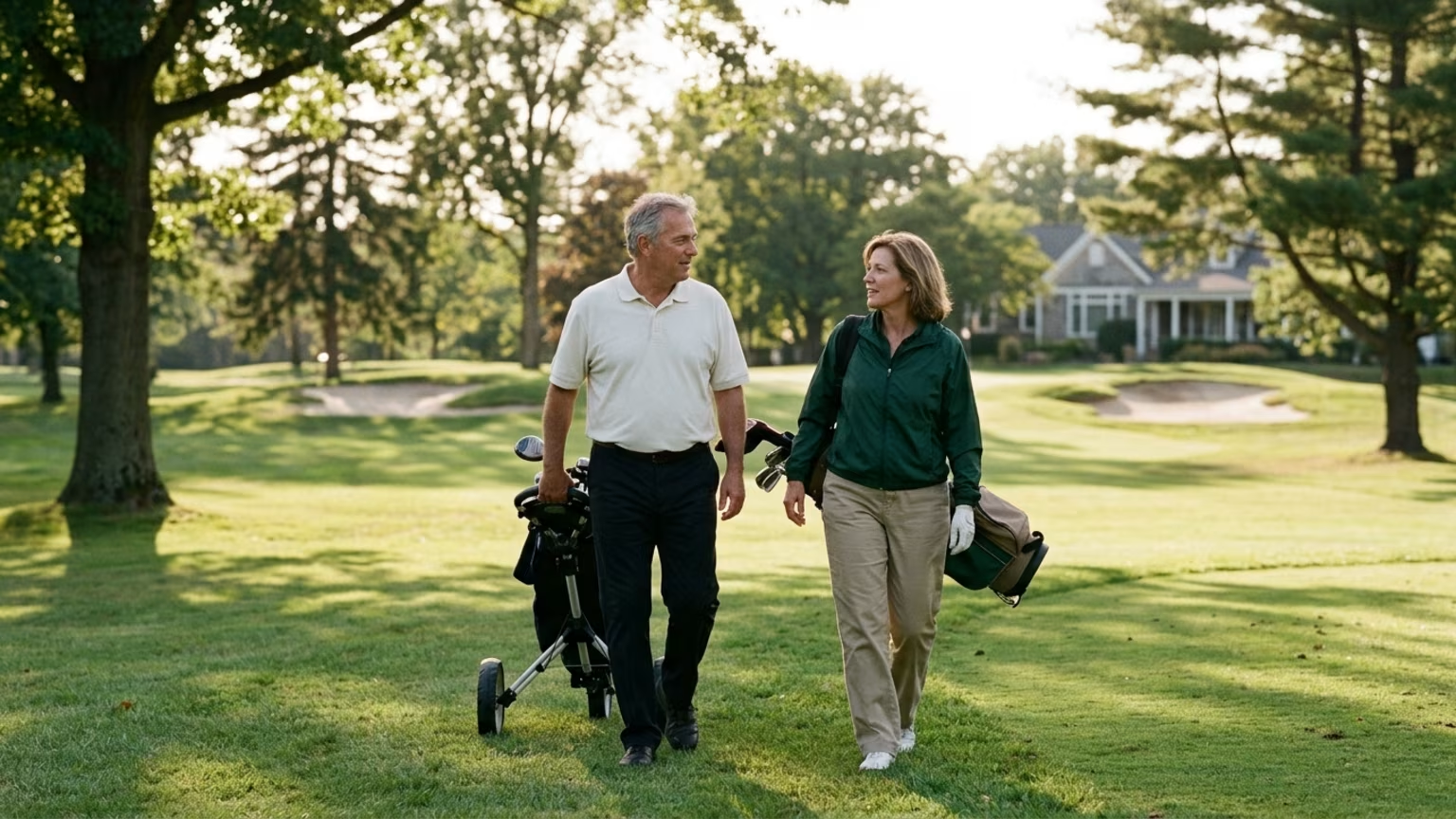
The trial population consisted of adults over 70 with mild or moderate frailty. You cannot directly generalize these findings to healthy recreational golfers in their 40s, 50s, or 60s. Aging players face a continuous shift in physical capacity that threatens their stamina. Walking an 18-hole course requires sustained lower-body endurance, joint resilience, and consistent aerobic energy.
When functional capacity declines, a golfer becomes highly vulnerable to injury and exhaustion. A loss of walking endurance directly impacts performance on the back nine of a round. Muscle fatigue limits rotational flexibility and alters swing mechanics, forcing the body to compensate with awkward movements. Lower-body endurance acts as the foundation for a repeatable golf swing late in the afternoon.
When the legs tire, the upper body attempts to generate power through forced rotation, which strains the lower back. Older players may swing with less speed than professionals, but their joints still absorb substantial rotational stress during every shot. Preserving the ability to walk comfortably is a mandatory requirement for enjoying the game over the long term. If you cannot walk the fairway, climb modest inclines, and recover between holes, your playing years will be severely limited.
Researchers are increasingly measuring aging through these exact metrics of preserved physical function. Protecting these metrics protects your scorecard over the years.
A sensible longevity plan prioritizes established health habits rather than waiting for experimental treatments to reach the market. Golfers who want to extend their playing years should adopt a combined approach to strength and mobility. Progressive strength training builds the lower-body muscle mass needed to navigate a hilly course without pain. Aerobic conditioning prepares your cardiovascular system to deliver oxygen efficiently during a four-hour round.
Adding dedicated practice to stay steady on the course will further protect your physical foundation against age-related decline. You can use functional capacity as a highly practical training target in your own weekly routine. The six-minute walk test serves as an excellent benchmark for clinicians to track mobility and endurance over time. Try tracking your own ease of movement during your rounds to monitor your functional resilience.
Baseline strength, muscle mass, and general health will keep you capable while longevity therapies remain in the experimental phase. A golfer should never interpret a personal struggle with a six-minute walk test as a diagnosis of frailty or a prediction of treatment response. Instead, use these observations as a signal to adjust your training volume and prioritize adequate recovery. Focus entirely on maintaining your baseline strength and walking ability to stay active while medical research continues to evolve.
When practicing your balance and mobility exercises, focus entirely on engaging your lower body before rotating your shoulders. If you experience persistent fatigue or a noticeable decline in your physical function, seek a proper medical evaluation. A strong baseline will always be your best defense against early frailty.
The XPRIZE finalist designation represents a significant push toward extending healthy human function. It does not represent regulatory approval, clinical adoption, or definitive proof that laromestrocel cures aging. The 63.4-meter walking improvement comes from a single reported clinical program analyzing frail adults. It should not be interpreted as evidence that stem cell therapy broadly improves frailty or extends healthy life for everyone.
The available evidence does not establish that this therapy improves golf swing speed, clubhead speed, or course management skills. Researchers have not shown that being fitter makes someone more likely to benefit from laromestrocel in the future. The planned XPRIZE study has not yet reported its final sample size, treatment arms, or safety-monitoring plan in the University of Miami article.
The most critical lesson for golfers is to avoid seeking out unapproved stem cell treatments for athletic enhancement. The reported results are preliminary signals of mobility preservation rather than conclusive proof of extended healthy life. The appropriate response to this research is cautious optimism regarding the future of longevity medicine.
Medical science is shifting its focus toward preserving overall function rather than just treating isolated diseases. Your ability to walk, balance, and recover will dictate how long you can comfortably play the game. What adjustments will you make to your mobility routine this season to steer clear of this hazard?
Follow Golfergy for practical insights on performance, mobility, recovery and healthy ageing. Stay connected for new articles, research-led guidance and ideas to help you play better for longer.


A practical strength framework for golfers over 40, built around everyday goals, sensible progression and a careful look at limited golf research.


A research-led look at strength, balance, mobility and trunk control, with a flexible planning framework for golfers over 40.
Understand golf mobility after 40 with a comfortable-turn self-check, hip and shoulder guidance, and a clear look at flexibility and swing speed.
Explore practical resources on performance, recovery, mobility and golf longevity.
Read the Blog