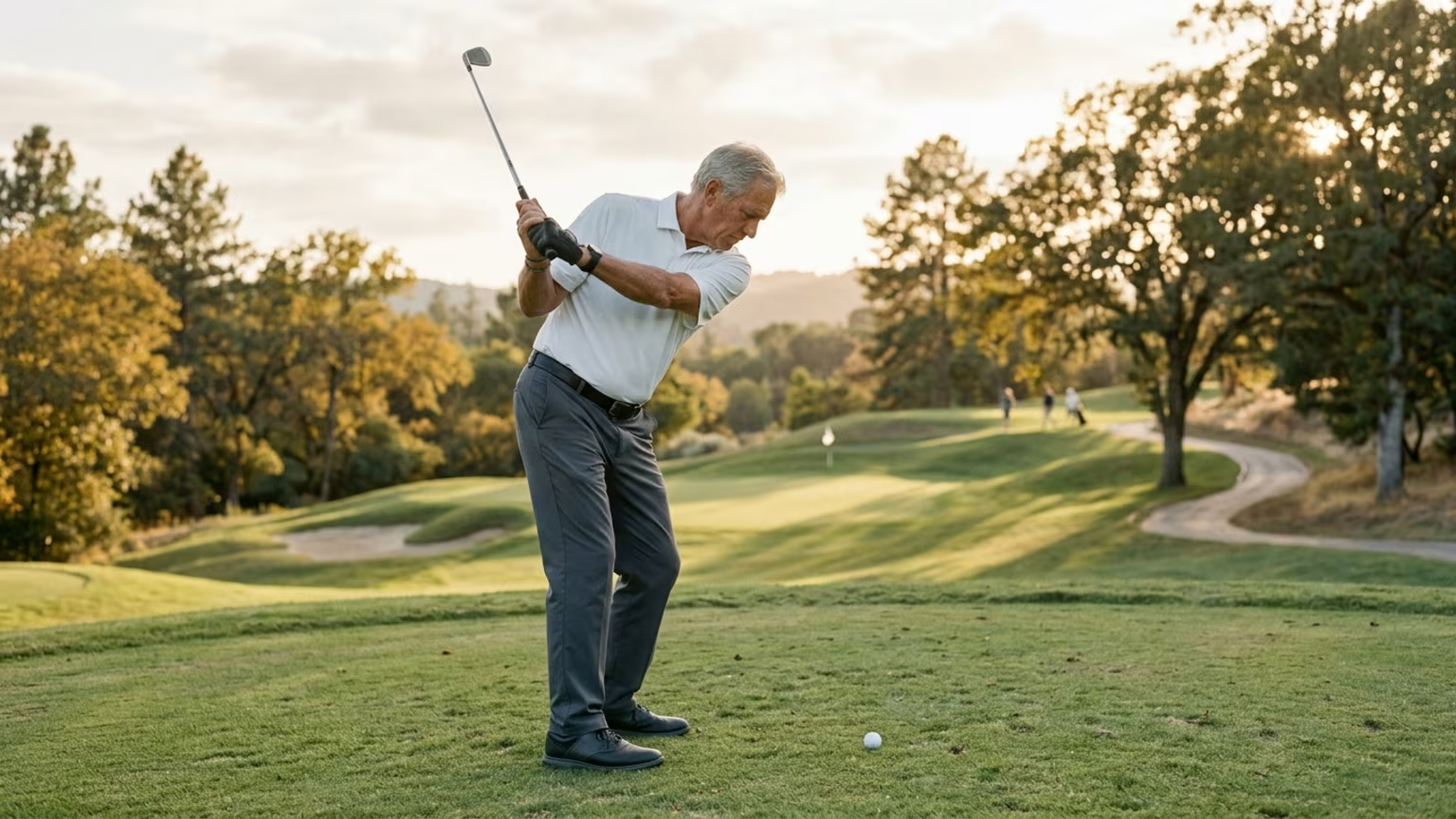

Explore the science of balance as a trainable physical capacity. Learn how older golfers can improve dynamic stability and functional mobility on the course.




A systematic review recently reported that perturbation-based balance training was associated with a 23% reduction in fall rates in older adults. It also showed a 24% reduction in injurious falls in the same population. This matters because it proves that physical stability is not a fading trait you must accept. It is a highly trainable capacity that can keep mature golfers steady on challenging terrain.
Your vision provides a clear reference point to the horizon. The proprioceptive system includes sensors in your joints and muscles that detect changes in ground pressure. Your vestibular inner ear system senses head rotation and tilt. By strengthening these systems together, golfergy readers can improve dynamic stability and functional mobility.
The 4-step stability protocol for older golfers:
Before starting any physical routine, you need to know your starting point. Understanding your baseline is vital when assessing your golf fitness. Stand next to a sturdy wall or heavy golf bag for safety. Place your hands lightly on the support surface.
Lift one foot slightly off the floor and hold this position for 10 seconds. Notice if your standing ankle wobbles or if you immediately rely on your hands. Try this on both legs to see if one side is notably weaker. This gentle test reveals how your visual, proprioceptive, and vestibular systems are currently working.
A 2026 systematic review found that sensorimotor-based interventions improved both dynamic and static balance in older populations. The review reported a large standardized effect for dynamic balance measured with the Timed Up and Go test, g = -0.89. It also noted a large effect for static balance measured with the Berg Balance Scale, g = 0.94. You can train these systems using simple movements at home.
Phase one focuses on the feet and ground connection. Stand near a wall and perform a three-point foot check. Focus entirely on feeling pressure under your heel, the base of your big toe, and the base of your little toe. Do this on both feet without rolling to the outside edges.
Next, practice an athletic address hold to build muscular endurance. Take your normal golf posture and soften your knees. Hinge forward from the hips and hold this position for 10 to 20 seconds. This builds endurance in the muscles that stabilize your trunk.
Now you can add controlled pressure shifts to simulate a golf swing. Move your weight slowly until roughly 55% is on your trail side. Slowly shift until 55% is on your lead side. Keep your upper body still while your legs do the work.
Once the basic positions feel comfortable, you can add golf-specific movement. Try a single-leg support drill by lightly touching a counter or golf club for support. Hold this position for 10 to 20 seconds per side, and then add a slow torso turn. This safely introduces rotation while challenging your static limits.
Next, try the step-and-swing drill. Step toward a target, plant your lead foot, and make a controlled half swing. This movement trains the timing of pressure transfer without demanding full speed. It prepares your lower body to handle the momentum of the clubhead safely.
Golf is a mental game that requires precise physical execution. A review of 23 randomized controlled trials involving 1,674 participants found improvements in functional mobility from dual-task training. While holding your address position, count backward by ones or recite a simple phrase. This trains your brain to maintain a stable stance while handling cognitive demands.
Mean adherence across these studies was 80.82%, showing that these tasks are highly accessible. You can also incorporate proven functional movements into your routine. An updated systematic review of the Otago Exercise Program reported improvements in several physical-function measures associated with fall risk.
These measures included the Timed Up and Go and the Berg Balance Scale. It also improved the Short Physical Performance Battery, 30-second sit-to-stand, and Falls Efficacy Scale-International. Adding simple sit-to-stand exercises from a chair builds the leg strength required for a solid base. Practicing calf raises near a wall also builds crucial ankle strength.
This approach prioritizes stability over brute force for older players. Programs involving at least six hours of perturbation training reduced falls by 33% in a dosage subgroup. Most typical programs delivered approximately two hours. Consistent, modest practice is highly effective over time.
Many enthusiastic golfers make the mistake of progressing too quickly with balance training. They see tour professionals standing on unstable foam pads and try to mimic them immediately. The available evidence does not justify claims that unstable equipment is automatically better. Starting on unstable surfaces can actually increase your risk of injury.
Another common error is closing your eyes during balance drills. Visual input is a primary contributor to human balance. Removing your vision sharply increases the difficulty and creates unnecessary danger. Always keep your practice area well lit and focus your eyes on a clear target.
Some players try to replace traditional practice with novel formats like video games. A review of exergaming interventions in adults aged 60 and older included nine studies involving 1,385 participants. Compared with usual care, exergaming was associated with fewer people experiencing one or more falls at 12 months, with a risk ratio of 0.75. However, the authors noted substantial heterogeneity and limited evidence for several other outcomes.
You can trigger the benefits of this training seamlessly while out on the fairway. When you face an uneven lie, take a slightly wider stance and shorten your swing. Perform a slow rehearsal swing while actively feeling the pressure in your feet. This brief check confirms you can complete your rotation without losing control.
These simple exercises fit perfectly into a weekly healthy ageing routine. A prospective analysis spanning four cohort studies in 15 countries found that hobby engagement was associated with lower frailty among adults aged 65 and older. The association appeared to plateau beyond modest engagement frequency. By checking your stability before a tough shot, you protect your body and enjoy the game longer.
You do not have to accept physical decline or fear the uneven lies on your favorite course. The research proves that your nervous system can learn to manage unexpected shifts. The 5-minute investment today that saves you 18 holes of aches tomorrow is well worth the effort.
Follow Golfergy for practical insights on performance, mobility, recovery and healthy ageing. Stay connected for new articles, research-led guidance and ideas to help you play better for longer.


A practical strength framework for golfers over 40, built around everyday goals, sensible progression and a careful look at limited golf research.


A research-led look at strength, balance, mobility and trunk control, with a flexible planning framework for golfers over 40.
Understand golf mobility after 40 with a comfortable-turn self-check, hip and shoulder guidance, and a clear look at flexibility and swing speed.
Explore practical resources on performance, recovery, mobility and golf longevity.
Read the Blog


