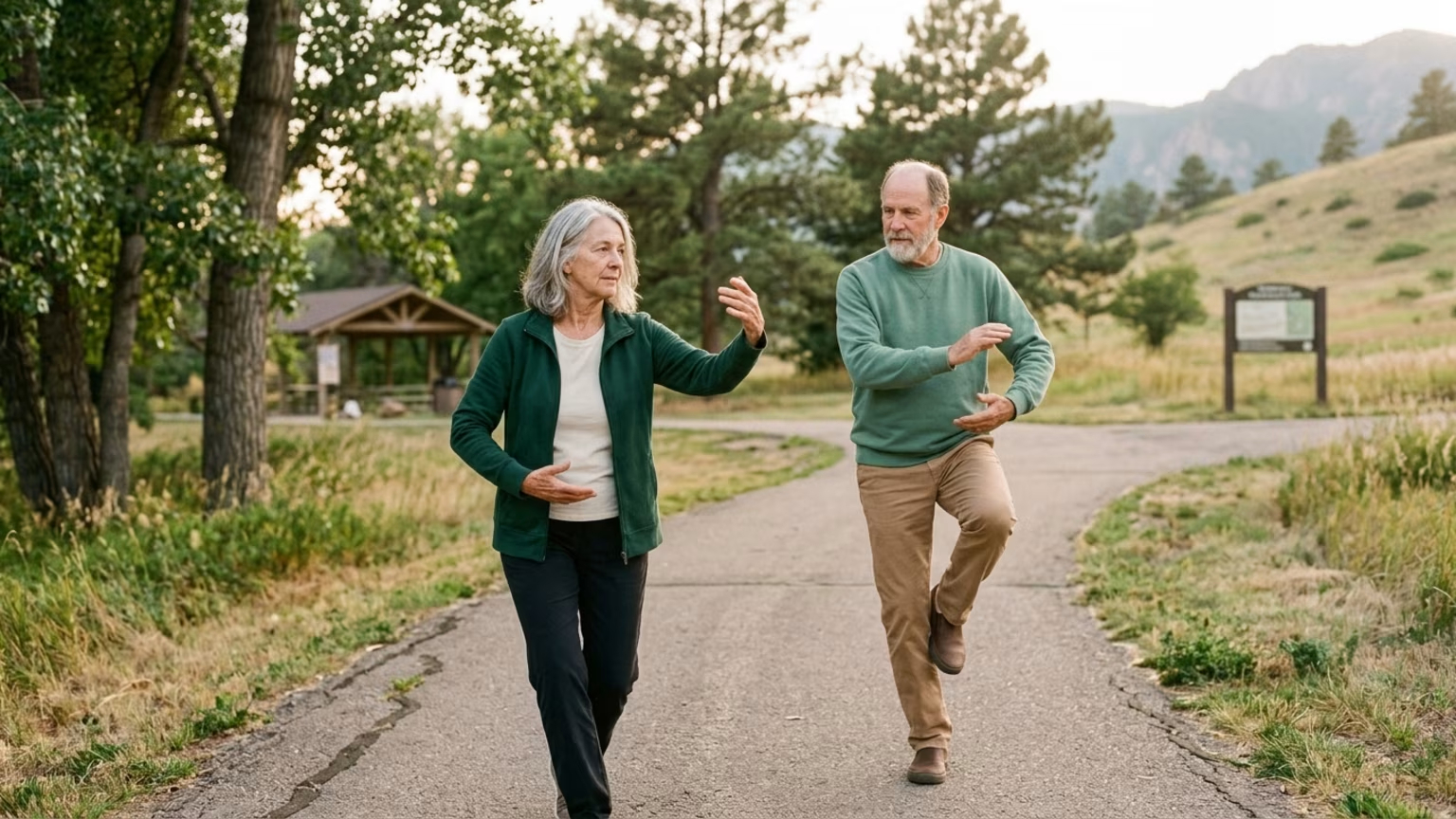

Learn how DLR research on masters athletes helps older golfers maintain lower limb strength, rotational stability, and consistent swing mechanics.




Healthy aging in golf is not the pursuit of eternal youth, but rather the deliberate preservation of your physical function over time. Biological decline is not a predetermined cliff edge that ruins your swing at age fifty. It is a slow, measurable shift in physical capacity that you can actively manage. The German Aerospace Center (DLR) is currently studying this concept through its Track and Field Masters Athletic Cohort (TaFMAC) Study.
This project is a 10-year international field study examining fitness, training, and health in competitive masters athletes. Researchers use longitudinal designs to follow athletes over a long period. This method helps them understand how the human body adapts to continued exercise. DLR defines masters athletes as competitive athletes who continue training and competing beyond the age considered mature for their sport.
This group is scientifically valuable for understanding human longevity. Many older athletes retain relatively high levels of physical performance, cognitive health, and overall wellbeing. They maintain these qualities alongside the natural decline normally seen in aerobic fitness and muscle strength. This preservation also applies to flexibility, balance, and vascular function.
Maintaining your physical function dictates exactly how you feel on the back nine. A preserved aerobic base means walking up a steep fairway does not drain your energy. Your legs stay fresh for the next tee shot, and your heart rate recovers quickly. A recent scoping review summarized in the available research found that endurance training supports a strong aerobic capacity.
The review noted that lifelong endurance training was associated with low adiposity and strong aerobic capacity. Endurance work alone does not solve every physical problem for older adults. The review reported that lifelong endurance training did not fully prevent lower muscle mass, motor-unit loss, or age-related reductions in power. The golf swing requires significant force production, rotational stability, and movement speed.
A golfer must generate power from the ground up. The scoping review found that strength and sprint athletes showed greater appendicular lean mass, maximal strength, and explosive force than endurance athletes. These athletes also demonstrated better type-II-fibre preservation. These fast-twitch muscle fibers help you transfer weight efficiently and generate clubhead speed during a round.
You cannot rely exclusively on walking the course to protect your swing mechanics. You must actively maintain your lower limb strength and functional mobility. A comprehensive routine helps you manage mid-round fatigue and tightness on the golf course.
Physical changes begin to compound naturally as golfers pass age 40 and 50. Muscle tissue becomes less responsive to ordinary daily activities. The TaFMAC project aims to examine how fitness, training, and health change over time. Researchers want to identify which specific factors may help preserve physical function and reduce disease risk with age.
The DLR article notes that older age can involve accelerated physiological decline. This natural decline often targets the very attributes older golfers need most. The scoping review found that masters-athlete studies reported lower rates of confirmed sarcopenia than those reported in community-dwelling older populations. Sarcopenia is the age-related loss of skeletal muscle mass and strength.
When older adults lose this muscle mass, they often lose postural control and balance on the course. A weak lower body forces the upper body to compensate during the golf swing. DLR is also examining parallels between aging and microgravity. The researchers connect healthy aging with aerospace medicine to understand human resilience.
They use the shared physiological challenges of aging and spaceflight to investigate muscle, bone, cardiovascular, and metabolic function. Both older age and spaceflight create significant physiological stress. Masters athletes and astronauts use structured interventions to preserve physical function under this heavy stress.
The TaFMAC researchers collected new data at the 2026 World Masters Athletics Championships in Daegu, South Korea. The testing programme included aerobic capacity, muscle strength, cardiovascular and vascular function, and lung function. The study is led by the Department of Metabolism and Human Performance at DLR's Institute of Aerospace Medicine. It also features direct collaboration from the Department of Cardiovascular Aerospace Medicine.
International partners named by DLR include the University of Texas at Austin and the University of Saskatchewan. Brandon University and California State University, Bakersfield are also involved. The project also partners with Juntendo University, Yonsei University, Yeungnam University, and Keimyung University. A DLR symposium associated with the Daegu championships addressed healthy aging and the preservation of human function across the lifespan.
This event featured Professor Dominik Pesta of DLR and the University of Cologne. It also featured Professor Hiro Tanaka of the University of Texas at Austin. DLR explicitly cautions that masters athletes do not demonstrate how to stop aging. Instead, these athletes show how much physical function can be preserved over time.
The scoping review further concluded that continued training after elite retirement appeared more important than historical elite status alone. This means recreational golfers can benefit from ongoing habits rather than worrying about their past athletic achievements. The focus should be on practical training over a long period.
A 2026 narrative review of exercise for fall prevention investigated movement habits for older adults. This review reported that the most consistent evidence favored regular, progressive, and individually tailored programmes. These effective routines combine balance, functional, and strengthening exercises. Building a weekly healthy ageing routine helps older golfers implement these scientific findings safely.
The review reported improvements in static and dynamic balance, lower-limb strength, and functional mobility. It also noted gains in postural control, gait, and fall-prevention self-efficacy. Golfers can apply these concepts with a simple split squat to build lower limb strength. Stand with one foot forward and one foot back.
Lower your hips straight down toward the ground. Focus entirely on pushing through your lead heel to return to the starting position. You can also train your balance with basic single-leg standing drills. Stand near a wall or a sturdy chair for safety.
Lift your trail leg slightly off the ground. Focus entirely on keeping your standing foot flat against the floor. This targeted practice builds the stability needed for dynamic weight shifts in the golf swing. Understanding the difference between general mobility vs. flexibility can further refine your exercise choices.
Consistency matters far more than intense effort for older adults. You do not need to train like a competitive sprinter to see physical benefits. You simply need to maintain a realistic weekly routine over several years. Studying how to slow biological aging is about consistent input rather than searching for an immediate cure. Preserving your physical capacity is the quiet mechanism that keeps you playing better for longer.
Follow Golfergy for practical insights on performance, mobility, recovery and healthy ageing. Stay connected for new articles, research-led guidance and ideas to help you play better for longer.


A practical strength framework for golfers over 40, built around everyday goals, sensible progression and a careful look at limited golf research.


A research-led look at strength, balance, mobility and trunk control, with a flexible planning framework for golfers over 40.
Understand golf mobility after 40 with a comfortable-turn self-check, hip and shoulder guidance, and a clear look at flexibility and swing speed.
Explore practical resources on performance, recovery, mobility and golf longevity.
Read the Blog


