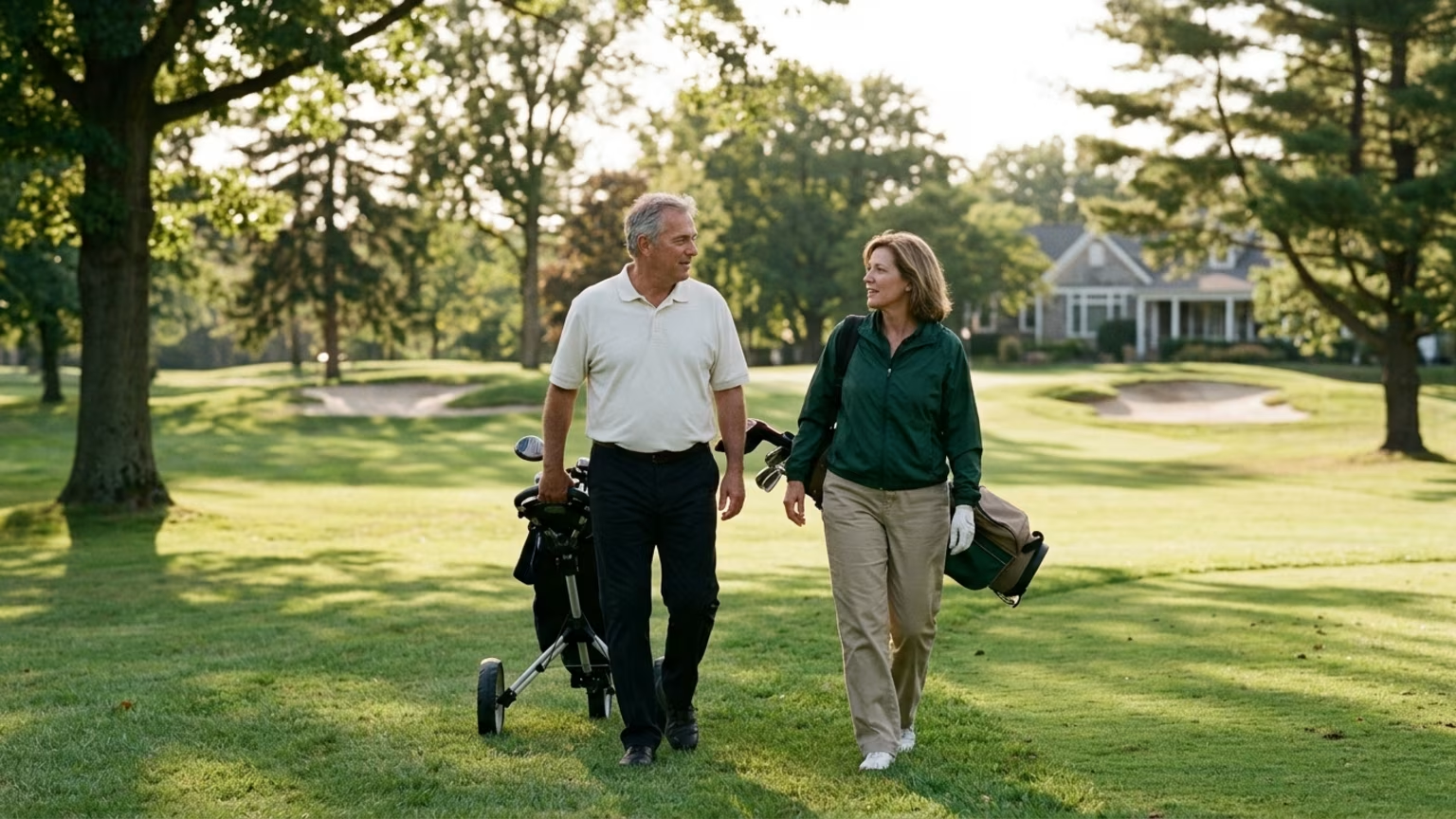
Physical therapist Jacqueline Hooton recommends standing marching exercises for older adults. Learn how this upright core routine helps older golfers improve balance.




On October 7, 2026, Women’s Health UK published an article featuring Jacqueline Hooton. The publication identifies Hooton as a 63-year-old physical therapist, healthy-ageing coach, and founder of the Her Garden Gym training platform. She recommends standing marching core exercises for older adults as a practical way to train balance without hitting the mat. Many older players find floor work uncomfortable or impractical for their daily fitness routines.
Hooton says these upright marching movements have functional carryover because the core stabilizes the body during movement. When you perform a standing march, your trunk muscles must fire to keep your spine steady as you lift each leg. This action mimics the physical demands of walking, climbing stairs, and carrying heavy items across the yard. Your core acts as a central anchor that controls your shifting center of gravity with every step.
Instead of isolating one muscle group on a mat, standing marches force your entire midsection to work together. Women’s Health UK reports that an unidentified 2021 study found distinct benefits from step-marching exercises in older adults. The research showed improvements in lower-limb strength, balance, and fear of falling. When you train your core in a standing posture, you prepare your body for upright athletic tasks.
A strong core provides the braking system for your golf swing. When your club reaches the end of its follow-through, your trunk muscles must decelerate your torso safely. If those muscles lack upright coordination, your lower back takes the brunt of the rotational force. Standing core work trains these muscle groups to fire together while you are on your feet.
A separate report in Sports Medicine Weekly highlights the physical profile of older players. The report describes a 2023 cross-sectional comparison of recreational golfers aged 65 to 79 against sedentary peers. Researchers found that the golfers demonstrated higher grip strength and better static and dynamic balance. However, the study design cannot show that playing golf actually caused those specific differences.
It simply shows an association between the active golfers and better physical test scores. Still, the physical demands of playing 18 holes require a solid baseline of balance and muscle control. You need adequate functional physical capacities for safer, longer play to manage uneven lies and sloped fairways. Standing core exercises offer a targeted way to support those athletic traits away from the course.
Golfers over 40 face a gradual decline in balance and core stability as they age. Your body relies heavily on rapid muscle contractions to maintain its posture during dynamic athletic movements. As you get older, your trunk muscles often lose some of their ability to fire quickly and brace your spine. This loss of stability becomes obvious when trying to hold a balanced finish after an aggressive golf swing.
A weak core forces the lower back to absorb forces it was not designed to handle. Maintaining a stable posture is crucial to protect your spine and stay pain-free on the golf course. Standing exercises specifically address this vulnerability by challenging your balance in an upright posture. Hooton considers the addition of a dumbbell-balance challenge especially relevant with age.
When you hold a weight while marching, your core must actively resist the downward pull of gravity from one side. This offset load forces your trunk muscles to engage intensely to keep your torso perfectly straight and upright. For players over 40, this type of training builds the exact stability needed to support the lower back during the golf swing.
The Women’s Health UK article presents four progressively more challenging marching variations to build this stability. The routine includes the suitcase march, overhead march, overhead suitcase march, and crossbody march. Each variation changes how the weight challenges your balance and trunk control. The publication suggests trying each exercise for 30 to 40 seconds to build muscular endurance.
The suggested starting point is Level 1, which focuses purely on the basic suitcase march. To perform this format, march in place while holding a single dumbbell at your side like a suitcase. The routine calls for 30 seconds of work per side, resting for 15 seconds between sides for three total sets. Keep your chest tall and focus entirely on controlling your posture as your knee lifts.
Moving slowly is much better than rushing through the march. The goal is not to raise your heart rate or break a massive sweat. The focus is purely on testing your balance and forcing your core to maintain a rigid posture. Taking your time forces your trunk muscles to do the heavy lifting.
You must avoid leaning away from the weight as you shift your balance from foot to foot. The article says the overhead march variation may help reduce back pain. However, it offers no exercise-specific trial or other evidence for that outcome on the page. You should progress slowly and master the basic suitcase march before raising any weights above your head.
Rushing into complex overhead movements can compromise your form and strain your lower back. Building a strong foundation step by step is the best way for older golfers to build a strong base to avoid pain.
Many older players believe that sit-ups, planks, and crunches are the only proven ways to build core strength. The article argues that standing exercises more closely resemble everyday movement than those traditional floor moves. Getting up and down from the ground can be tough on the knees, hips, and lower back. Standing marches offer an accessible alternative that keeps you firmly on your feet while still challenging your midsection.
This does not mean you must abandon all mat work if you already find it helpful. Women’s Health UK acknowledges that planks and crunches still have a place in a well-rounded fitness routine. If you enjoy floor exercises and can perform them without pain, they remain a useful tool for building endurance. But standing marches provide a clear path to building functional strength for those who prefer to train upright.
Maintaining your balance and core control is critical for enjoying the game as you get older. Upright training variations allow you to build stability in a highly functional position without unnecessary joint stress. What adjustments will you make to your mobility routine this season to steer clear of this hazard?
Follow Golfergy for practical insights on performance, mobility, recovery and healthy ageing. Stay connected for new articles, research-led guidance and ideas to help you play better for longer.


A practical strength framework for golfers over 40, built around everyday goals, sensible progression and a careful look at limited golf research.


A research-led look at strength, balance, mobility and trunk control, with a flexible planning framework for golfers over 40.
Understand golf mobility after 40 with a comfortable-turn self-check, hip and shoulder guidance, and a clear look at flexibility and swing speed.
Explore practical resources on performance, recovery, mobility and golf longevity.
Read the Blog