

A movement-led golf warm-up for golfers over 40, with a flexible example, practical adaptations and clear limits on injury-prevention claims.




Chasing a deeper stretch before the first tee misses the point of a golf warm-up. The aim is to prepare for a swing, not to pass a flexibility test beside your golf bag.
For golfers over 40, that is a useful change of focus. A warm-up does not need to become another workout or a contest with your younger self. Golfergy's view is simpler: use movement to build toward the golf you are about to play.
The advice to “stretch until you feel loose” makes flexibility the whole assignment. For a mature recreational golfer, that leaves out the task ahead: moving through a swing. A routine made only of held positions contains no practice of that action.
This is not a case for declaring every static stretch harmful. It is a case for giving moving preparation the leading role before play.
A published summary of a 23-study review reports that dynamic and resistance-based warm-ups tended to improve golf-performance measures. That supports a movement-led approach rather than making long static holds the centre of the routine.
An account of a 2004 study describes 10 male golfers who performed a golf-specific warm-up and 10 matched controls. The researchers measured clubhead speed in a laboratory. The authors reported improved performance after an intervention that combined warming up before testing with repeated practice over five weeks.
The evidence has clear boundaries. The review's injury findings were mixed and inconclusive. The small study did not measure injury rates or playing longevity. Its results do not establish a typical benefit for older golfers or a single warm-up before one round.
The movement example below comes from senior-golf guidance rather than a validated universal protocol. The evidence sets no ideal duration or tested adjustments for weather and daily readiness. Those choices are practical editorial judgments, not study findings.
The real planning problem is not proving that you can reach farther. It is making space between being still and asking for a golf swing. That is a gap a movement-based warm-up can address without claiming to identify the cause of stiffness.
Golfergy's approach is to keep the job narrow: prepare for the next activity. Trying to fix every movement concern beside the first tee asks too much of one short routine. Work on broader questions about balance and control belongs in a wider plan.
That changes the question from “Am I flexible enough?” to “Have I built toward the movement I am about to make?” It also removes the need to judge the warm-up by how deep a stretch feels.
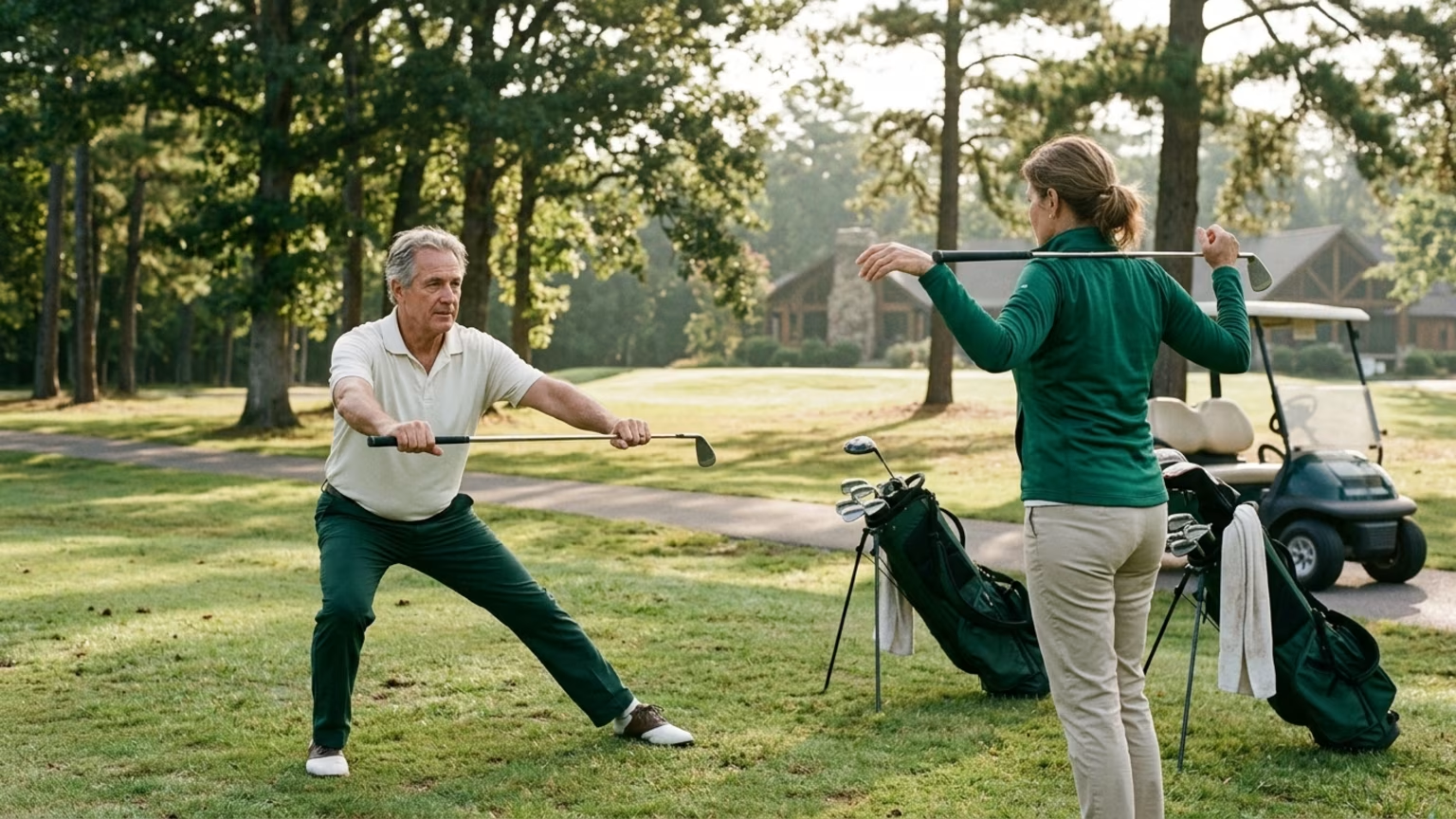
A sustainable habit needs a clear purpose, not a long exercise menu. Golf guidance for senior players describes trunk turns and supported leg swings before progressively faster practice swings. The example here follows that pattern and begins with easy movement.
Each stage has one focus. There is no need to think about your hips and shoulders and swing speed at the same moment.
Easy movement starts the sequence. This stage is about getting moving before the more golf-specific work. Keep the aim modest rather than turning the opening into a test of fitness.
Controlled trunk turns come next. Focus on the turn itself rather than trying to reach a new end position. In this example, the movement is rehearsal rather than a measure of your flexibility.
The senior-player guidance also includes supported leg swings. Keep attention on that single leg movement before moving to the next part of the routine. The point is a clear sequence, not several actions competing for attention.
Practice swings then build gradually in speed. This is the most direct link to the shot ahead: moving toward the action you intend to use on the tee. The warm-up is preparation for that swing, not a separate attempt to produce your fastest possible swing.
That order is the useful takeaway. Easy movement leads into golf-relevant motions and then swing rehearsal. Golfergy's guide to a movement-first pre-round progression offers related reading on organising that transition.
Our editorial preference is to keep the purpose steady while letting the routine fit the day. A flexible sequence is more useful than treating a clock as the main goal. Time and conditions can shape the example without turning it into a different mission.
A scaled-down version can preserve the progression from easy movement to golf motions and practice swings. The practical aim is to avoid replacing preparation with a rush to full speed. Shorter does not need to mean more frantic.
Think about keeping the stages in view rather than squeezing in every possible exercise. The sequence is a way to organise preparation, not a list that has failed if the tee time interrupts it.
For a cold or uncomfortable day, the same editorial principle applies: use a comfortable version rather than force the usual routine at the usual pace. Weather is a reason to adjust the plan, not to chase a deeper stretch. Nothing in this approach requires reaching a particular speed before play.
Daily readiness deserves the same flexibility. A routine can be scaled down without becoming a test you have to pass. The objective remains preparation rather than proving that today's movement matches your best day.
Pain or restricted movement calls for personal guidance from a qualified healthcare professional. A generic warm-up is not an assessment or a treatment plan. Keep that decision separate from the question of how to organise ordinary pre-round movement.
Consistency here does not mean copying yesterday's movements exactly. For Golfergy, it means returning to the same sensible idea: start moving and build toward golf. That is a manageable habit to carry between rounds without treating every stiff morning as a new problem to solve.
For your next piece of reading, focus on how dynamic movements lead into swing rehearsal. Look for a clear progression rather than a long list of stretches or promises about avoiding injury.
Golfergy's guide to moving preparation before the first tee is a useful next stop. Keep one question in mind as you read: what job does each movement do before the practice swing?
The aim is not to win the warm-up. It is to arrive at golf having prepared for golf.
Follow Golfergy for practical insights on performance, mobility, recovery and healthy ageing. Stay connected for new articles, research-led guidance and ideas to help you play better for longer.


A flexible training framework for golfers over 40 that makes room for strength, balance, mobility and aerobic activity alongside play.


See how balance fits alongside strength and coordination in golf, with a supported practice example and a clear look at the evidence.

A practical strength framework for golfers over 40, built around everyday goals, sensible progression and a careful look at limited golf research.
Explore practical resources on performance, recovery, mobility and golf longevity.
Read the Blog


