

A progressive golf warm-up for players over 40, moving from easy activity to fuller practice swings without treating preparation as a flexibility test.




That progression follows a senior-focused golf warm-up guide that proposes a five-minute routine. Its useful feature is the order: general movement comes before controlled mobility and practice swings. The time label is not a deadline to race against.
The evidence has clear limits. This is practitioner guidance rather than a proven best protocol, and the available material does not establish a particular breathing pattern or exercise-by-exercise dose. A golf injury article also cautions that warming up has not been shown conclusively to prevent golf injuries.
For an informal starting point, borrow the comfortable trunk turn used in the routine. Notice whether turning feels easy or restricted without pushing farther to find your limit. Treat this as a check-in rather than a test with a passing score.
Keep the question narrow: how does this movement feel today? There is no need to turn it into a full swing or compare your range with another golfer's. A restricted feeling is not a reason to force a larger turn.
Pain, balance limitations or a medical concern call for guidance from a qualified health professional. The check should not become an attempt to diagnose the problem or stretch through symptoms.
For a broader look at movement awareness, Golfergy's guide to tracking how you move before golf offers related reading. Keep that separate from the immediate task of preparing to play.
The sequence calls for support during leg swings and a club for practice swings. There is no reason to turn this warm-up into an equipment session. Keep the focus on the documented movements rather than adding resistance or stretching tools.
The following is an example based on the senior-focused guide. Follow the movement order without turning each stage into a workout or a test of range.
Start with walking or marching. The source describes brisk walking or marching before the mobility movements. For this opening stage, the task is simply to get moving rather than begin with a demanding stretch.
Do not jump straight from this stage into your biggest practice swing. Shoulder and arm movements come next in the documented progression.
Move the shoulders, then the arms, within a comfortable range. Focus on that small task before adding a trunk turn.
The aim is not to reach a position you struggle to hold. Keep this stage gentle rather than using it to test how far an arm can travel. No forced stretch is needed to complete the sequence.
Next comes comfortable trunk rotation. Turn without trying to reach your largest possible backswing position.
Keep your attention on the turn itself. A warm-up does not need to become a swing lesson or a search for extra rotation. The guide's instruction to stay comfortable matters more than matching someone else's range.
Move on to supported leg swings. Use support while moving the leg through a comfortable swing.
Support belongs to this movement. Removing it to make the exercise harder changes the task into something the documented sequence does not ask for. The goal here is controlled movement rather than a balance challenge or a high leg swing.
Finish with practice swings that start at half swings and progress toward fuller swings. Keep the earlier comfort limit as the movement becomes more golf-specific.
Fuller does not mean forced. There is no need to make the final practice swing your longest or hardest swing of the day. The progression is from smaller golf movements toward the movement you are preparing to use.
Golfergy's guide to organizing your first-tee preparation provides related context for keeping preparation sequential.
Pre-round preparation and longer-term mobility work have different jobs. The senior-focused guide reflects that distinction by describing its short warm-up separately from a home routine.
Sports Medicine Weekly summarizes an eight-week study involving golfers aged 55 to 79. That report describes improvements in strength, range of motion and clubhead speed after a multimodal exercise program.
Those findings concern repeated training over weeks. They are not evidence that a few minutes before a round creates lasting mobility changes. Use the warm-up to prepare for today's golf rather than asking it to replace longer-term physical work.
The most obvious mistake is turning every movement into a stretch competition. A larger trunk turn or higher leg swing is not the stated goal. Comfortable movement and a gradual progression are.
Another mistake is skipping the build-up. Going straight to a full practice swing leaves out the sequence's general movement and controlled mobility stages. Keep the order instead of treating the final swing as the whole warm-up.
Watch for these changes in purpose:
The routine is not a challenge to complete at any cost. Symptoms are not a target to work through.
On the course, carry forward the same comfortable-movement principle rather than adding a more demanding stretch. During a pause in play, a comfortable trunk turn can repeat a familiar part of the warm-up.
When making practice swings, keep the small-to-fuller progression in mind. There is no need to make every rehearsal swing full-sized or force a position that feels restricted.
The connection is simple: repeat the familiar movement approach rather than inventing a new fairway routine.
A useful pre-round routine has a modest job: move first, add controlled mobility and build toward golf swings. It does not need to prove your flexibility or solve a persistent physical problem before the opening tee shot.
Bottom Line: Prepare for the swing you can make comfortably today. Start small, build gradually and leave the pursuit of lasting mobility change to longer-term work.
Follow Golfergy for practical insights on performance, mobility, recovery and healthy ageing. Stay connected for new articles, research-led guidance and ideas to help you play better for longer.



Understand how your hips and mid-back contribute to a golf turn, with practical habits that put comfort ahead of extra backswing length.

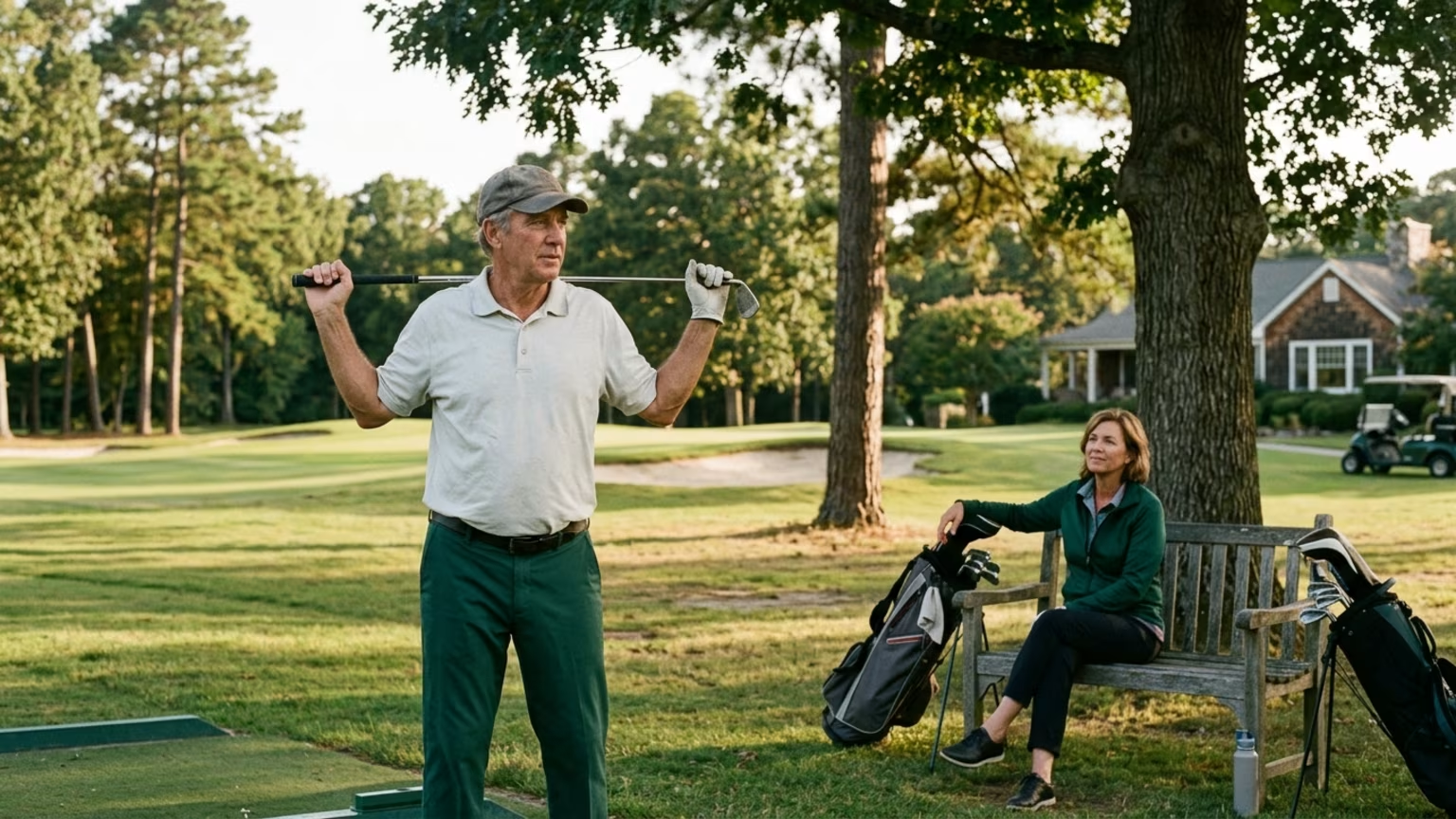
Observe comfortable movement and control to frame better questions about your golf swing, with guidance on when pain needs professional assessment.

Understand how hips, upper back and trunk contribute to your golf turn, with practical warm-up habits that respect your available mobility.
Explore practical resources on performance, recovery, mobility and golf longevity.
Read the Blog


