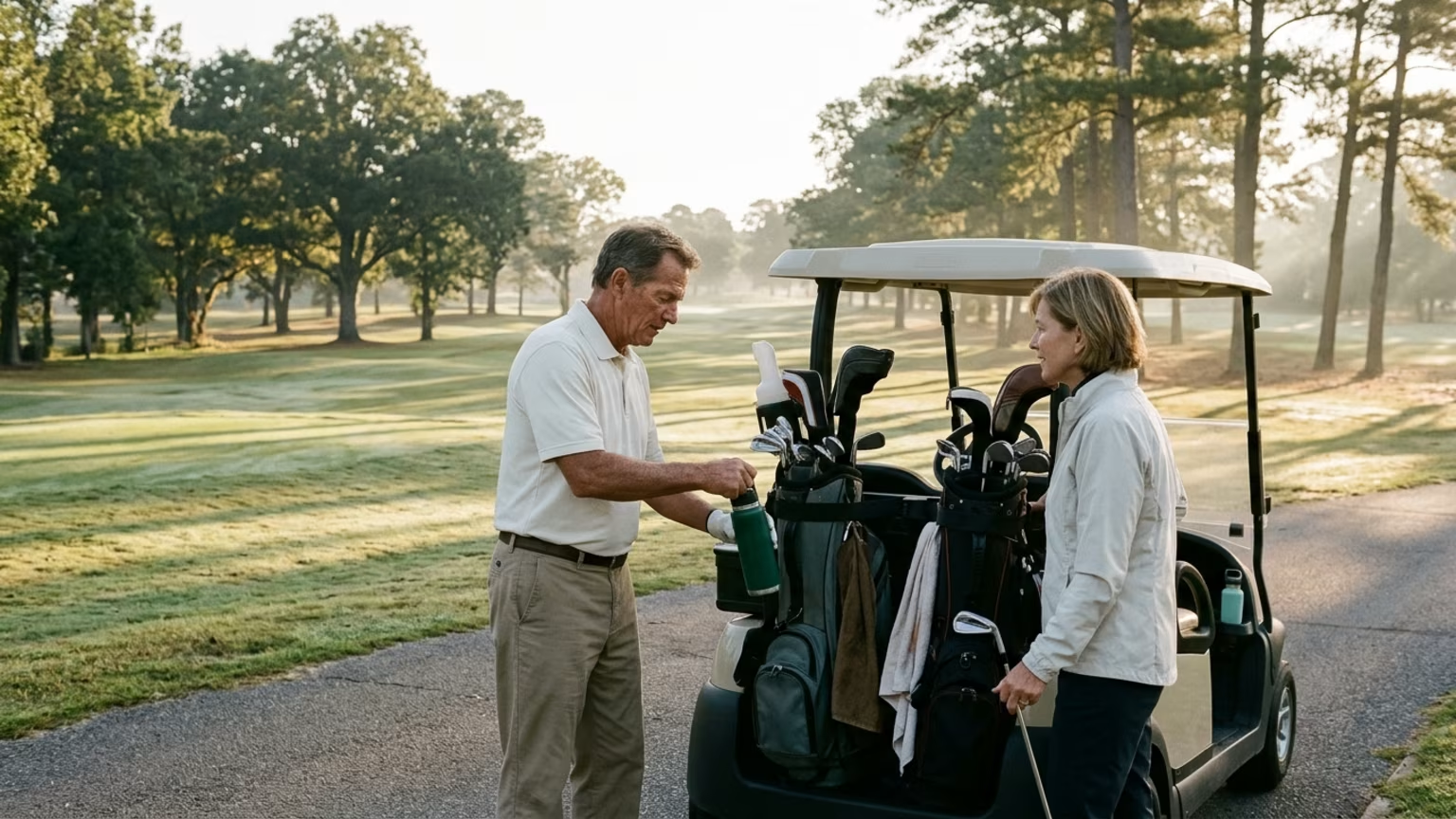

Adjust golf hydration to weather, walking and round length. Use thirst and personal patterns without treating a fixed bottle count as a target.




A walking golfer may lose roughly 1.8 litres of sweat over a 4.5-hour round in mild conditions, according to Golf News, but that estimate is not a personal drinking target.
Sweat rate describes how much fluid someone loses through sweating over time. Golf News cites an estimate of about 400 millilitres per hour for walking in mild conditions. That is an estimate of fluid leaving the body rather than an instruction about how much to drink.
The distinction matters because a typical figure describes a set of circumstances. It does not describe every golfer on every course. Golf News reports that heat, humidity and individual sweat rate can change fluid needs.
The round itself also matters. The same article describes 18 holes as taking about four to five hours and notes that walking and riding involve different physical demands. Using a cart does not remove the extended time spent outdoors.
Treat that sweat-rate estimate as context. It helps explain why hydration deserves attention during a long round. It does not turn a bottle label into a personalised plan.
Golf News reports that a small 2012 study found shorter 9-iron shots under mild dehydration. Reported distance fell from 128.6 to 114.6 metres. Average error increased from 4.1 to 7.9 metres.
Those findings come through secondary reporting rather than the original study text. They are not a forecast of how much distance any particular golfer will lose.
The useful lesson is narrower: hydration belongs in the performance conversation. These results are a reason to take fluid habits seriously rather than a promise that drinking more will produce longer shots.
For an experienced golfer the useful question is not whether your bottle count matches a younger player's. It is whether your plan fits the day's demands and your own health circumstances.
Golf News describes a limited golf hydration research base that draws heavily on studies from the UK and Ireland. The assembled evidence does not establish a validated protocol for older recreational golfers or show a larger hydration-related performance effect after 40. It cannot supply an age-based drinking target.
There is a clear personal safety consideration. Heat guidance reported by LAist advises people with a prescribed fluid limit or medication-related fluid concerns to seek individual medical advice. Ask your healthcare professional how to manage fluids in hot weather before changing your intake.
That is a more useful distinction than assuming every older golfer should drink extra. Your medical circumstances deserve more weight than a playing partner's routine.
The supported approach is a planning habit rather than a training drill. Begin normally hydrated and respond to thirst and circumstances during play. Use what you learn from different rounds to make the plan more personal.
Look at the expected weather and the amount of walking planned. Include the likely length of the round in that review. Golf reporting identifies those factors as relevant to fluid needs without giving a formula that converts them into a precise volume.
Keep each part of the review simple. Start with the conditions. Then think about whether you will walk or ride. Finally consider how long you expect to be outside.
The aim is to notice when today's round differs from your usual one. A familiar bottle count should not become a rule that overrides a different forecast or a longer day.
For related context, Golfergy's guide to matching fluids to course conditions looks at the same planning question through weather and terrain.
A summary of National Athletic Trainers’ Association guidance describes drinking to thirst as a practical fallback when someone does not know their sweat rate. That gives recreational golfers a usable starting point without requiring them to calculate losses on the course.
Keep the day's circumstances in view alongside thirst. A hotter round or a more demanding walk is a reason to reassess the plan. It is not a reason to force down a predetermined amount.
The same guidance summary warns that overdrinking can also be harmful. Finishing every bottle is therefore not a performance goal. The task is to respond to the round rather than pass a drinking test.
Golf nutrition commentary suggests comparing pre-round and post-round body weight across several rounds to understand personal fluid-loss patterns. This is an optional rough field check rather than a diagnostic test or a replacement formula.
If you use that approach, keep the round's circumstances alongside the readings. Note the weather and whether you walked or rode. Record the round length so that the number has some context.
Look for a pattern across outings rather than turning one reading into a rule. The purpose is to learn how your own rounds differ. It is not to create a compulsory post-round drinking volume.
For weekends with repeated play, our guidance on managing consecutive rounds offers a broader recovery planning topic to read alongside hydration.
Set the benchmark around an adaptable routine rather than a younger golfer's numbers. A useful plan should account for the actual round and respect any individual medical advice. It should also leave room to change when the circumstances change.
Ask a few practical questions:
These are process checks rather than a scorecard for diagnosing hydration. They keep attention on decisions you can make without pretending that a universal number fits your body.
Golfergy focuses on practical guidance for mature recreational golfers. Here that means making the routine fit the player and the round. It does not mean replacing one rigid target with a new age-labelled target.
The sweat-loss estimate gives hydration a place in your planning. The reported distance findings give it relevance to golf. Neither tells you how many bottles you personally need to finish.
Begin normally hydrated. Use thirst and conditions to guide drinking during play. Review your own patterns across rounds and get personal medical guidance where fluid limits or medications are involved.
Numbers are useful context, not drinking orders: match the plan to the round rather than making the round fit a quota.
Follow Golfergy for practical insights on performance, mobility, recovery and healthy ageing. Stay connected for new articles, research-led guidance and ideas to help you play better for longer.


A practical look at protecting sleep between golf rounds, with guidance on regular bedtimes, early tee times, screens and caffeine timing.


Rest or easy movement after golf? Use comfort, symptoms and personal capacity to guide the next day, with clear signs to seek assessment.

Plan recovery between golf rounds by separating walking and carrying choices, then comparing fatigue and comfort with your usual baseline.
Explore practical resources on performance, recovery, mobility and golf longevity.
Read the Blog