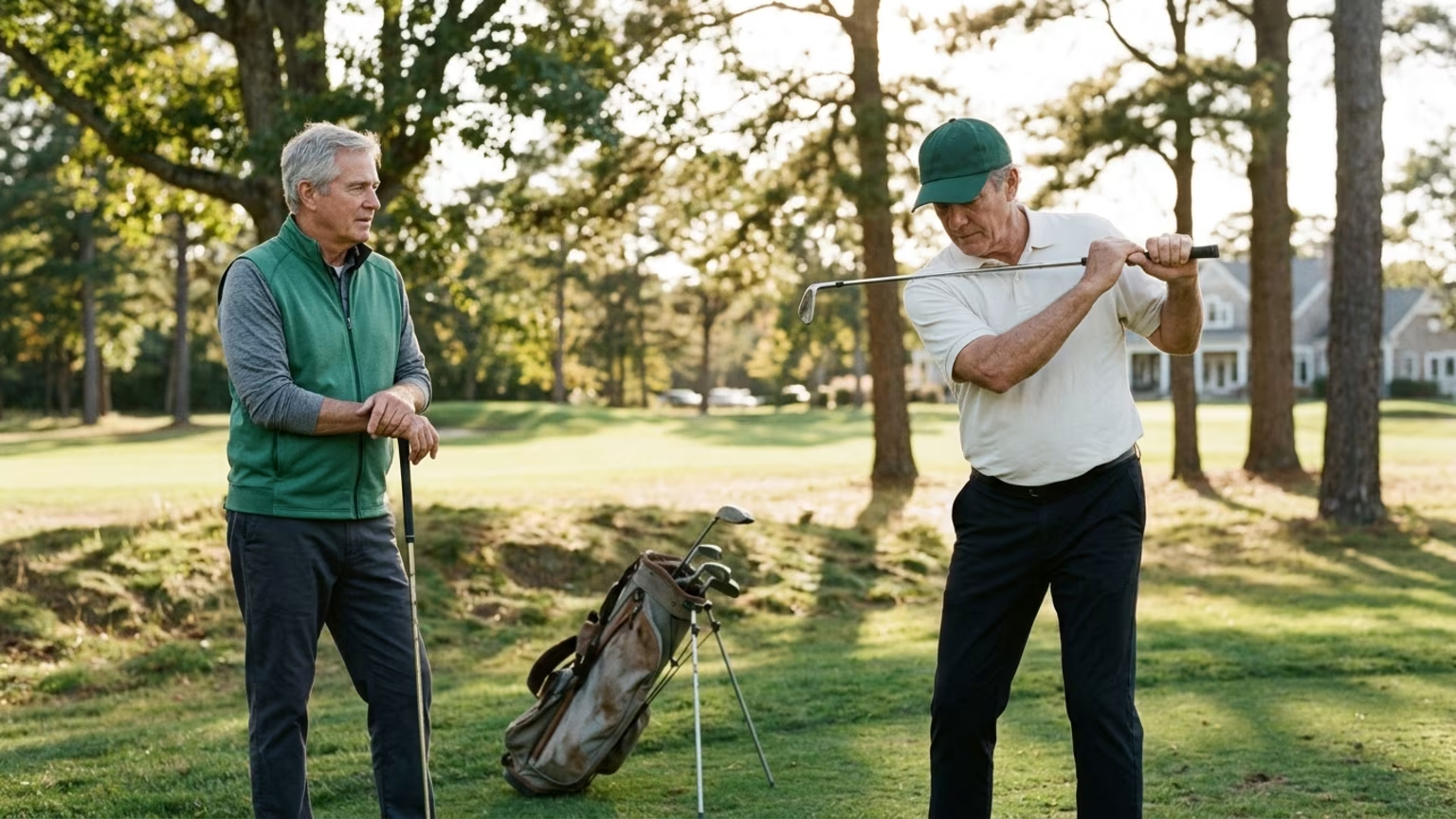
A measured look at golf’s possible balance benefits, walking demands and why a round’s physical load is not proof of complete fitness.




Carly Hunt’s Psychology Today article “More Than a Game: The Therapeutic Benefits of Golf” was published October 30, 2026. It suggests golf may support proprioception, balance and muscular endurance in older adults. For experienced players, that puts the physical activity within a round in the spotlight.
Hunt attributes those possible benefits to Murray and colleagues’ 2017 scoping review, The relationships between golf and health, published in the British Journal of Sports Medicine. Her article brings that earlier research into a wider discussion of golf’s physical, mental and social value.
For golfers over 40, the useful distinction is between the activity a round provides and the preparation an individual needs. Walking the course and moving equipment belong in the first category. Understanding how much those activities contribute to lasting physical improvements takes a closer reading of the evidence.
The research discussed across the approved coverage addresses several different questions. Some findings compare golfers with people who are inactive. Others examine the demands of a round or review the wider golf-health literature. Those approaches provide different kinds of information.
Sports Medicine Weekly describes a 2023 comparison of recreational golfers aged 65 to 79 with sedentary peers. The golfers had higher grip strength and better static and dynamic balance. That is a finding about differences between the groups at the time they were assessed.
A separate secondary account describes a 2023 randomized crossover study involving 25 healthy habitual golfers. Their average age was 68. Participants completed an 18-hole round, 6 km of Nordic walking and 6 km of brisk walking on separate occasions.
According to that account, the golf round lasted longer and used more energy at a lower intensity than the walking conditions. The result describes the combination of duration and intensity in those sessions. It is not a ranking of which activity is best for every older golfer.
Psychology Today also reports an estimated 11,000 to 16,600 steps for walking 18 holes. It gives an estimate of about 6,200 steps when taking a cart. These figures help explain why a discussion of golf fitness should include movement around the course rather than focus entirely on the swing.
Read together, the findings draw attention to two separate subjects: the physical work involved in playing and the physical qualities found among people who play. Keeping those subjects separate makes the practical message clearer.
For an experienced recreational golfer, these reports offer useful context rather than a forecast of personal improvement. The specific studies described here involved older adults or healthy habitual golfers. Their findings do not establish the same outcome for everyone aged 40 and above.
The 2017 source behind Hunt’s physical-benefit claim was a broad scoping review. It was not itself a training trial proving that golf caused improvements. A secondary summary of Sorbie and colleagues’ 2022 systematic review in Sports Medicine describes mixed findings and limited evidence tracking changes over time.
The 2023 golfer comparison was cross-sectional, meaning it compared groups at one point in time. As Sports Medicine Weekly notes, that design cannot establish cause and effect. People with better starting strength or balance may be more likely to continue golfing, so the differences cannot simply be credited to playing.
The step estimates have a separate limitation. Psychology Today does not provide their underlying measurement details or identify a specific study for them in the article text. They should not become a universal expectation for every course, player or mode of play.
Finally, the evidence summarized here does not establish that golf prevents falls or replaces targeted strength, balance or mobility work. It also does not show that recreational golfers face greater physical risk than professionals. The relevant comparison is between the demands of a round and the individual’s preparation, not between amateur and tour status.
The practical response is to value golf’s movement without asking it to account for every aspect of fitness. Golfergy’s focus is research-led guidance that helps mature recreational golfers play better for longer. Here, that means keeping on-course activity and individual preparation in the same conversation.
A walking round is physical activity, not merely the time between shots. When thinking about the day’s demands, include the movement around the course alongside the golf itself. This is a way to recognise the work already involved rather than attach a training promise to a step total.
Our guide to the physical demands of walking a course provides a related place to continue that discussion. The useful starting point is the round being played, not a headline estimate treated as a personal target.
Carrying or pushing a bag also belongs in the picture of the round’s total load. That work should be counted rather than treated as an automatic fitness bonus. The supported takeaway is to acknowledge the demand, not to prescribe a particular way of transporting equipment.
This keeps the distinction between activity and preparation intact. A round can contain meaningful movement while leaving separate questions about strength or balance. Golfergy’s framework for thinking about golf readiness addresses those broader areas of physical preparation.
Playing golf and preparing for golf deserve separate attention. The first describes participation in the game. The second concerns the physical qualities relevant to the individual player and the demands they want to manage.
A broader view of training for recreational golf keeps strength, balance, mobility and aerobic work within that discussion. The research reviewed here does not supply a personal exercise programme. Decisions involving symptoms or individual exercise needs belong with a qualified healthcare professional.
Hunt’s article offers a reason to appreciate golf as a source of movement. The supporting coverage describes walking demands and physical differences between older golfers and sedentary peers. That makes the activity within a round worth recognising alongside the score.
The open questions concern how much lasting change comes from playing itself and which golfers gain which benefits. For now, the grounded approach is straightforward: count the walking and equipment handling as part of the round’s workload. Keep individual preparation as a separate subject rather than assuming participation answers every fitness question.
Follow Golfergy for practical insights on performance, mobility, recovery and healthy ageing. Stay connected for new articles, research-led guidance and ideas to help you play better for longer.


Learn how strength, mobility, balance and power relate to golf after 40, with practical ways to notice needs and discuss a sensible starting point.

Separate golf mobility from strength and warm-ups, keep practice manageable, and recognise when a restriction needs professional assessment.

Move from walking to controlled movements and easy swings, with clear expectations about warm-ups, injury evidence and longer-term golf fitness.
Explore practical resources on performance, recovery, mobility and golf longevity.
Read the Blog