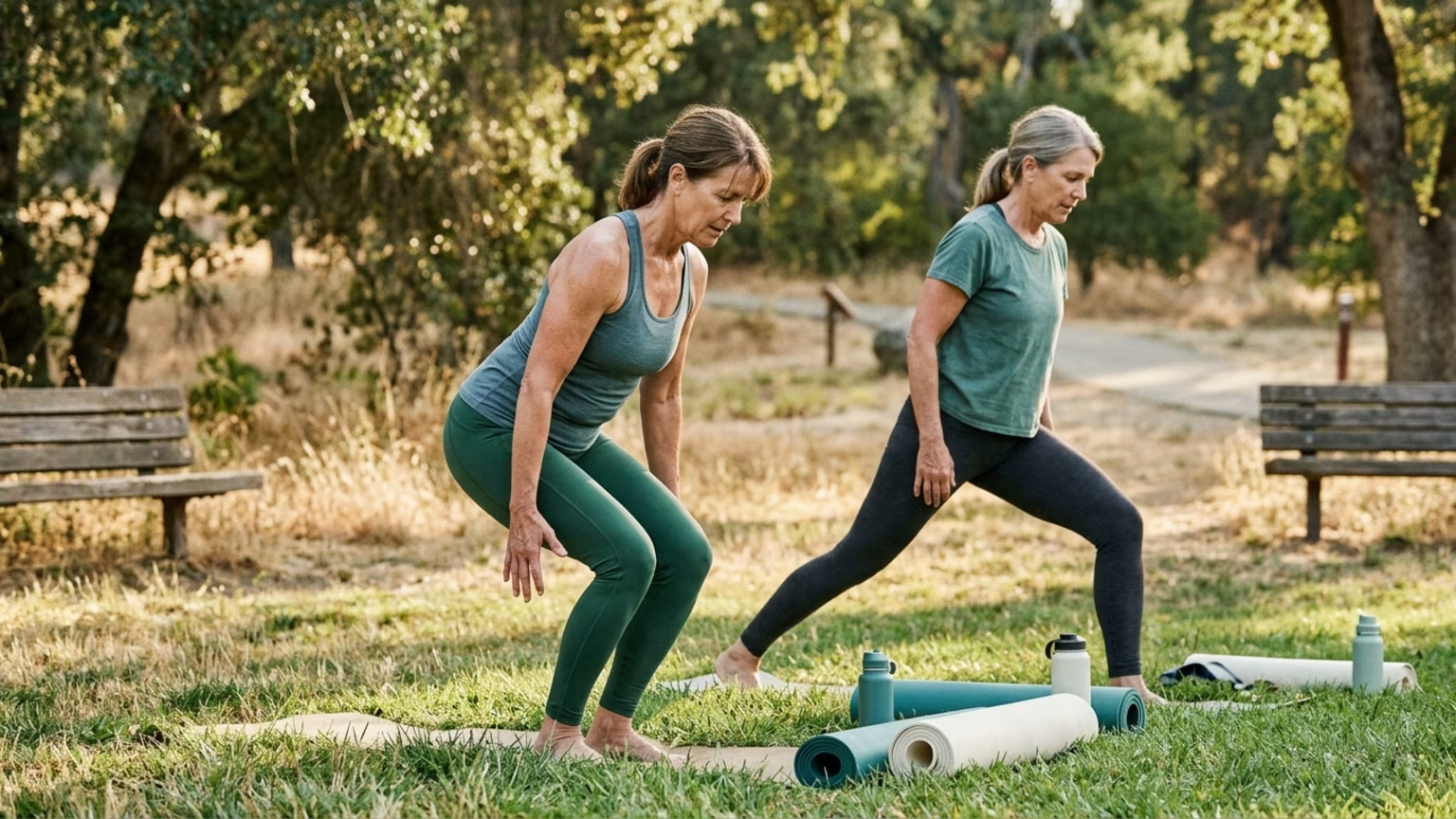

A pilot trial suggests fast-paced, cue-driven yoga supports physical and cognitive coordination. Learn how older golfers can build better movement habits.




Cognitive-motor coordination is simply your brain and body's ability to process information and execute physical movements simultaneously. It is the engine that keeps your swing steady and focused during a long round of golf. Many older players treat fitness and mental sharpness as two completely separate tasks. A pilot randomized controlled trial published in Scientific Reports compared a fast-paced, cue-driven yoga program called YogaCue with traditional Hatha yoga in independently living adults aged 60 to 90.
The YogaCue trial fits a wider healthy-ageing research trend toward exercise programs that combine physical and cognitive demands. Researchers are moving away from treating fitness and cognitive training as entirely disconnected activities. This approach aims to build routines that prepare older adults for complex physical environments. Training your body to react quickly while maintaining balance has immense value for longevity.
On the golf course, cognitive-motor coordination dictates your physical capabilities on the back nine. You are rarely just swinging a club in perfect isolation. You have to read the lie, remember your swing thoughts, and maintain lower-body power while managing fatigue. This constant switching between mental focus and physical execution requires significant energy.
When your ability to process those overlapping demands drops, your swing control starts to fade. You might notice your posture slipping or your legs feeling heavy during the final holes. Your brain struggles to send the right sequencing signals to your muscles when physical exhaustion sets in. Building a routine that trains your brain and legs at the same time can help you maintain stable movement late in a round.
Lower-limb power is highly relevant to walking the course comfortably. Cognitive offloading becomes much easier when your body can handle the physical strain. A physically prepared golfer has more mental energy left for shot selection and green reading. Maintaining that energy is the secret to finishing strong.
As golfers pass age 40 and 50, both lower-limb power and cognitive processing speed undergo natural changes. The nervous system becomes less efficient at recruiting muscle fibers quickly. This physical decline reduces your leg power and affects your balance on uneven lies. At the same time, managing physical fatigue takes up more of your cognitive resources.
A 2026 systematic review and meta-analysis found that structured exercise was associated with better global cognition in community-dwelling older adults. Researchers noted that heterogeneity was substantial and the certainty of evidence was rated very low. Still, losing leg strength makes walking 18 holes harder, which directly drains the focus you need for late-round decision-making. Proper cognitive recovery over 18 holes relies heavily on maintaining a capable physical foundation.
Without adequate lower-body power, every step requires more effort and pulls attention away from your next shot. Physical exhaustion makes late-round concentration incredibly difficult for any older player. Your brain simply cannot prioritize swing mechanics when your legs are struggling to carry you up a hill. Addressing this decline requires targeted physical habits that challenge your coordination.
Researchers initially randomized 54 participants for the recent trial. Only 34 completed the 24-week intervention and post-intervention testing. The analyzed sample contained 17 YogaCue participants and 17 Hatha participants. Participants attended supervised, 60-minute sessions three times per week for 24 weeks.
The study had no non-exercising control group, and the sample was predominantly female. The researchers suggest that YogaCue's faster movement intervals and visual and auditory cues may create greater simultaneous cognitive and physical stimulation than slower-paced yoga. YogaCue combined action observation, verbal instruction, colored visual paddles, and auditory gong cues. The program also included progressively faster transitions.
The authors describe Hatha yoga as prioritizing postural control, breathing, and body awareness. They also note its focus on flexibility, coordination, balance, and range of motion. YogaCue required participants to remember and respond to numbered or color-coded movement sequences. The YogaCue group also had to handle randomized sequence orders while transitioning rapidly between poses.
Across the full sample, scores improved significantly on the Flanker test, List Sorting Working Memory Test, and Fluid Cognition Composite Score. Both YogaCue and Hatha showed significant within-group improvement on the Fluid Cognition Composite Score. Aerobic fitness improved across the overall sample, with gains appearing more pronounced in YogaCue. The report states that body-fat percentage declined significantly only in the YogaCue group.
Blood pressure improved across the overall sample. Systolic reductions were driven by the Hatha group, while diastolic pressure declined in both groups. Lower-limb power gains and physical performance-test improvements were more pronounced in YogaCue. Lower-limb strength gains and Timed Up & Go improvements were reported primarily in the Hatha group.
The study's memory findings require especially careful wording. The report says total recall, delayed recall, and percentage retained on the Hopkins Verbal Learning Test decreased significantly in YogaCue participants. The study conclusion then says episodic and verbal memory may improve with YogaCue. This apparent inconsistency means we cannot claim YogaCue definitively improves memory.
Because there was no non-exercising control group, the study cannot determine how much of the improvement was caused specifically by YogaCue or Hatha. Repeated testing, social participation, and normal variation could also play a role. The high dropout proportion can also exaggerate or obscure apparent differences between the two exercise groups. These factors highlight the need for cautious interpretation of the results.
The study was not designed around golfers and included no golf-specific measures. Researchers did not test clubhead speed, ball speed, driving accuracy, or walking performance over 18 holes. They also did not track swing consistency, injury incidence, or late-round decision-making. The participants were independently living older adults without specified uncontrolled neuromuscular or cardiovascular disease.
They also lacked uncontrolled cerebrovascular, inflammatory, or autoimmune conditions. A golfer should not assume that a fast-paced routine can be safely copied without instruction. Look for supervised sessions that combine mobility, balance, controlled lower-body strengthening, and simple reaction cues. Try classes that force you to coordinate movement with external instructions rather than treating static stretching as your entire routine.
This helps older golfers improve balance and stay steady during complex movements. Taking an integrated approach may support physical qualities useful for golf. Progress gradually and prioritize stable footing. Traditional Hatha-style work remains highly valuable for aging golfers.
The study associated Hatha with improvements in lower-limb strength, Timed Up & Go scores, and systolic blood pressure. Focus entirely on maintaining controlled transitions during any routine. Stop immediately if you experience chest pain, unusual breathlessness, dizziness, or acute joint pain. Individual medical clearance is always appropriate for golfers with significant health conditions.
Building routines that challenge your brain and your body simultaneously prepares you for the realities of the golf course. It gives you the physical resilience to handle uneven terrain while maintaining the mental clarity needed for shot execution. Training your body to process cognitive cues while maintaining lower-limb power is a practical way to keep playing better for longer.
Follow Golfergy for practical insights on performance, mobility, recovery and healthy ageing. Stay connected for new articles, research-led guidance and ideas to help you play better for longer.


A flexible training framework for golfers over 40 that makes room for strength, balance, mobility and aerobic activity alongside play.


See how balance fits alongside strength and coordination in golf, with a supported practice example and a clear look at the evidence.

A practical strength framework for golfers over 40, built around everyday goals, sensible progression and a careful look at limited golf research.
Explore practical resources on performance, recovery, mobility and golf longevity.
Read the Blog


