
Discover why dynamic balance and proprioception are more critical than raw power for golfers over 40. Learn a simple 3-step routine for post-40 consistency.




In a 10-year study of 5,900 adults aged 65 and older, regular golfers demonstrated a 15.1% mortality rate compared to 24.6% for non-golfers. This data proves that staying active on the course extends our lives. The 3-step dynamic stability routine starts here:
When I developed medial epicondylitis, commonly known as golfer's elbow, I thought I needed complete rest. Six weeks off the course did nothing to help. I finally learned that active recovery with a flexbar was the actual solution. It taught me that treating golf injuries requires loading the tissue properly, not just sitting on the couch and hoping for the best.
The same active approach applies to our sense of balance as we age. We can actively train our bodies to stay balanced and stable. This proactive mindset keeps us on the fairway longer. You have the power to control how your body ages.
Proprioception is the ability of your body to sense its position and movement in space. This sense naturally declines with age due to deteriorating muscle spindle function and slowed nerve conduction. This biological change makes basic movements feel less secure over time. You must address this sensory decline before you try to fix your swing mechanics.
Slowed nerve conduction means your brain takes slightly longer to realize your weight has shifted too far. By the time you feel yourself swaying off the ball, the downswing has already started. This minor delay creates major contact issues at impact. Recognizing this biological reality is the first step toward better golf.
The loss of proprioception happens so slowly that most players never notice it. You might think your swing is getting shorter because your muscles are tight. In reality, your brain is limiting your range of motion because it no longer feels safe. Restoring that safety signal is the secret to gaining your mobility back.
Before starting any new training protocol, you need a safe way to check your current baseline. Stand barefoot on a flat floor near a wall. Lift your trail leg slightly off the ground and try to hold that stance for ten seconds. If you immediately wobble or reach for the wall, your baseline requires attention.
Experts advocate for a joint-by-joint approach to stability in the golf swing. This proven method requires stable feet, mobile ankles, stable knees, and mobile hips. You can develop this functional stability right at home. Move slowly through these steps and listen to your physical limits.
The joint-by-joint philosophy prevents older players from overloading vulnerable areas. When your ankles lose mobility, your knees are forced to absorb the twisting forces of the swing. Knees are designed for stability, not massive rotation. Proper training keeps each joint performing its specific biological job.
First, practice tandem walking to improve your dynamic balance. Walk straight across the room by placing your heel directly against the toe of your other foot. Tandem walking forces you to connect deeply with the floor beneath you. Focus entirely on feeling the ground with each deliberate step.
Next, move to a wall for supported single-leg stands. Holding a single-leg stance for 10 to 30 seconds near a support wall helps recalibrate the brain's sense of balance. This simple hold rebuilds the neural pathways that keep you upright. Focus entirely on keeping your planted foot quiet and grounded.
Finally, practice your weight-shift rehearsals without a club. Get into your standard golf posture and rock slowly from your trail foot to your lead foot. Ground force is the only external source of angular momentum in a golf swing. Focus entirely on turning your trail hip during the shift.
A weak foundation forces your upper body to overwork during the downswing. This overcompensation leads to casting the club and losing power before impact. Proper ground force generation starts from the ground up, not the shoulders down. When your feet are stable, your hands can release freely through the ball.
Repeating these exact movements daily trains your body to find its center naturally. Building a routine takes time, patience, and repetition. You will notice a firmer connection to the ground within a few weeks. The key is to execute each small movement with complete focus.
Many golfers push too hard when trying to fix their balance. While stability is vital, over-focusing on staying still can lead to a rigid swing. Balance must be dynamic, allowing the body to move through the kinetic chain. Being too static drastically increases your risk of joint injury.
Dynamic balance requires your brain to process movement and stability simultaneously. Many players fail because they lock their knees in an attempt to feel grounded. Locking the knees stops the flow of energy and ruins your natural athletic rhythm. You have to stay soft and athletic over the ball.
Some players also make the mistake of performing long static stretches right before playing. Research now shows that long static holds immediately before teeing off can actually reduce clubhead speed and driving distance. Dynamic rotations and half-speed swings are now the preferred standard. Keep your warm-up active to protect your speed.
Poor hip rotation is another frequent trap for enthusiastic players. When this chain is broken, such as by a lack of internal hip rotation, golfers often compensate with lateral sway. This dangerous sway disrupts balance and increases lower back stress. You must keep your lower body mechanics smooth and controlled.
Do not ignore the true stress placed on your knees during a round. Contrary to the low-impact myth, high-speed motion capture shows that knee loading during a golf swing can exceed the forces seen in many traditional high-impact sports. This heavy joint stress is why a stable base is so critical for longevity. Protect your joints by turning smoothly instead of swinging with maximum effort.
You do not have to leave your good habits in the living room. You can maintain your newly found stability while you wait by the golf cart. Take thirty seconds to perform a slow weight-shift rehearsal while your playing partner hits. This simple act keeps your central nervous system primed for the next shot.
Your playing partners might wonder why you keep shifting your weight near the cart. Let them hit their shots while you silently prepare your nervous system. Golf is a game of preparation, and physical readiness dictates your mental confidence. A stable body naturally produces a calm and focused mind.
The fairway is a dynamic environment filled with uneven lies and slippery grass. You cannot expect perfect balance on every single swing. Your goal is simply to give your nervous system the best possible chance to succeed. A quick sensory reset helps your body adapt to the changing terrain.
You can also use the cart for a quick single-leg stand if your balance fades. Grounding your lead foot reminds your brain how to interact with the turf. Good ankle mobility will help you maintain a solid connection to the ground. Small activations on the course translate to much better ball-striking.
Pay attention to how your feet feel inside your shoes during these quick breaks. Your toes need room to grip the ground properly. A strong connection to the earth prevents sloppy upper body movements. Consistent turf interaction leads to consistent golf shots.
International health bodies like the WHO and CDC now specifically recommend multicomponent activities for older adults. These routines combine functional balance with strength training at least three days a week. We know that a 55-year-old who engages in daily balance training can maintain higher functional stability than a sedentary 35-year-old. Age is just a number when you put in the right work.
Our bodies respond well when we give them clear and consistent signals. You do not need to spend hours in the gym to see real benefits. Five minutes of focused balance work every morning creates a massive compound effect over time. Small daily habits always beat random bursts of intense effort.
We saw earlier that those 5,900 adults proved golf is a powerful tool for a longer life. The game keeps us healthy and engaged if we protect our physical foundation. Building a balanced swing requires patience, consistency, and a willingness to adapt. The 10-minute investment today that saves you 18 holes of aches tomorrow.
Follow Golfergy for practical insights on performance, mobility, recovery and healthy ageing. Stay connected for new articles, research-led guidance and ideas to help you play better for longer.


The 2027 PGA Show is expanding its Performance Zone. Learn why the golf industry's shift toward fitness and recovery matters for players over 40.

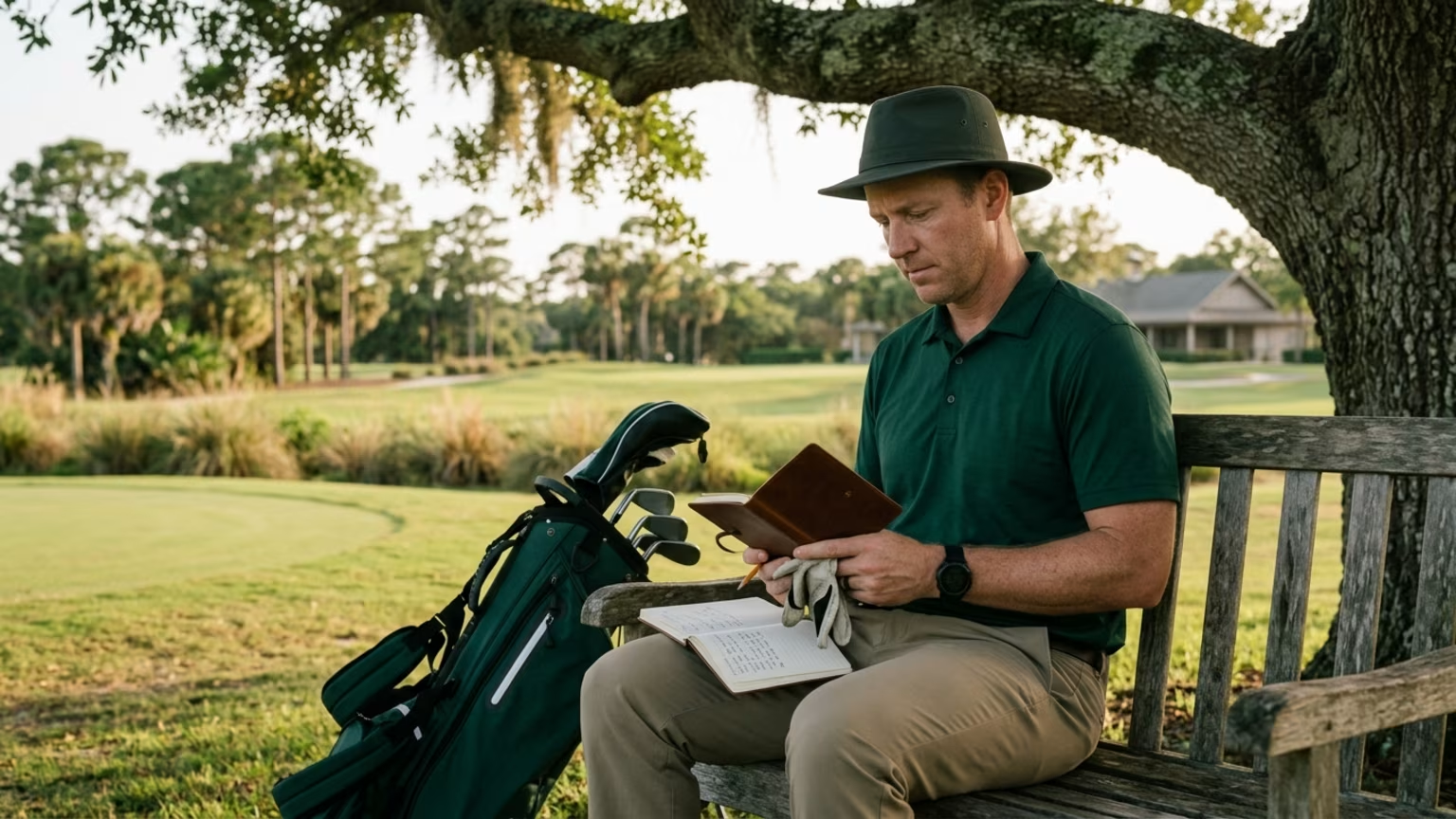
Brooks Koepka called his 2026 PGA Tour return pathetic after struggling with his putting. Learn how older players can track performance to maintain consistency.

Learn why dynamic stability and neuromotor fitness matter for older golfers. Find practical habits to adapt to uneven lies and protect your aging joints.
Explore practical resources on performance, recovery, mobility and golf longevity.
Read the Blog