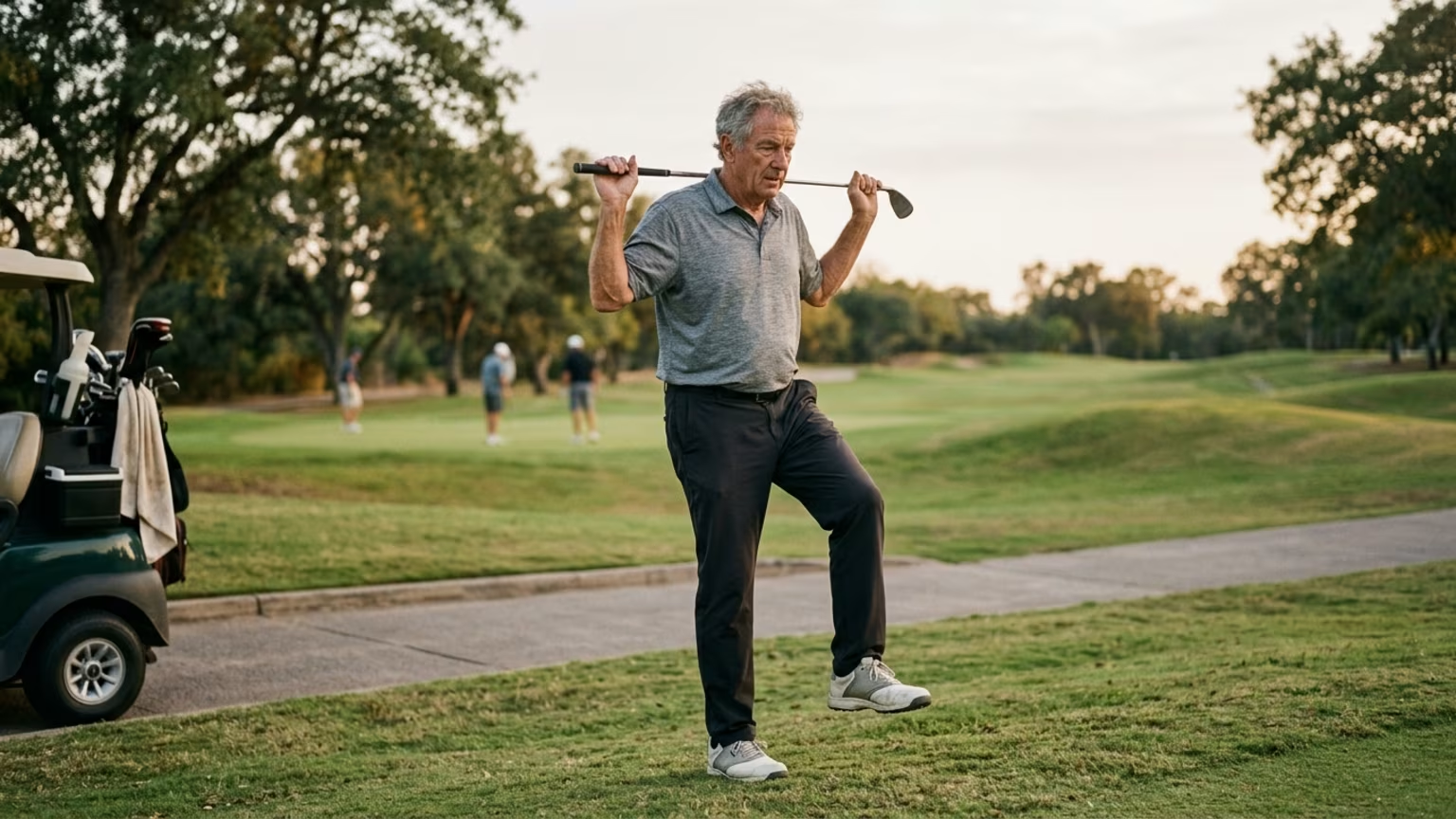

Learn how functional balance training and strength work combine to help golfers navigate uneven lies, prevent falls, and extend their playing years safely.




You step awkwardly onto a sidehill lie in the thick rough, and suddenly your lower back tightens as you try to hold your stance. In our experience, this physical decline is common on the course. As one of our team members noted: "A few years ago, I noticed my swing falling apart around the 14th hole. My lower back would tighten up, and I started compensating with my arms. I spent months thinking it was a swing flaw. It was not until I started a simple evening hip mobility routine that I realized my glutes were just turning off from fatigue. Fixing that one physical limitation brought my back nine scores down drastically."
The golf course rarely offers a perfectly flat surface for your swing. The British Journal of Sports Medicine reports that playing golf may improve proprioception, balance, muscular endurance and physical function. These benefits are particularly clear among older adults. However, the authors noted that research on golf-specific strength and balance remains limited. Amateur golf injury rates sit at approximately 0.28 to 0.60 injuries per 1,000 hours. Reported annual injury incidence among amateur golfers varies widely from 15.8% to 40.9%.
The physical toll adds up quickly over an 18-hole round. The lower back accounts for approximately 18.3% to 36.4% of amateur golf injuries in the cited literature. Wrist and hand injuries account for another 10% to 32% of reported cases. A review identified repetitive practice volume as the most frequent reported cause of injury. Suboptimal swing biomechanics are another frequent cause among amateurs. Your body needs a reliable defense against this constant wear.
Older golfers who want to protect their joints typically choose between two main physical strategies. Option A is a traditional resistance training program built around heavy lifting. Option B is a targeted functional routine focused entirely on balance and task-specific control. Golfers often struggle to decide which method will actually keep them on the course longer.
Heavy gym sessions look impressive on paper. Balancing on one leg feels much less dramatic. Players must decide where to spend their limited recovery time and energy. Understanding the specific physical demands of the game helps clarify this choice.
Option A focuses heavily on building muscular power and strength. Lifting weights builds important lower-body power. Many older players rely on strength programs to hit the ball further. However, building raw strength without practicing coordination leaves a massive gap in your physical armor.
Research indicates that resistance work is not a complete preventative solution for older adults. A synthesis of randomized trials found that resistance training alone produced a rate ratio of 1.14 across five trials. The evidence offered no clear fall-prevention benefit when this method was used by itself. A player might be able to leg press a heavy weight but still lose control stepping out of a deep bunker.
Stiff muscles can also restrict the natural turning motions required for a smooth swing. Older joints often complain when subjected to heavy loads without adequate mobility work. Strength is incredibly useful, but it cannot solve the problem of an uneven lie on its own. Golf requires the body to react fluidly to unpredictable terrain.
Option B focuses directly on how your body controls its position in space. A targeted stability routine trains the feet, ankles and hips to work together smoothly. Programs involving gait, balance and task training produced a fall-rate ratio of 0.76 across 39 randomized controlled trials. This type of training creates high-certainty evidence for reducing overall fall rates.
This targeted control translates beautifully to the golf course. Better single-leg stability helps a player maintain posture through the dynamic motion of a swing. Stronger ankles allow you to step confidently across a steep grassy slope. The goal is to make ordinary golf positions feel much less threatening to the body.
Practicing single-leg stances trains the nervous system to react quickly to small changes. When your lead foot slips on wet grass, a well-trained ankle can catch the weight shift before you fall. This proactive joint control reduces the physical stress placed on the lower back. Focused balance work acts as a shock absorber for your entire skeletal system.
Both options require time, dedication and a bit of physical effort. Traditional gym routines often require a paid membership or expensive home equipment. Traveling to a gym also takes time out of a busy weekly schedule. These logistical barriers often stop recreational players from sticking to their fitness goals.
Balance and functional work present far fewer hurdles for the average person. You can perform a highly effective stability routine using only a sturdy chair in your living room. The financial cost is minimal, and the time commitment is easily managed. Players who invest in smart recovery and fatigue management often prefer these low-impact home sessions.
Golfers must also manage their total physical workload during the peak season. Adding intense heavy lifting to a busy playing schedule can easily lead to burnout. A 15-minute home stability session adds minimal stress to the muscles. This makes it an ideal companion to regular course play and walking.
The smartest strategy for extending your playing years actually brings both methods together. A synthesis found that programs combining balance and functional work with resistance training yielded a fall-rate ratio of 0.66. This result came from 11 trials and showed a larger estimated reduction in fall rates. Combining muscle power with joint coordination provides the most comprehensive physical protection.
Golf demands a massive amount of lower-body endurance. Golfers who walk 18 holes typically take between 11,245 and 16,667 steps. They cover approximately 4 to 8 miles during a standard round. That volume of walking requires strong legs and resilient, adaptable feet.
Building functional muscular power helps you handle the raw distance. Adding dedicated stability practice allows you to navigate the hills, bunkers and slopes safely. You cannot maximize your longevity by focusing on just one physical trait.
A practical home routine trains your foot awareness, ankle control and single-leg stability. Always perform these exercises near a sturdy support like a heavy chair or a kitchen counter. Safety comes first, so never push yourself to the point of a painful loss of control. Start with two or three short sessions per week to build consistency.
Begin with supported weight shifts to wake up your nervous system. Stand behind your chair and shift your weight slowly to the right foot. As you settle your weight, focus entirely on turning your trail hip. Shift back to the left foot and complete 8 to 10 slow repetitions per side. This small movement teaches the pelvis to stay quiet while one leg unloads.
Next, practice controlled heel raises to build lower-leg capacity. Hold your support lightly and rise onto the balls of both feet. Lower yourself slowly rather than simply dropping your heels to the floor. Complete two sets of 8 to 12 repetitions to engage the calves and feet.
You can also practice short-foot exercises to wake up the muscles in your arches. Keep your toes relaxed and gently draw the ball of the big toe toward the heel without curling your toes. Hold this contraction for three to five seconds. Perform six to eight repetitions per foot to build a better connection with the ground. These drills are a practical way to build foot awareness, though current research does not yet establish that toe exercises independently prevent falls.
Once you master the basic shifts, you can progress to a single-leg stance with a forward reach. Stand on one leg near your support and reach your free foot lightly forward. Return to the starting position, then reach sideways and backward. Perform 4 to 6 reaches in each direction per side to challenge your dynamic stability. The goal is to keep the standing knee tracking smoothly in line with your toes.
Choose traditional strength work to build your physical engine, and targeted balance training to steer that power safely around the course. Start by adding five minutes of supported weight shifts to your morning routine today.
Follow Golfergy for practical insights on performance, mobility, recovery and healthy ageing. Stay connected for new articles, research-led guidance and ideas to help you play better for longer.


A practical strength framework for golfers over 40, built around everyday goals, sensible progression and a careful look at limited golf research.


A research-led look at strength, balance, mobility and trunk control, with a flexible planning framework for golfers over 40.
Understand golf mobility after 40 with a comfortable-turn self-check, hip and shoulder guidance, and a clear look at flexibility and swing speed.
Explore practical resources on performance, recovery, mobility and golf longevity.
Read the Blog