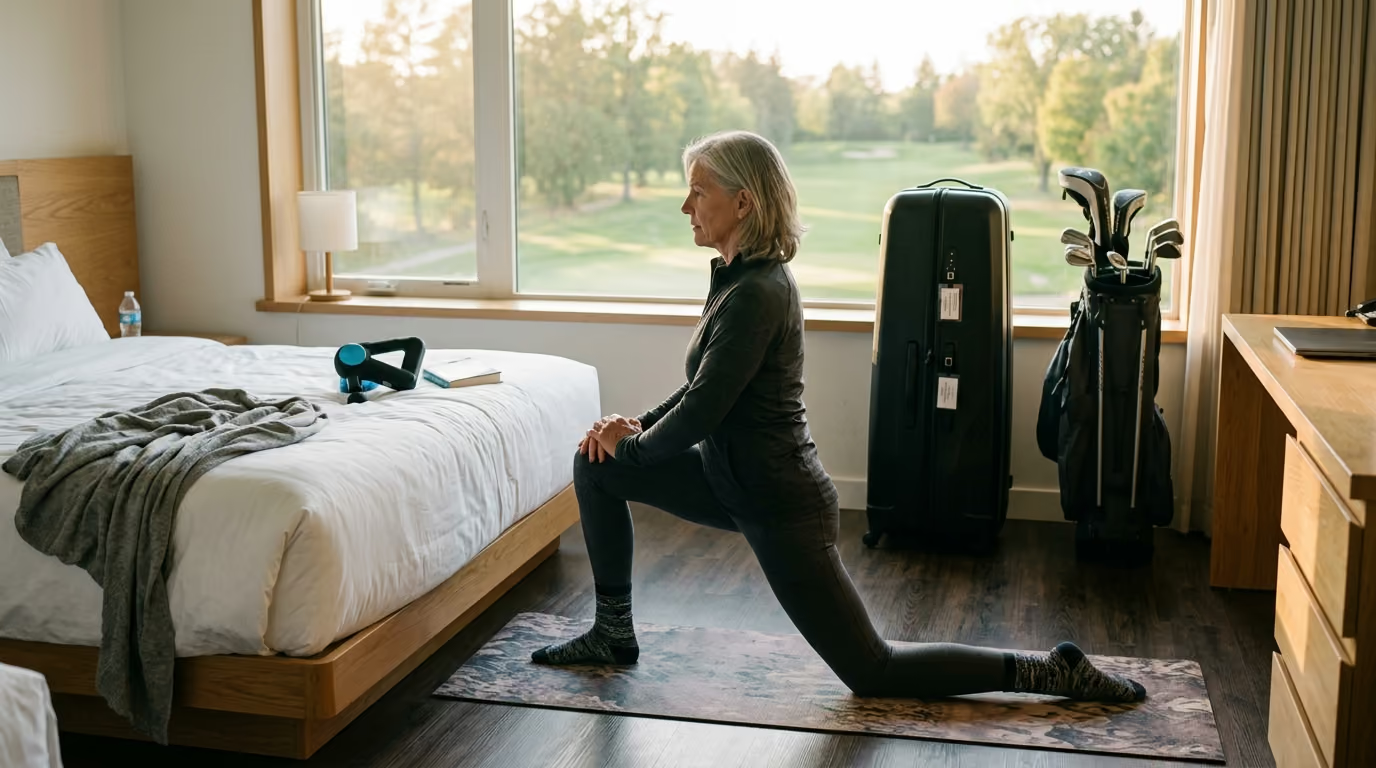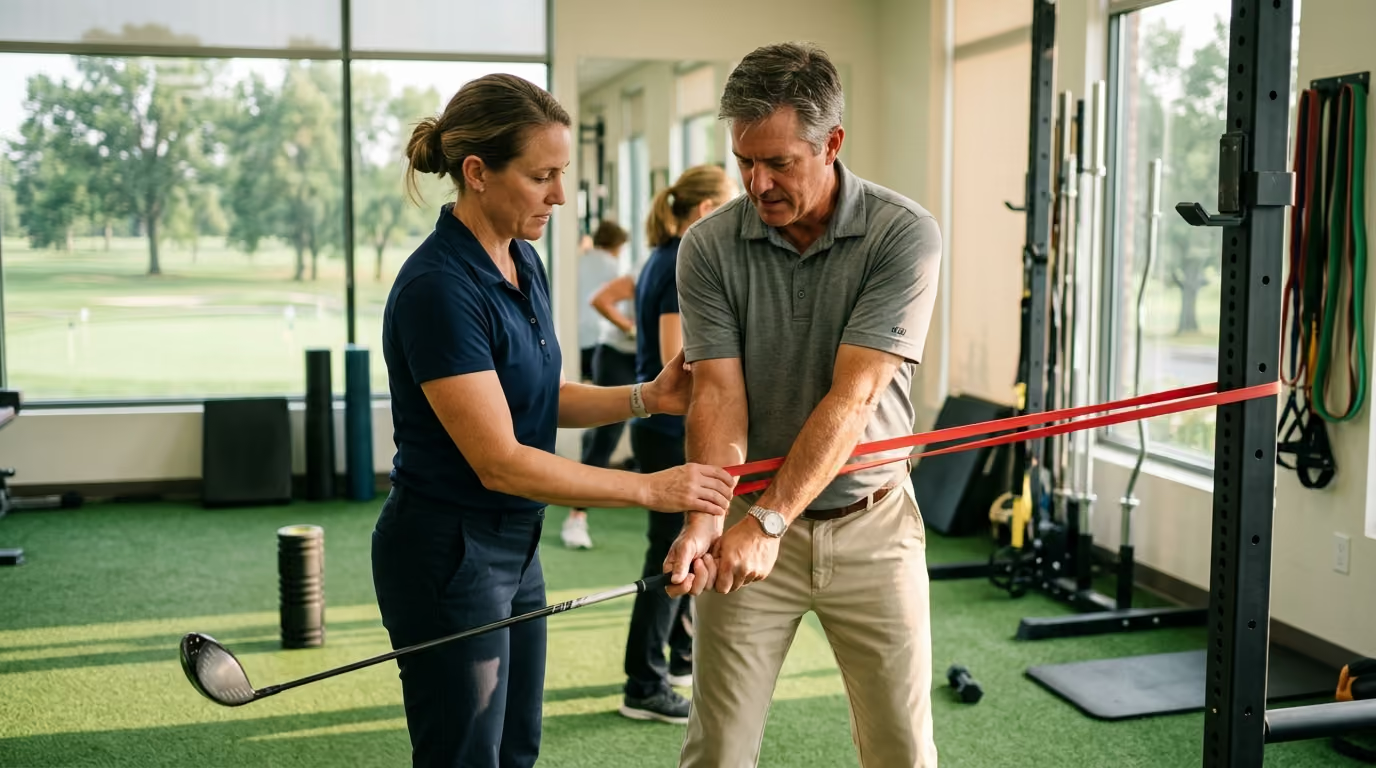

Golfers often treat arm pain with total inactivity, but progressive loading is the real key to rebuilding damaged tendon tissue.




Many players believe that complete rest is the ultimate cure for sore, aching arms. They pack away their clubs for a month, wait for the pain to fade, and then expect to return to the course pain-free. This passive approach actually makes your arm tendons weaker and more vulnerable to injury. Complete rest is one of the worst choices you can make for chronic pain in your elbows and shoulders.
This guide is designed to help you understand why your arms hurt and how to rebuild them. We will look at how your swing mechanics load your upper body. You will learn the difference between raw irritation and structural wear. By the end, you will have a clear, scientific plan to play without pain.
Imagine standing on the tenth tee with a driver in your hand. You have played a decent front nine, but your arm is starting to complain. You take a smooth backswing and transition into the downswing. At the moment of impact, a sharp, burning pinch shoots through the outside of your lead elbow.
Your hand slips off the grip in reaction to the pain. The ball slices into the right trees. This is lateral epicondylitis, which is commonly called tennis elbow. It is one of the most common issues that mature players face on the course.
On the next hole, you try to hit a delicate wedge out of thick green-side rough. Your trail arm tries to scoop the ball over a bunker. A dull, deep ache flares on the inside of your trail elbow. This pain is medial epicondylitis, which is also known as golfer's elbow.
Later in the round, during a high follow-through, you feel a tight pulling sensation in the front of your shoulder. This is a strain of the long head of your biceps tendon. These physical issues can ruin your enjoyment of the game. They make you dread swing impact and force you to play defensive, weak shots.
To protect your swing and keep playing, you need a strong plan. Let us study why these injuries occur and how they develop in your body. We will focus on how injury prevention can keep you on the fairway.
Many golfers use the term tendonitis to describe any pain in their arms. True tendonitis is an acute, short-term inflammatory response. It happens when you suddenly double your practice hours or hit a hidden tree root. The tissue becomes warm, swollen, and tender to the touch.
However, chronic pain that lingers for months is usually tendonosis or tendinopathy. Research from the British Journal of Sports Medicine shows this is a degenerative process. The collagen fibers inside your tendon lose their neat, parallel structure. They become disorganized, tangled, and weak.
Tendons have a very limited supply of blood. This lack of blood flow makes healing a slow process. When a tendon is repeatedly overloaded without proper recovery, the body cannot repair the micro-tears fast enough. The tendon begins to break down at a cellular level.
Standard anti-inflammatory treatments like ice and rest do not fix disorganized collagen. Your tendon needs targeted physical pressure to stimulate repair. Without this load, the tissue stays weak and thin. The moment you swing hard again, the pain returns immediately. Let us look at how mobility strategies can address this root cause.
To stop arm pain, you must understand how your body moves. Elbow injuries account for 24 percent to 33 percent of all injuries in amateur golfers according to sports medicine data. In contrast, they only affect about 10 percent of professional players. This massive gap is caused by swing mechanics.
The "chicken wing" is a classic swing fault that harms the lead arm. During the follow-through, your lead elbow bends outward instead of rotating smoothly. This movement places a massive eccentric strain on the extensor tendons on the outside of your elbow. The tissue is forced to stretch under extreme tension.
Another common fault is "scooping" at impact. This happens when you try to help the ball into the air by flicking your wrists. Scooping overloads the extensor tendons on the outside of your lead elbow. It forces the small forearm muscles to do the work of your larger leg and core muscles. This constant wrist-flicking leads directly to tennis elbow.
On the other side, casting your club causes golfer's elbow in the trailing arm. This issue occurs when you release your wrists too early in the downswing. Your trail hand tries to force the club down to make contact. The flexor muscles in your forearm contract violently to control the heavy club.
This violent contraction pulls hard on the inner bone of your trail elbow. Over time, this constant pulling damages the tendon attachment point. If you want to improve your golf performance, you must train your body to release the club naturally.
The bicep tendon is also vulnerable during the swing. The long head of your biceps tendon runs through a narrow groove in your shoulder. If you pull down hard with your lead arm from the top of the swing, you pinch this tendon. It also gets strained when your shoulder reaches maximal rotation during a high follow-through.
Every golfer has unique swing habits that place specific demands on the body. We can categorize these habits into distinct swing profiles. Knowing your profile helps you target the root cause of your pain.
The Caster is a very common swing style among recreational golfers. This fault occurs at the very start of the downswing. Instead of letting the club fall naturally, the player forces the club down with their trail arm.
This premature release of the wrists is called casting. It looks like a fisherman throwing a line into the water. When you cast, the flexor muscles in your trail forearm contract violently. This contraction places an immense eccentric load on the medial epicondyle.
Over time, this repetitive snapping motion causes micro-tears in the trail elbow tendon. If you feel pain on the inside of your trail arm, you are likely casting the club. Rebuilding your strength will help you control this transition.
The Scooper profile is the opposite of the caster. This fault occurs at the bottom of the swing near impact. The player tries to help the ball get into the air by flicking their wrists upward.
This motion causes the lead wrist to bend backward at impact. This wrist-flicking forces the extensor muscles on the outside of your lead arm to contract under extreme stress. This stress is concentrated on the lateral epicondyle.
This action is often paired with "chicken winging" in the follow-through. When your lead elbow buckles outward, it creates a harsh jarring force. If you feel pain on the outside of your lead arm, you fit the Scooper profile.
The Pull-Down profile is characterized by an over-active lead arm. At the top of the backswing, the player pulls the club down violently. This movement is similar to pulling a heavy rope down from a ceiling.
This pulling motion forces the long head of the biceps tendon to work under extreme tension. The tendon is forced to guide the shoulder through a rapid rotation while under load. This rapid movement pinches the tendon inside its narrow bony groove.
Over time, this pinching causes the tendon to become frayed and irritated. If you feel a deep, aching pain in the front of your lead shoulder, you likely pull down too hard.
To fix your pain, you must make sure you are treating the correct issue. Many golfers waste months treating their elbows when the real problem lies elsewhere.
If your outer elbow pain does not improve with rest or exercise, check your nerve pathways. The radial nerve can become trapped by tight muscles in your forearm. This mimics the symptoms of tennis elbow.
To test for this, press your fingers into the muscle belly about two inches below your elbow bone. If this area is extremely tender and shoots pain down to your fingers, you may have radial tunnel syndrome.
This issue requires gentle nerve gliding exercises rather than heavy loading. A physical therapist can show you how to slide the nerve back and forth through the muscle tunnel.
Your neck is the control center for your arms. If a nerve is pinched in your neck, you will feel it in your arm. This is a very common issue for golfers over forty.
If you experience numbness or tingling in your fingers along with elbow pain, suspect your neck. If the pain changes when you tilt your head back, this is another strong clue.
A professional evaluation of your neck is vital in these cases. Treating the neck with traction and mobility exercises can resolve your arm pain completely.
If you feel a sharp pinch during a round, do not try to play through it. You can use a simple, immediate trick to reduce the stress on your arm tendons. This quick adjustment will help you finish your round safely.
Shift your mental focus away from your hands and arms. Focus entirely on turning your trail hip during the backswing. When your trail hip turns early, your body creates ample room for your arms to swing. This prevents you from pulling the club down with your biceps.
For your elbows, try to feel your lead hand stay flat at impact. Do not let your wrists flick or scoop. This simple shift in feel reduces the mechanical load on your forearm tendons instantly. It allows your body to transfer energy efficiently from your legs to the ball.
You can also adjust your setup to protect your joints. Flare your lead foot outward by about twenty degrees at address. This position allows your hips to rotate more easily through the ball. It reduces the need for your arms to pull and twist at impact. Keep practicing your mobility to make these movements easier.
For decades, the standard treatment for sore tendons was rest and ice. Modern research shows this approach is highly ineffective for chronic tendon issues. Your tendons actually need heavy load to heal.
The cells inside your tendons are called tenocytes. These cells are responsible for building and repairing collagen. However, tenocytes are lazy cells that sleep most of the time. They do not respond to light stretching or high-repetition exercises.
The only way to wake up these cells is through heavy, slow mechanical tension. This process is called mechanotransduction. When you place a heavy load on the tendon, the tenocytes deform under the pressure.
This physical deformation triggers a chemical signal inside the cell. The cell starts producing type I collagen, which is the strong building block of healthy tendons. This process requires a slow, controlled movement to prevent further damage.
Studies show that heavy slow resistance training is much more effective than stretching. It helps reorganize the messy, tangled collagen fibers into neat lines. This rebuilding process takes time and consistency. It is a vital part of long-term recovery for any active player.
Modern sports science has replaced total rest with optimal loading. To rebuild your tendons, you must follow a structured exercise program. This program is split into three distinct phases that help remodel the damaged tissue.
Phase 1 focuses on isometric loading. This phase is designed to reduce pain. Research shows that holding a muscle under tension without moving the joint calms the nervous system. Hold a light dumbbell with your palm facing up. Use your healthy hand to lift the weight, then hold it still with your sore arm for 45 seconds.
Repeat this exercise five times with a short rest between reps. Do this twice a day. You should notice a decrease in your pain within a few days. Once the pain is manageable, you can move to the next phase.
Phase 2 focuses on isotonic and eccentric remodeling. This phase uses heavy, slow resistance to stimulate collagen growth. Sit down and rest your forearm on your thigh with your palm facing down. Slowly lower a dumbbell over a count of four seconds, then raise it over two seconds.
Focus entirely on the slow lowering phase. Research shows this slow movement forces your tendon to lay down new, strong collagen fibers. Use a weight that challenges you by the tenth repetition. Perform three sets of ten repetitions three times a week. Building your strength this way is vital for recovery.
Phase 3 focuses on energy storage. The golf swing is a high-speed event. Once you can lift weights without pain, you must prepare your tendons for speed. Use light resistance bands to perform quick, controlled pulling movements.
This trains the tendon to store and release elastic energy safely. Stand on the band and hold the other end with your arm straight. Pull up quickly, then return to the starting position with control. Perform two sets of fifteen quick repetitions twice a week.
To heal your tendons, you must perform specific exercises with perfect form. Use these four movements to target your elbows and shoulders. Always perform these movements slowly and without sudden jerks.
This exercise targets lateral epicondylitis on the outside of your elbow. Sit in a chair with your forearm resting flat on a table. Your hand should hang over the edge of the table with your palm facing down.
Hold a light dumbbell in your hand. Use your healthy hand to lift the weight upward. Once the weight is up, let go with the healthy hand and hold the weight still with your sore arm.
Keep your wrist perfectly straight and parallel to the floor. Hold this static position for 45 seconds. Lower the weight slowly using your healthy hand to help.
Perform five repetitions of this hold. Rest for two minutes between each repetition. This static hold helps calm the nervous system and reduces pain.
This movement targets medial epicondylitis on the inside of your elbow. Sit down and rest your forearm on your thigh with your palm facing up. Hold a dumbbell in your hand.
Use your healthy hand to curl the weight up toward your wrist. Once the weight is at the top, let go with your healthy hand. Slowly lower the weight back down over a count of four seconds.
Only use your sore arm for the lowering phase. Once you reach the bottom, use your healthy hand to lift the weight back up. Perform three sets of ten repetitions.
Do this exercise three times a week. The slow lowering motion stimulates collagen repair in the flexor tendon. It helps your trail arm recover from the strain of casting.
This exercise helps soothe pain in the front of your shoulder. Stand facing a wall about one foot away. Place your sore arm against the wall with your elbow bent at ninety degrees.
Your forearm should be flat against the wall surface. Gently press your arm forward into the wall. Use about fifty percent of your maximum effort.
Hold this press for thirty seconds while keeping your shoulder blade pulled back. Do not let your shoulder shrug up toward your ear. Release the pressure slowly.
Perform four repetitions of this hold. This exercise activates the bicep tendon without moving the joint. It is a safe way to build tolerance in the shoulder.
This movement strengthens the rotator cuff to support your biceps. Anchor a light resistance band to a doorknob at elbow height. Stand sideways next to the anchor point.
Hold the band with your outside hand. Keep your elbow tucked tight against your side. Keep a folded towel under your elbow to help maintain this position.
Slowly rotate your forearm outward away from your stomach. Hold the outer position for two seconds, then return to the start over three seconds. Perform two sets of twelve repetitions.
This movement builds stability in the shoulder joint. A stable shoulder reduces the load placed on the bicep tendon during your follow-through. This is an important step in your healthy ageing routine.
Many tendon injuries do not happen on the course. They are built during long, repetitive practice sessions on the driving range. To protect your arms, you must modify how you practice.
Avoid hitting fifty drivers in a row. Repetitive swings with the same club place identical forces on your joints over and over. This repetition quickly leads to overuse injuries.
Instead, practice with a purpose. Switch clubs after every three shots. Play a simulated round of golf on the range by hitting a driver, then an iron, then a wedge.
This variation changes the speed and angle of your swings. It gives your muscles and tendons a brief rest between heavy loads. It also makes your practice much more realistic.
Take regular breaks during your practice session. Stand up, stretch your chest, and walk around for two minutes after every twenty shots. This break allows your tendons to recover from the stress of loading.
If you feel any pain during your practice, stop immediately. Do not try to push through the pain to finish your bucket of balls. Pushing through pain only delays your recovery.
Your equipment plays a major role in how much vibration reaches your joints. Making smart gear choices can significantly reduce your risk of injury.
As we mentioned earlier, graphite shafts are a great choice for joint health. Modern graphite shafts are just as stable and accurate as steel shafts. However, they are much better at dampening vibration.
If you prefer steel shafts, look for models with built-in vibration dampening technology. These shafts have a dampening insert inside the tube that absorbs high-frequency vibrations. This simple addition can protect your elbows from the harsh impact of off-center hits.
Do not overlook the texture of your grips. Cord grips are very firm and slip-resistant, but they transmit a lot of vibration to your hands. Soft, compound grips are much gentler on your joints.
Be certain to replace your grips every season. Old, worn-out grips become slick and hard. This forces you to squeeze the club much harder to keep it from slipping, which overloads your tendons.
Fresh, tacky grips allow you to maintain a light grip pressure even in wet weather. This is an easy way to protect your forearms from strain.
Your practice surfaces also matter. Avoid practicing on hard, synthetic driving range mats during the off-season. Hitting down on these mats sends a massive shock wave up your club shaft and into your arms. If you must use a mat, focus on sweeping the ball clean rather than hitting down.
Better yet, seek out natural grass practice ranges whenever possible. Grass absorbs the impact of the club much better than hard rubber mats. This helps protect your elbows and shoulders from repetitive jarring forces. This is a key step in supporting your healthy ageing goals.
Your tendons are made almost entirely of collagen. Recent clinical studies show that you can support your body's tendon repair process with targeted nutrition. A meta-analysis published in the German Journal of Sports Medicine showed excellent results from pairing exercise with collagen.
The protocol is very simple to follow. Take 15 to 30 grams of hydrolyzed collagen combined with 50 milligrams of Vitamin C. Consume this mixture roughly 30 to 60 minutes before your rehab session or your practice round.
The timing of this supplement is crucial. Tendons have a very poor blood supply when you are resting. However, when you start moving, blood flow to the tendons increases significantly. This increased blood flow delivers the collagen building blocks directly to the damaged tissue.
The Vitamin C is necessary because it acts as a cofactor for collagen synthesis. Without it, your body cannot bind the amino acids together to repair the tendon. This routine can increase tendon thickness and stiffness by up to 11 percent compared to exercise alone.
Be certain to drink plenty of water alongside this protocol. Hydration helps keep your joints lubricated and supports cellular repair. Over time, this nutritional habit will help you build resilient tendons that can withstand the forces of the golf swing.
Focus entirely on turning your trail hip during the swing to create space, relax your grip pressure, and let your larger leg muscles protect your arm tendons.
Follow Golfergy for practical insights on performance, mobility, recovery and healthy ageing. Stay connected for new articles, research-led guidance and ideas to help you play better for longer.


Explore practical resources on performance, recovery, mobility and golf longevity.
Read the Blog