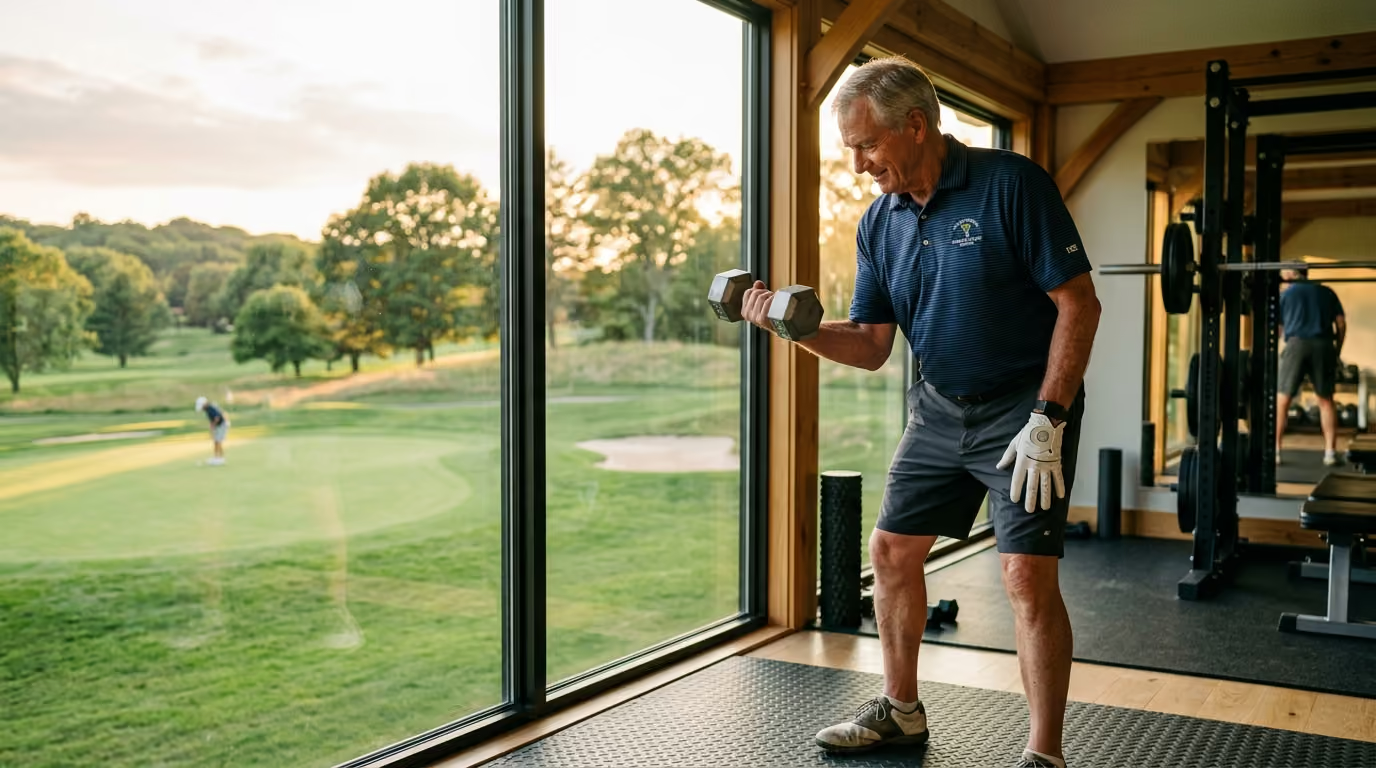

Stiff knees and aching hips on the back nine show why senior golfers need targeted resistance training to maintain strong bones and healthy joints.




Many golfers believe that walking eighteen holes is the ultimate exercise to keep their skeleton strong. This comfortable belief is actually a mistake. While walking is excellent for your heart, it does little to keep your bone density high. In fact, research shows that playing golf alone does not build stronger bones.
We often treat our bodies like old cars with parts that slowly wear out. We think that every swing takes a mile off our joint life. Consequently, many players over fifty stop lifting weights or running. They think they are saving their joints from damage.
This passive approach actually speeds up joint decay. Your body is a biological system. It does not wear out like metal. Instead, it adapts and repairs itself when you place specific physical stress on it.
To keep your bones strong and joints greased, you must do more than just play golf. You need targeted resistance and impact training. This is why focusing on healthy ageing concepts is the key to playing golf forever. Without structured training, your bones will slowly thin out even if you walk the course daily.
Arthur is a fifty-eight-year-old golfer with a passion for the game. He is standing on the fourteenth tee of a challenging, hilly course. He has been walking for over three hours. Now, he feels a dull, warm ache in his lead knee.
He tries to make a full, smooth backswing. However, his hips feel tight and locked. He cannot turn his trail hip fully. To compensate for this tightness, Arthur sways his entire body away from the target.
His head slides several inches to the right. As he swings down, his club strikes the ground early. A large chunk of turf flies into the air, and the ball dribbles fifty yards down the fairway.
This sway fault does more than ruin his scorecard. It places immense, unnatural pressure on his lower back and knees. Arthur's joints are screaming for better physical preparation. This on-course frustration is a clear warning sign of structural decay.
To protect your body, you must understand how your skeleton reacts to physical force. This begins with a biological rule known as Wolff's Law. This rule states that bone grows or remodels in response to the specific forces you place upon it.
If you do not apply stress to your bones, they will slowly thin out. After age forty, bone mineralization decreases by about 0.3 percent to 0.5 percent every year. Over a lifetime, men can lose up to 35 percent of their cortical bone. Women often lose even more because of hormonal shifts during menopause.
To stop this loss, you must use a biological process called mechanotransduction. This process is how your cells convert mechanical movement into chemical signals. When you lift weights, your bone cells sense the load. They immediately signal your body to deposit more minerals into the bone matrix.
This is why strength training routines are so crucial for senior golfers. Without this heavy load, your bones will continue to decay.
Your joints also rely on movement to stay healthy. Your joint capsule is filled with a thick fluid called synovial fluid. This fluid acts as a natural grease for your cartilage.
When your joints stay still, this fluid becomes thin and dry. However, cyclic movement doubles the secretion rate of hyaluronic acid. This acid is the primary lubricant in your joints.
Research shows that cyclic movement raises this lubricant secretion to 22.6 micrograms per hour. In contrast, static joints only secrete 10.3 micrograms per hour. Movement is literally the lotion that keeps your joints gliding smoothly.
You cannot fix a physical problem until you know where it is. The Titleist Performance Institute, or TPI, created a framework called the Body-Swing Connection. This system shows how physical limitations lead directly to swing faults.
For example, if your hips cannot rotate, your body will find another way to turn. This often leads to a fault called "Early Extension." This happens when your hips move toward the ball during the downswing.
Early extension forces your spine to stand up quickly. This movement puts terrible compressive force on your lower back. It also makes your shots highly inconsistent.
You can test your own mobility at home. Stand with your feet together and try to turn your hips while keeping your chest still. If you cannot do this, your hip joints lack the necessary separation from your torso.
Another common fault is the "Reverse Spine Angle." This occurs when your upper body tilts toward the target at the top of your backswing. It is usually caused by a stiff upper back.
To prevent these faults, you must screen your body regularly. Identifying these tight areas is the first step toward effective injury prevention strategies.
When you arrive at the golf course, your joints are likely stiff from driving. You need an immediate way to grease your hips and shoulders. You can do this right next to your golf cart in just five minutes.
Avoid holding deep, static stretches before you play. Static stretching can temporarily reduce muscle power. Instead, use active movements that pump fluid into the joint spaces.
First, focus entirely on your lead hip. Stand on your trail leg and hold the golf cart for balance. Slowly swing your lead leg forward and backward ten times.
Keep your torso quiet as you do this. This gentle movement pumps fresh synovial fluid directly into your hip socket. Now, switch legs and repeat the process for your trail hip.
Next, stand tall and hold a golf club across your upper chest. Place your hands on opposite shoulders to secure the club.
Focus entirely on turning your upper back while keeping your hips completely still. Turn slowly to the left, then turn to the right. Perform ten slow, controlled repetitions.
This movement prepares your thoracic spine for the rotation of the swing. It is a quick, simple way to grease your joints before you strike your first tee shot.
To build lasting bone density, you must perform axial loading. This means applying weight through the long axis of your bones, especially your hips and spine. Standard walking is not a strong enough stimulus to trigger this bone growth.
You can build a strong skeleton at home with two key exercises. Perform these movements two to three times per week. Always start with light weights and focus on perfect form.
The first exercise is the Goblet Squat. This movement targets the femur and the pelvis, which are common sites for bone loss.
Perform three sets of eight repetitions. This heavy load triggers your body to build denser bone in your hips.
The second exercise is the Weighted Lunge. This movement builds single-leg stability and strengthens your hip joints.
Perform three sets of six repetitions on each leg. This single-leg training is vital for supporting your weight during the golf swing.
While heavy lifting builds bone, you also need to maintain your rotational flexibility. If your joints cannot turn, your swing will suffer. You can protect your joints by performing two key mobility drills daily.
The golf swing requires a massive amount of rotation in a short time. If your hips or upper back are locked, your body will force your lower back to twist. The lower back is not built for rotation. This mistake is a primary cause of disc injuries in older golfers.
The first drill is the Archer Twist. This exercise keeps your upper back flexible, which prevents lower back pain.
Perform ten repetitions, then switch knees and repeat on the other side. This drill maintains the seventy degrees of upper back rotation needed for a safe swing. This is an excellent addition to your improving golf mobility routine.
The second drill is the 90/90 Hip Stretch. This stretch targets your hip joints, which must rotate fully during the swing.
Hold this stretch for thirty seconds while taking deep belly breaths. Repeat this stretch on the opposite side. This drill protects your knees by making sure your hips do the turning.
Many mature golfers believe that walking is the safest way to exercise. However, slow walking does not provide the high-force impact needed for bone health. To build truly dense bones, you must transition to osteogenic loading.
Aerobic exercises like swimming or cycling are great for your lungs. Yet, they provide almost zero structural stimulus for your bones. Your skeleton requires a quick, sharp force to trigger bone mineral growth.
Osteogenic loading uses brief, high-force impacts to stimulate bone mineral density. This sounds scary for older joints, but it can be done safely. You do not need to jump off high boxes to get this benefit.
You can start with a simple exercise called Heel Drops. This drill provides a safe, controlled shock to your skeleton.
Perform twenty of these drops daily. The mild impact sends vibrations up your legs, which signals your bones to grow stronger.
If your joints are healthy, you can progress to low-level hops. Stand on a soft mat and perform small, continuous jumps.
Keep your jumps low, just an inch off the ground. Land softly on your feet, absorbing the force with your hips and knees.
These small impacts teach your body to handle ground reaction forces. This is the exact force you use to generate power in your golf swing. This progression is an important part of your golf recovery practices and longevity plan.
When trying to improve their physical health, many senior golfers make critical mistakes. These errors can actually cause more harm than good. You must recognize these pitfalls to stay safe.
The first mistake is resting too much for chronic joint stiffness. It is natural to want to sit down when your knees or hips ache. However, inactivity actually worsens chronic joint pain.
Static joints do not cycle their fluid efficiently. It takes up to thirty hours for a resting joint to refresh its lubricant. An active joint can do this in half the time. Movement is the only way to deliver nutrients to your joint cartilage.
The second mistake is avoiding heavy loads because of a fear of wear and tear. Many players believe their joints have a limited lifespan. They think lifting heavy weights will wear out their cartilage.
This belief is scientifically incorrect. Cartilage needs loading to remain healthy and thick. If you only lift light weights, you will never trigger the osteogenic response needed for bone growth.
The third mistake is ignoring the warning signs of a reverse spine angle. This swing fault occurs when your spine tilts toward the target at the top of your swing. It is often caused by a stiff upper back.
If you ignore this limitation, you will place terrible shear forces on your lower lumbar spine. You must address your upper back stiffness before you try to swing faster.
Your equipment choices have a massive impact on your physical longevity. The wrong gear can place unnecessary stress on your bones and joints. Making a few simple adjustments can protect your body from wear.
First, examine your golf shoes. Traditional golf shoes with heavy metal spikes lock your feet firmly into the turf.
While this provides traction, it also stops your ankles from rotating. This force is then transferred directly into your knees and hips.
Switch to spikeless shoes with flexible soles. These shoes allow your feet to move naturally, which absorbs the shock of your swing.
Second, consider your club shafts. Steel shafts are highly rigid and transmit vibration directly into your arms.
This constant vibration can lead to elbow tendonitis and shoulder pain. Switching to graphite shafts can make a massive difference. Graphite naturally dampens vibration, which protects your upper body joints.
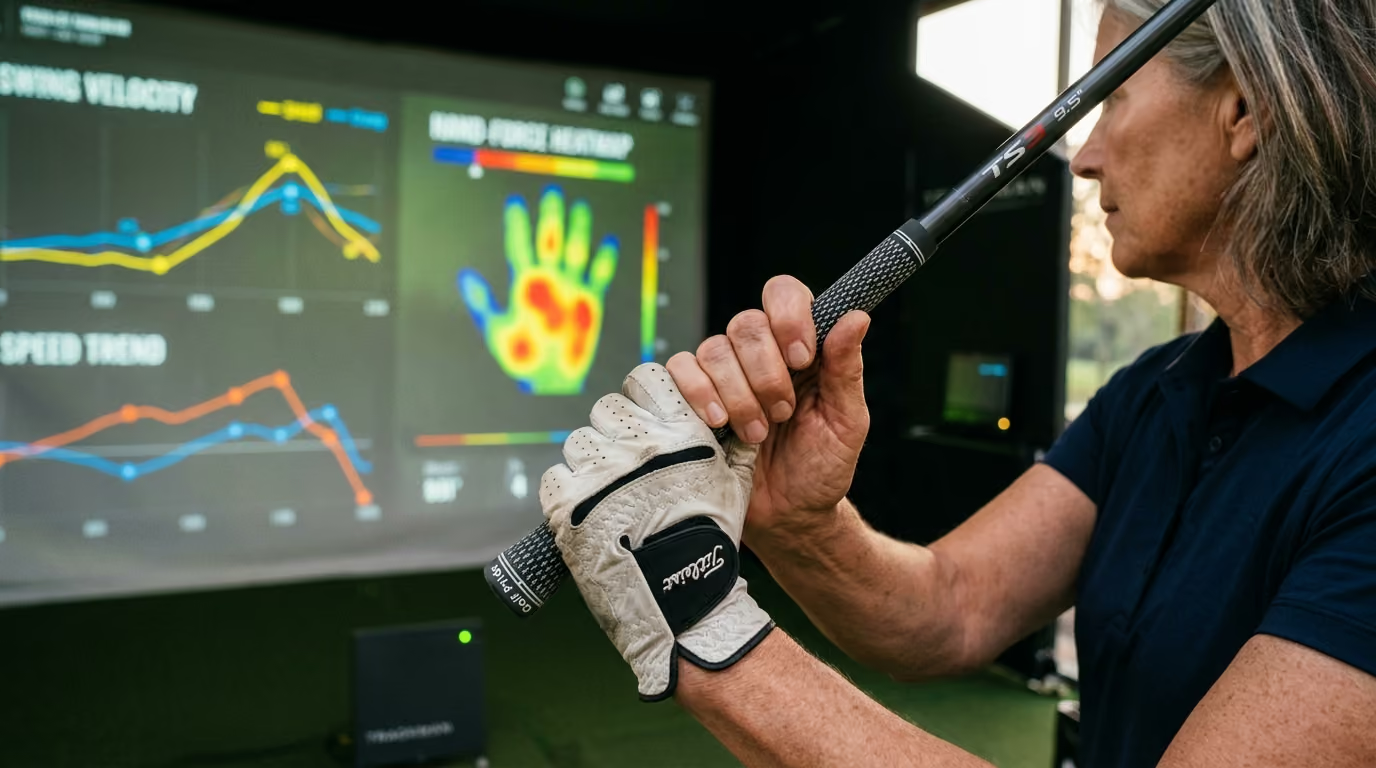
Third, look at the size of your grips. Small grips force you to squeeze the club with a tight, tense hand action.
This extra tension travels up your forearms, straining your wrists and elbows. Try using midsize or jumbo grips on your clubs.
These larger grips allow you to hold the club with lighter pressure. This simple change reduces joint strain throughout your entire arm.
Joint replacements are increasingly common for mature golfers. Fortunately, a new hip or knee does not mean the end of your playing days. With a careful plan, you can return to the course safely.
According to the American Academy of Orthopedic Surgeons, most golfers can return to play within twelve weeks of surgery. However, you must follow a structured progression to protect your new joint.
During Phase One, which covers weeks one to four, focus on walking and low-impact movement. You can practice putting and light chipping. Avoid taking any full swings. Use a stationary bike to help rebuild joint mobility and stimulate fluid production.
During Phase Two, which covers weeks four to twelve, you can begin taking partial swings. Use your short irons and swing at fifty percent speed. Focus entirely on maintaining your balance and coordination. Use this time to perform step-down exercises, which rebuild eccentric control in your legs.
When you finally return to full play, you should modify your swing. Open your lead foot outward by turning it to a ten o'clock position.
This open stance reduces the twisting force on your lead hip and knee during your downswing. Additionally, use a step-through finish.
Let your trail foot step forward toward the target after you strike the ball. This movement releases the rotational pressure on your lower back and artificial joints.
To play golf forever, you must train your body to adapt to resistance rather than trying to protect it from movement.
Keep your training consistent and your body will support your passion for years to come.
Follow Golfergy for practical insights on performance, mobility, recovery and healthy ageing. Stay connected for new articles, research-led guidance and ideas to help you play better for longer.


Explore practical resources on performance, recovery, mobility and golf longevity.
Read the Blog