
Understand trunk strength, control and mobility for golf, with practical starting points that focus on a comfortable turn rather than more rotation.




Trunk strength is your torso’s ability to produce or resist force. Trunk control is your ability to manage that force as you turn. For golf, the useful goal is a turn you can manage rather than the longest backswing you can reach.
That distinction separates strength work from flexibility work. Mobility and flexibility work concern the movement available to you. Strength and control work concern your ability to produce and manage force within that movement.
These goals belong alongside each other, but they are not interchangeable. A stretching session and a trunk-strength exercise ask different things of your body. Neither needs to become a campaign for more rotation.
The research brief’s practitioner explanations describe the trunk as having both turning and stabilising roles. In golf terms, that means thinking about how you rotate and how you manage your body position during that rotation. The lesson is broader than simply making the muscles around your middle stronger.
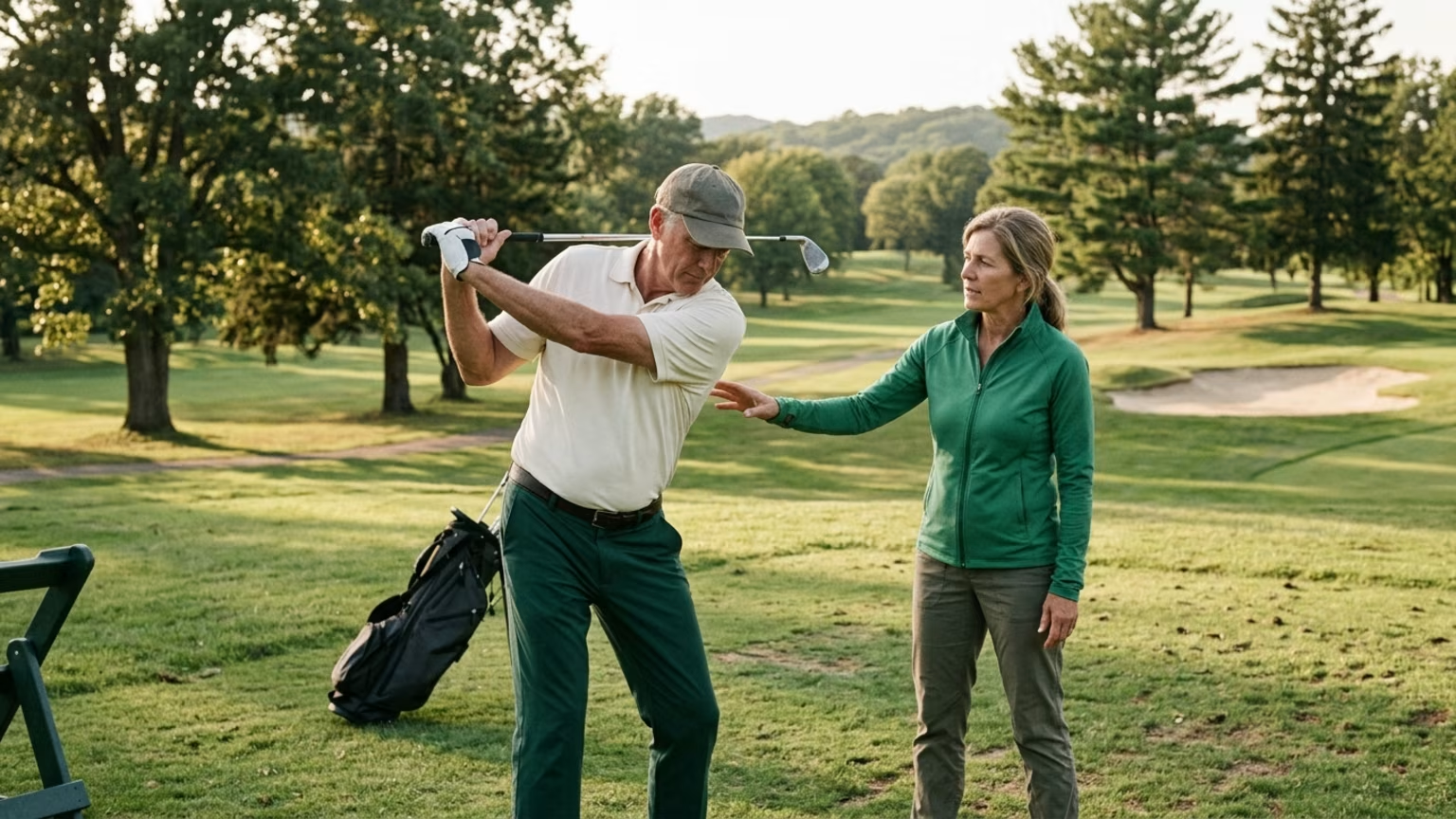
At the tee, separate the size of your turn from your command of it. Reaching farther into a backswing is not the same task as moving through a comfortable backswing with control. Treat those as different goals rather than assuming that progress in one proves progress in the other.
On an approach shot, apply the same distinction to posture. Think about managing the position you use to swing rather than trying to hold your torso rigid. Control work is about managing movement, not removing movement from the swing.
Across a full round, pay attention to what changes. Does your turn begin to feel forced? Does your body position become harder to manage on the back nine? Those observations give you something useful to discuss with a qualified professional without guessing at the physical cause.
The practical translation is straightforward: do not answer every uncomfortable or restricted feeling by trying to turn farther. Keep the immediate focus on a comfortable trunk turn. Golfergy’s guide to coordinating rotation across the body develops that movement-first perspective.
For golfers past 40 or 50, a useful question is: “What movement can I control now?” That is a better starting point for this discussion than assigning yourself a backswing target based on your birthday. Age provides context, but it is not an individual exercise assessment.
A golf-media account of an older-golfer study reports that a 2004 study included 31 male golfers aged 55 to 79. It describes 19 participants in an eight-week strength-and-flexibility program and 12 controls. The account reports that the training group’s average clubhead speed increased from 85.0 to 87.1 mph.
That finding gives this conversation a concrete older-golfer example. It describes strength and flexibility being trained together rather than treating either one as the complete answer. It does not turn a larger backswing into the objective.
The evidence has clear boundaries. This secondary account cannot isolate the effect of trunk-strength work or establish how and why trunk strength changes specifically after 40 or 50. The practitioner exercise guidance discussed here is not a tested universal routine or proof of injury prevention. Using comfortable movement without pushing through pain is a conservative editorial precaution rather than a protocol tested by these sources.
The practical response is to make present capacity the starting point. Avoid labelling every change in your swing as an unavoidable consequence of age. Also avoid treating a result from a combined program as a personal speed target.
At Golfergy, we favour sustainable physical preparation over fixed promises about what a golfer should achieve at a particular age. Our article on using age as training context follows that same principle.
Begin by separating the purpose of the work. A warm-up movement can introduce a comfortable turn. A strength exercise belongs to a different category: producing or managing force.
A senior-golf article recommends a warm-up that includes controlled trunk turns and hip rotations. It also includes shoulder and ankle movement. For this lesson, keep your attention on the trunk turn rather than trying to change several body movements at once.
The practical focus is a comfortable turn, not a deeper stretch. Stop short of pain rather than treating discomfort as something to work through. There is no need to turn the movement into a test of how far you can rotate.
Keep its purpose clear in your own mind: this is preparation for movement. Do not judge it by whether your backswing looks longer afterward. The question is whether you are practising a turn that stays within your current comfort.
This distinction also helps keep warm-up work separate from strength work. A controlled turn does not need to carry every training goal at once. Give it one job instead of asking it to stretch you farther and build strength at the same time.
A sports physiotherapy article lists trunk and hip strengthening among strategies discussed for golf-related back-pain prevention. Its examples include bridges, planks, bird dogs and rotational core work. These are practitioner examples of strengthening work rather than a reason to force extra backswing range.
A plank is one example to discuss when choosing an appropriate trunk-strength movement. Keep that discussion focused on the purpose of the exercise: strength and control. It is a different task from trying to gain more available movement through flexibility work.
For personal exercise selection, a qualified physiotherapist or exercise professional is the appropriate person to help adapt the movement to your current range and comfort. If pain is part of the picture, bring that into the discussion rather than trying to solve it by copying an exercise list.
You do not need to make the strength movement more golf-like by adding a bigger turn. Keep the immediate task small and clear. Work on the selected movement rather than combining it with an attempt to rebuild your swing.
Our guide to the difference between available movement and controlled movement offers more context for keeping those training purposes separate.
Training your trunk to manage the turn you have, rather than forcing a larger one, keeps the focus on Playing Better for Longer.
Follow Golfergy for practical insights on performance, mobility, recovery and healthy ageing. Stay connected for new articles, research-led guidance and ideas to help you play better for longer.


A practical look at golf strength after 40, with research on older golfers and simple habits for connecting training goals to a coordinated swing.


How legs, trunk and upper body share the work of a golf swing, with simple planning habits and a measured look at evidence for older golfers.

Understand mobility versus stability in golf, what older-golfer research reports, and two modest habits for comfortable movement control.
Explore practical resources on performance, recovery, mobility and golf longevity.
Read the Blog