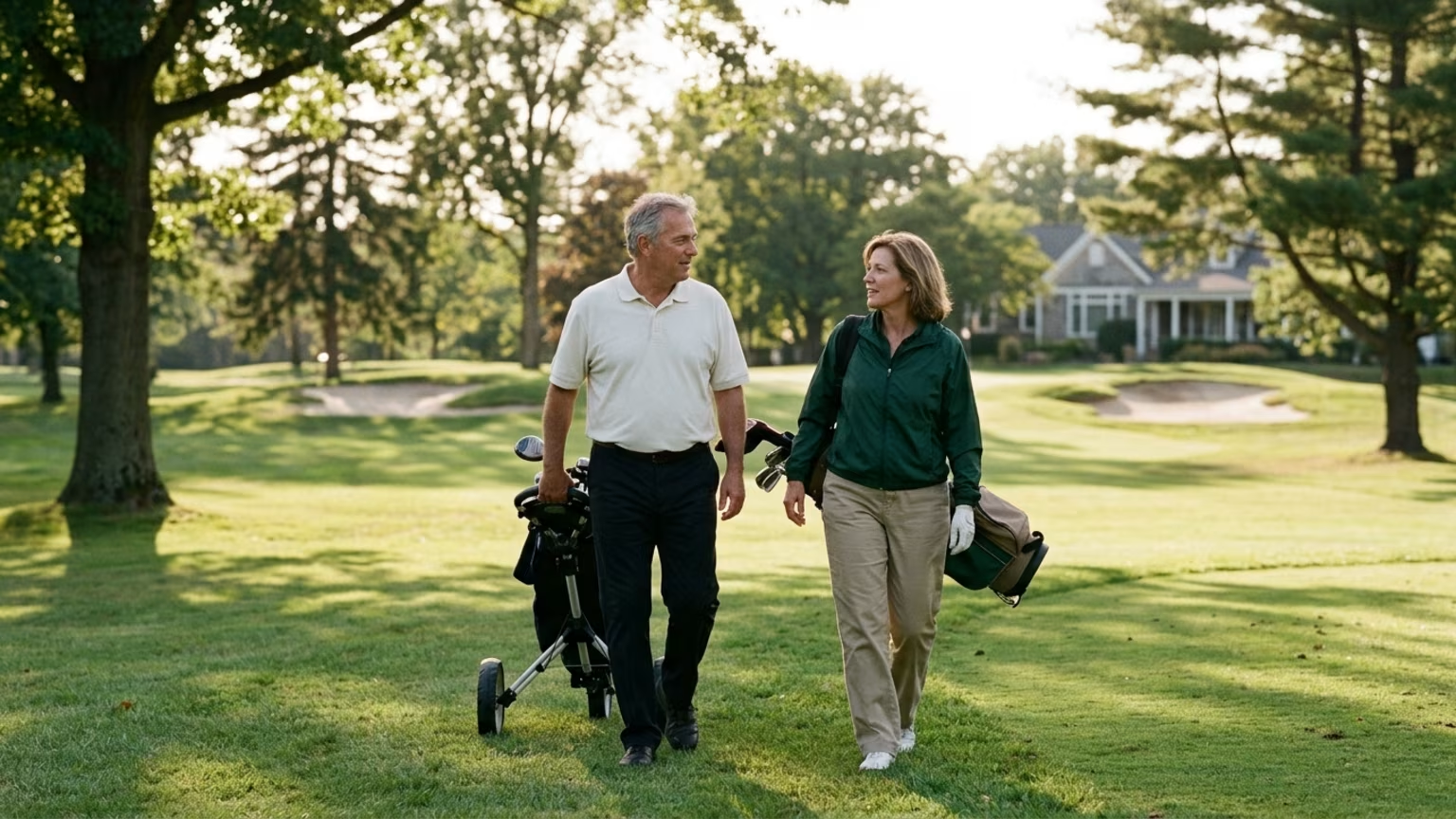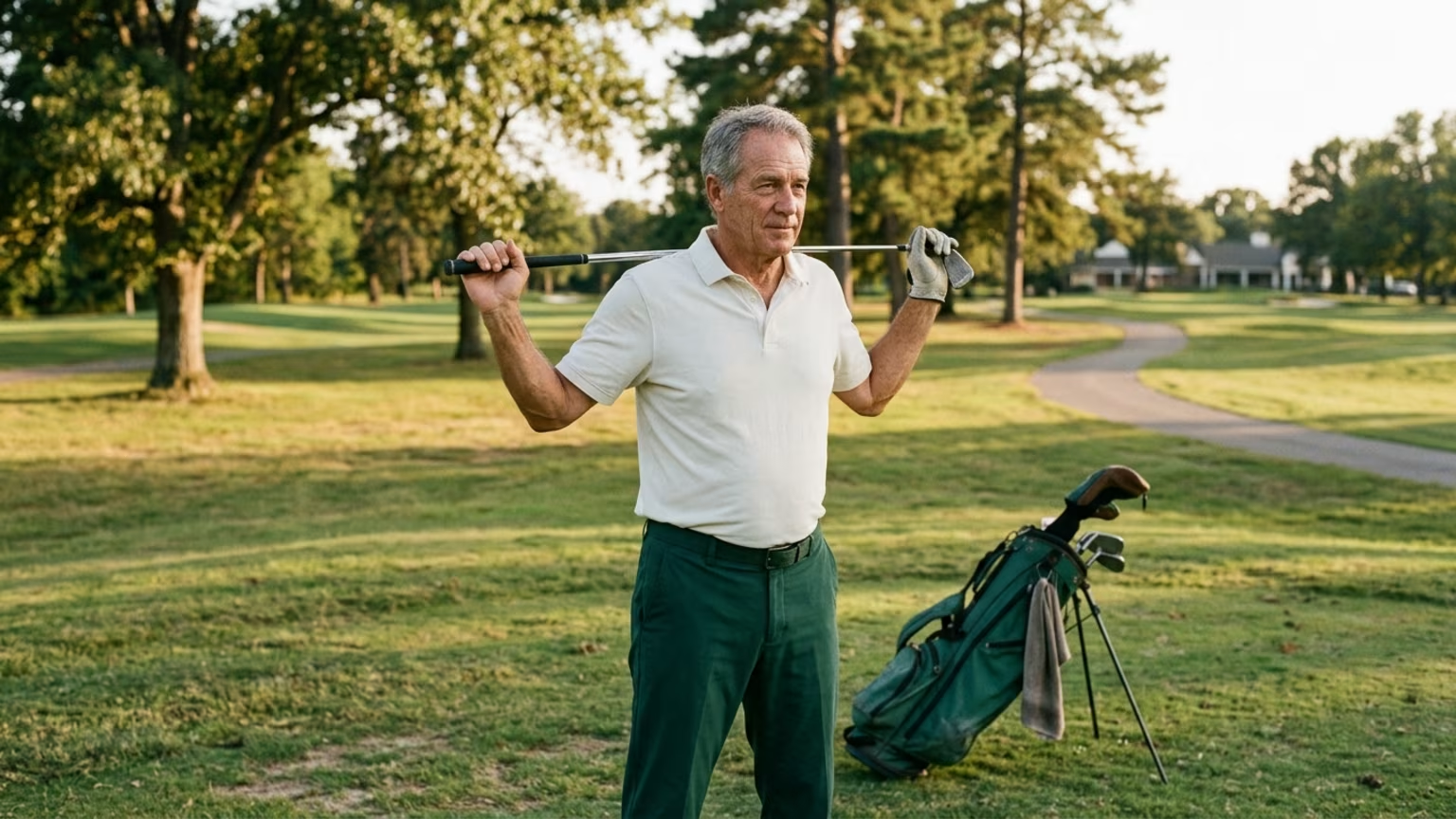

A grounded guide to comfortable golf rotation, gentle movement observations and pairing mobility with strength after 40.




Golf rotational mobility is your ability to turn through the hips, trunk and shoulders. Useful rotation means being able to use that movement comfortably and with control. It is not simply how far you can twist.
That distinction matters when your familiar backswing starts to feel less comfortable. Chasing the old shape is one response. A more practical starting point is noticing how each part of the turn feels without pushing for extra range.
At Golfergy, our focus is practical guidance that connects physical capacity to real golf movements. For rotation, that means looking beyond flexibility alone. Comfortable movement and strength belong in the same conversation about playing for longer.
A therapy-provider explainer describes the swing as coordinated movement involving the hips, trunk, shoulders and arms. The club is part of that moving system too. Its explanation is a useful reminder that a golf turn is not one joint doing all the work.
Think of hip movement as the lower-body part of that coordinated turn. Upper-back movement belongs within the trunk contribution. Shoulder movement brings another region into the action rather than replacing everything below it. These are connected contributions, not separate contests to see which body part can turn farthest.
The same provider notes that limits in mobility, strength, timing or balance may change how motion is distributed. The lower back may then be asked to create or absorb more motion. That makes whole-body coordination a more useful discussion than simply asking for additional shoulder turn.
Across a standard 18 holes, the practical question stays the same: does the turn feel comfortable and controlled? At the first tee, that question fits the transition from preparation to fuller swings. Through the middle of the round, it provides something more useful to notice than whether your backswing looks longer.
On the back nine, the goal is still a turn you can use rather than one you have to force. A larger-looking motion is not the only way to judge your movement. The focus here is how the turn feels during golf, not how impressive a stretching position looks away from the course.
For a related discussion, Golfergy looks at building usable range without forcing the back. The shared principle is to connect movement practice to the swing rather than treat extra range as the whole goal.
For golfers past 40 and 50, an age-based rotation target is not supported by this evidence. The available accounts do not establish when rotational decline begins or explain its biological causes. Rather than assigning a predictable loss to a birthday, the practical focus is your present movement and capacity.
There is some encouraging evidence that older golfers can respond to training. A secondary golf-media account reports that Thompson and Osness studied 31 male golfers aged 55 to 79. Of these, 19 took part in an eight-week strength-and-flexibility program and 12 were in a control group. The account reports that the training group’s average clubhead speed rose from 85.0 to 87.1 mph.
That was a small study reported secondhand, and the program combined strength with flexibility. It cannot isolate the effect of mobility or establish the same outcome for women and all golfers over 40. The available summary also lacks the detail needed to reproduce the program.
The pain evidence needs separate care. A physical-therapy article describes the relationship between particular swing mechanics and low-back pain as limited and conflicting. It also reports that pooled hip internal-rotation findings did not show a clear association with low-back pain. Restricted hip movement should therefore not be presented as a proven explanation for an individual golfer’s aching back.
The movement observations below are not validated home tests and have no established pass-or-fail threshold in these sources. The warm-up is general guidance rather than a tested personal prescription or proof of injury prevention. Pain, substantial restriction or concerns about returning to exercise call for individual guidance from a qualified clinician.
The constructive lesson is broader than “stretch more.” The older-golfer program addressed strength and flexibility together. That supports keeping both in the discussion rather than making mobility the sole answer to an ageing swing.
A useful observation starts with one body region and one small movement. For hip awareness, the research packet’s practical framing is a gentle seated or lying hip-rotation movement on each side. Attention stays on how that hip moves rather than on producing the biggest possible turn.
The observations are simple: comfort, stiffness and an obvious difference between sides. There is no score to chase. The purpose is to describe what you notice so that any later conversation about movement begins with something specific.
For upper-back awareness, the example is a slow and comfortable seated trunk turn. Focus entirely on the feel of that turn. The goal is an easy movement you can control rather than forcing the shoulders farther around.
Keep those observations separate instead of turning them into a whole-body flexibility challenge. A hip movement asks about the hip. A seated trunk turn asks about the feel of that turn. Neither needs to become a competition with your younger self or a playing partner.
Golfergy’s guide to making mobility practice relevant to your swing follows that same practical theme: keep the attention on movement you intend to use.
A golf-health article recommends a progressive pre-round warm-up. Its sequence moves from brisk walking to controlled shoulder circles, hip rotations, trunk turns and ankle mobility. Short-iron half swings come before full swings.
The useful feature is the progression rather than an attempt to stretch everything at once. Each movement gets its own attention. Shoulder circles are a preparation option here, not another range target to chase.
The same article recommends ongoing exercise to build hip, core and shoulder capacity. Alongside the combined strength-and-flexibility study, that gives this discussion a balanced direction: movement practice belongs beside strength work. A personal strength program is a matter for qualified guidance rather than a routine reconstructed from a brief study summary.
A warm-up and longer-term training also serve different purposes in this framing. The warm-up provides a gradual lead-in to swinging. Ongoing exercise keeps the discussion focused on building capacity beyond the first tee. Neither needs a promise of extra distance to have a place in a thoughtful approach to golf.
Comfortable rotation paired with strength keeps the goal where it belongs: Playing Better for Longer.
Follow Golfergy for practical insights on performance, mobility, recovery and healthy ageing. Stay connected for new articles, research-led guidance and ideas to help you play better for longer.


A practical strength framework for golfers over 40, built around everyday goals, sensible progression and a careful look at limited golf research.


A research-led look at strength, balance, mobility and trunk control, with a flexible planning framework for golfers over 40.
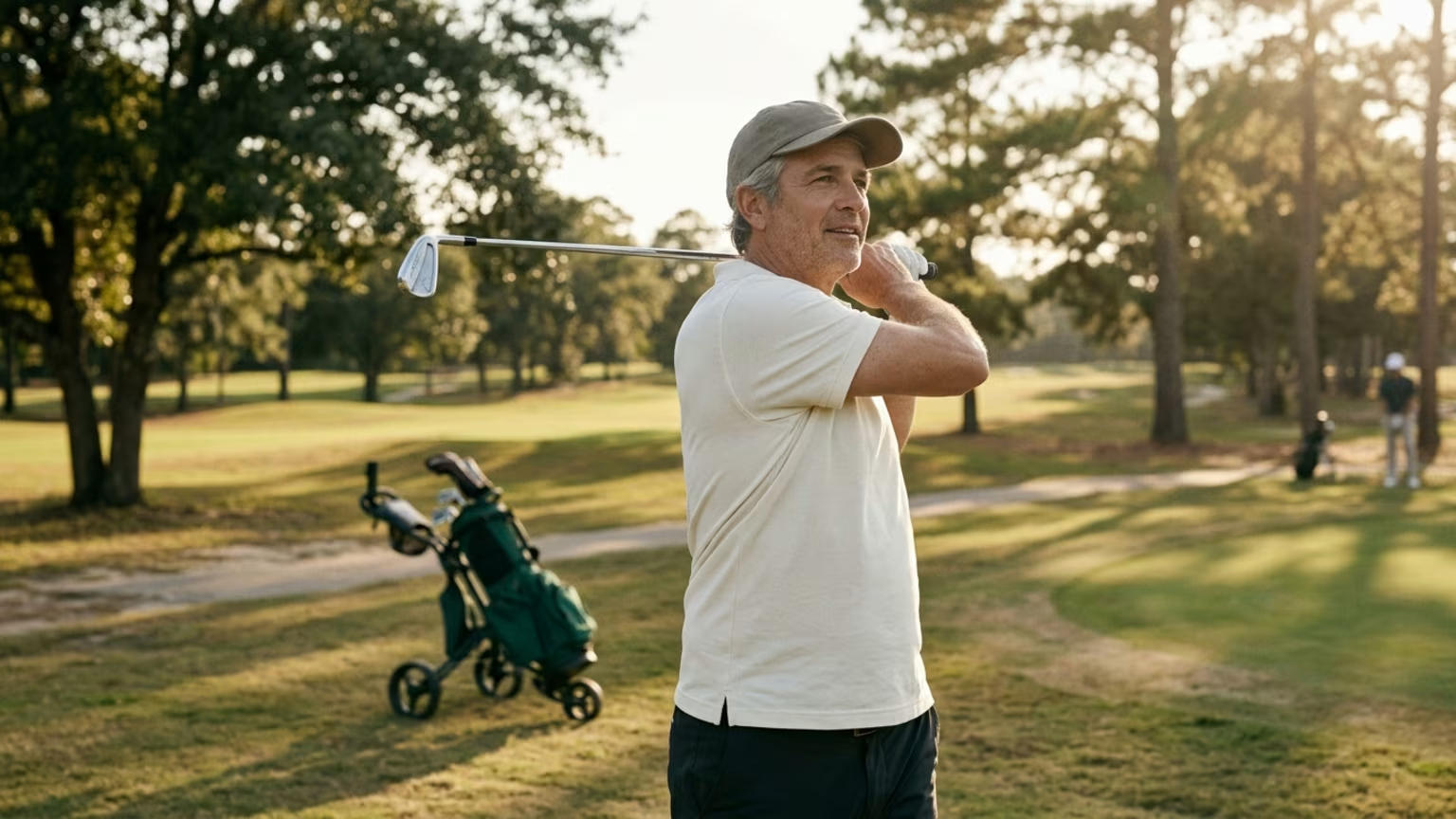
Understand golf mobility after 40 with a comfortable-turn self-check, hip and shoulder guidance, and a clear look at flexibility and swing speed.
Explore practical resources on performance, recovery, mobility and golf longevity.
Read the Blog