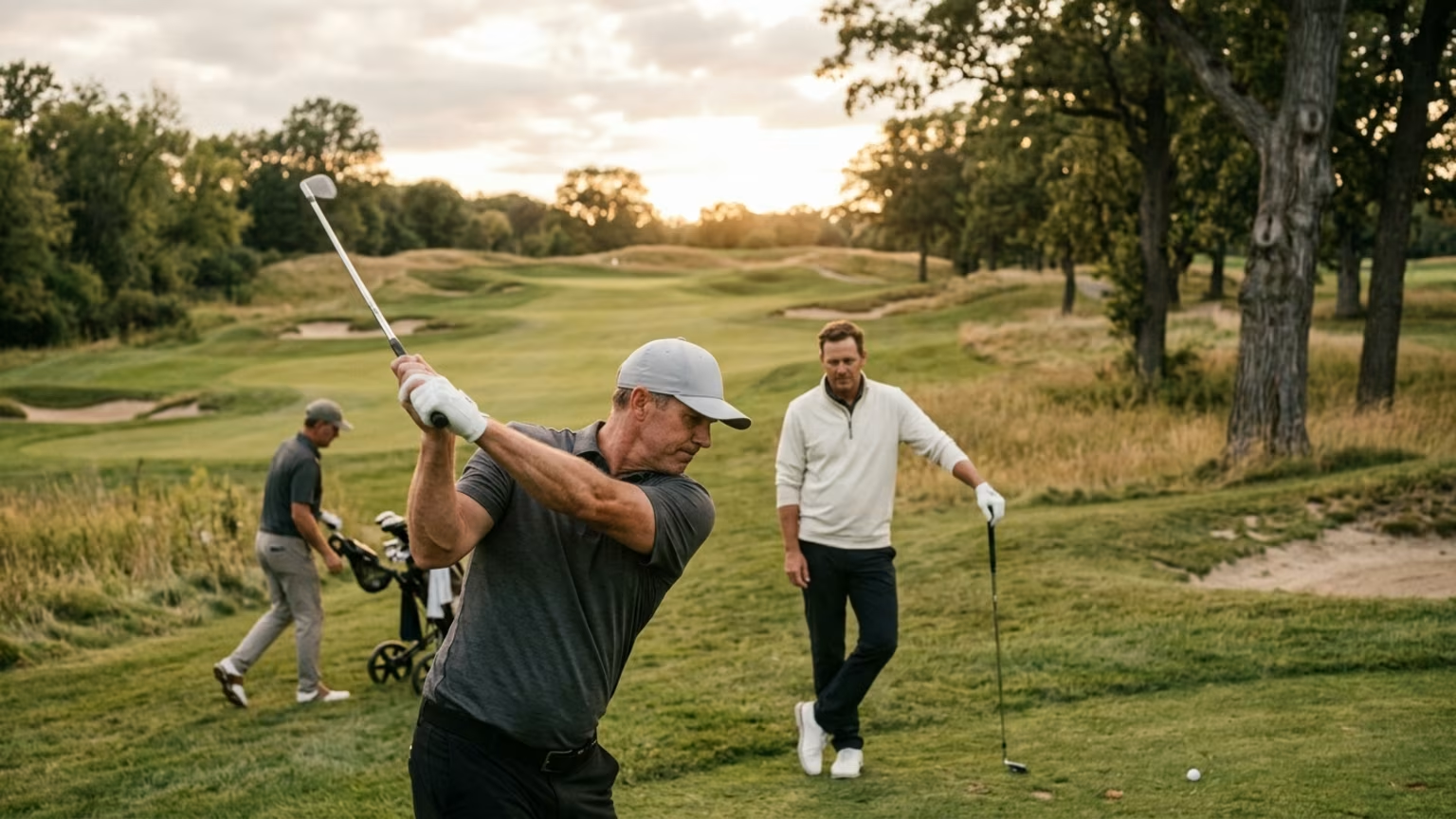

Learn how golfers over 40 can build leg strength, hip control, and trunk endurance to walk 18 holes and maintain a repeatable swing without fatigue.




Professional tournament golf demands a massive physical toll on the human body. A report on professional play describes a single round as roughly five miles of walking. Four rounds produce about 20 miles before practice and range work are even included. Published golf estimates commonly place a recreational 18-hole walking round at roughly four to six miles. That distance requires 9,500 to 13,000 steps across uneven terrain.
When mature players fade on the back nine, a single bad swing is rarely the true cause. Fatigue compromises mechanics, posture, and concentration late in the day. The physical demands of walking and carrying equipment quietly erode a player's foundation. This steady decline explains why many experienced players stop walking the course entirely.
"The saddest thing I have seen in golf is watching lifelong playing partners slowly drop out of our weekend group. It usually starts with a nagging shoulder or knee issue they ignore until it requires surgery. That pattern is exactly why I became obsessed with golf longevity. We do not have to stop playing as we age, provided we do the right maintenance work between rounds."
Playing 18 holes combines prolonged walking with hundreds of technically similar rotational movements. As fatigue accumulates, the physical qualities that keep a golfer moving safely begin to deteriorate. Leg strength fades, hip control weakens, and the trunk loses its necessary stiffness. The lower back often compensates when the hips and glutes stop producing force, leading to severe lower back stress.
This compensation forces the spinal joints to handle rotational forces they are not designed to absorb. The lumbar spine thrives on stability rather than extreme twisting. When tired legs fail to stabilize the pelvis, the lower back bends and twists simultaneously. This combination creates excessive sheer force on the spinal discs.
Over a long round, this mechanical breakdown makes every swing feel more costly. Muscles that should be resting between shots remain tense to protect irritated joints. This protective tension severely limits rotational freedom. It forces the golfer to rely on their arms and shoulders to generate speed.
Reversing this physical decline requires a progressive approach to resistance training. A 2026 summary of ACSM resistance-training guidance reported that heavier loads are most associated with maximal-strength goals. Meanwhile, moderate loads moved quickly are more relevant to power-oriented work. The cited 2026 summary reports broad benefits from resistance training.
The research says equipment type and training to failure did not consistently change major outcomes. This means you do not need a complicated gym setup to see significant improvements. A practical baseline is resistance training on at least two days each week to cover major muscle groups. You can start building a strong base with simple tools like resistance bands and dumbbells.
Building strength is a steady process that rewards consistency over intensity. Golfers should include balance work alongside strength and aerobic training. According to the Otago Strength and Balance exercise guidelines, simple balance routines are highly effective for older adults looking to maintain physical function. You can gradually progress resistance only when technique and recovery are completely reliable.
Age 40 is not a physiological cliff for athletic performance. However, long periods of desk work and reduced training volume take a heavy toll over time. Previous injuries and normal age-related reductions in muscle mass leave experienced players vulnerable. These factors make the demands of walking and swinging feel physically expensive.
Many golfers believe that simple cardiovascular exercise will preserve their game. They spend hours on a treadmill or stationary bike hoping it translates to the fairway. A recent health report questioning if walking 30 minutes a day is enough after 60 concluded that walking alone does not challenge maximal strength. It also fails to train the ability to stabilize the trunk against external loads.
A golfer who can lift well in a gym but rarely walks may still struggle. The cumulative duration of a hilly course requires specific walking capacity. You must build both strength capacity and walking tolerance to perform well for 18 holes. Combining these two elements is the foundation of true golf endurance.
The most practical response is adding progressive resistance training to your weekly routine. This approach targets the exact physical qualities that degrade over a long round. You must learn to load the hips and posterior chain without repeatedly flexing the lower back. The hip hinge trains the glutes and hamstrings to contribute when you bend.
Start your strength journey with a simple dowel hinge or a wall hinge. Focus entirely on pushing your hips backward while keeping your shins relatively vertical. Keep the load close to your body to minimize stress on your spine. Do not treat your lower back as the primary lever for this movement.
Split stances are another crucial category for older players. Golf is not performed from a perfectly symmetrical stance on every single shot. Split-stance training challenges the hips and trunk to control the body. Start with a supported split squat and progress to a reverse lunge carefully.
Carries are another highly effective category for mature players. A loaded carry demands that you walk while keeping your ribs and pelvis perfectly stacked. The challenge is to avoid leaning toward or away from the weight in your hands. Begin with short suitcase carries to build the lateral control required for a stable golf posture.
Many mature players attempt to stretch away every physical limitation they experience. They assume that tight hamstrings require aggressive daily stretching routines. The reality is that tightness is often a neurological response to physical weakness. Your body restricts range of motion to prevent you from entering unstable positions.
Another common error is believing you need complicated exercises that mimic the golf swing. Anti-rotation work is not intended to eliminate normal golf-swing rotation entirely. It trains the ability to resist an external rotational force and maintain control. A stable trunk is not a rigid trunk, and more rotation is not automatically better.
The practical target is maintaining a quiet pelvis while the arms move a band. Endless twisting exercises with heavy medicine balls often do more harm than good. They train speed before the foundational control is established. A simple suitcase carry is far more effective for building reliable trunk endurance.
We do not have to accept physical decline as an inevitable part of the game. Building leg strength, hip control, and trunk endurance will keep you upright. These functional capacities help your swing remain repeatable from the first tee to the final green. What adjustments will you make to your strength routine this season to keep your swing repeatable through the 18th hole?
Follow Golfergy for practical insights on performance, mobility, recovery and healthy ageing. Stay connected for new articles, research-led guidance and ideas to help you play better for longer.


A practical strength framework for golfers over 40, built around everyday goals, sensible progression and a careful look at limited golf research.


A research-led look at strength, balance, mobility and trunk control, with a flexible planning framework for golfers over 40.
Understand golf mobility after 40 with a comfortable-turn self-check, hip and shoulder guidance, and a clear look at flexibility and swing speed.
Explore practical resources on performance, recovery, mobility and golf longevity.
Read the Blog


