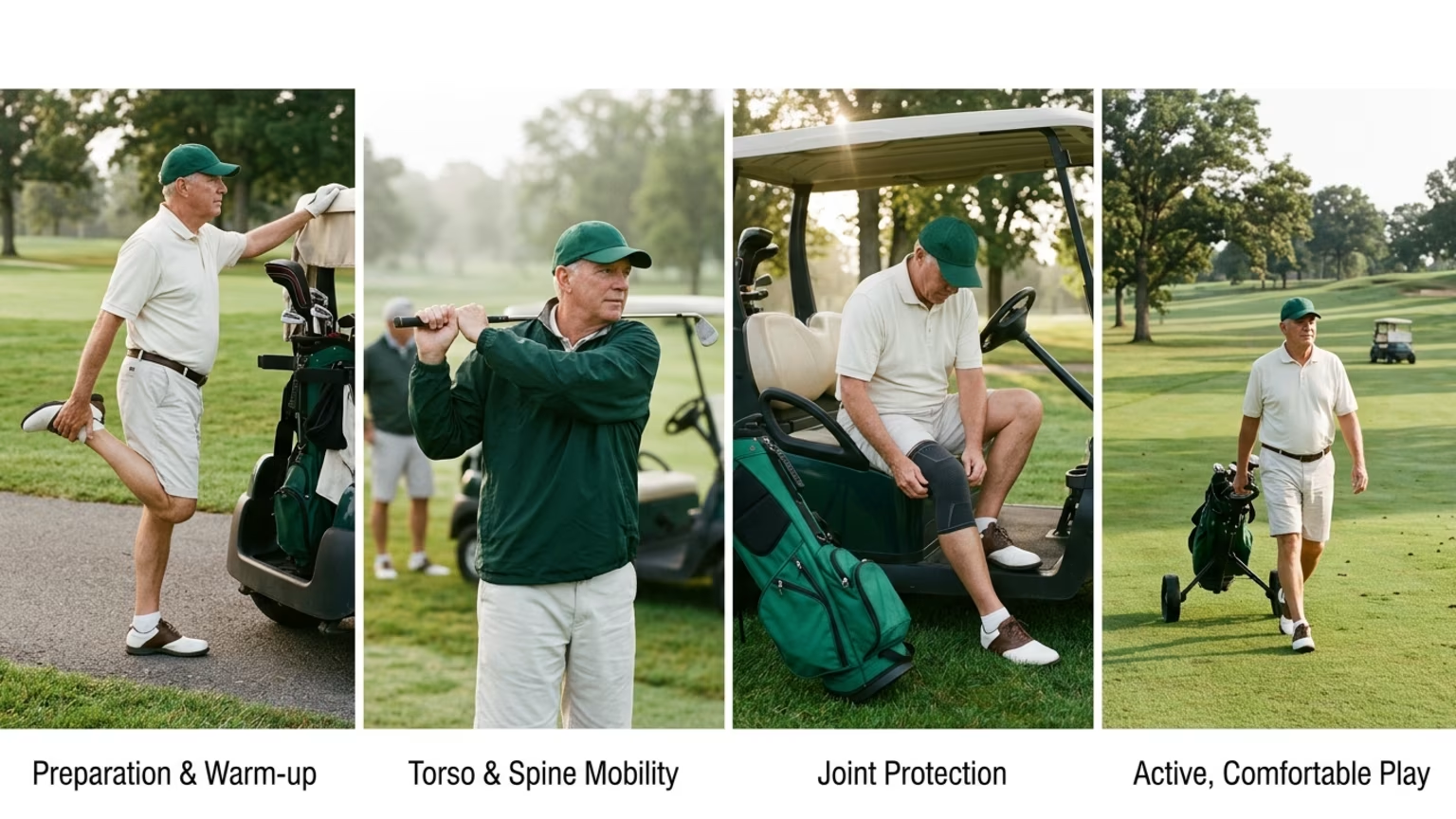

Prepare your body for the first tee with a repeatable, low-intensity routine. Progress safely from general movement to controlled swings before playing.




Understanding why rushing from your car to the first tee harms swing mechanics is the first step toward better play for experienced golfers. Many players grab a driver, step up to the ball, and attempt a full-speed swing with cold muscles. This abrupt transition from resting to high-intensity swinging places unnecessary stress on an older frame. Kriz Physical Therapy, summarizing the International Consensus Statement on Golf and Health, describes a safer sequence of aerobic activity, golf-specific mobility, and practice swings.
The 4-step pre-round protocol provides a clear path from the parking lot to the first tee:
Before beginning any physical preparation, it helps to understand how your body is moving on that specific morning. Every day presents a slightly different physical baseline for golfers over forty. A long drive to the course, a poor night of sleep, or lingering soreness from a previous round can alter your mobility. Checking your current range of motion gives you a clear starting point for the day.
Stand tall with your feet shoulder-width apart, cross your arms comfortably over your chest, and slowly turn your torso to the right. Return to the center, and then turn smoothly to the left. During this simple movement, notice where you feel resistance, stiffness, or hesitation in your rotation. Sports Medicine Weekly advises golfers to pay attention to stiffness or pain before ramping up their swings.
If turning feels restricted in one direction, you know to keep your initial stretches smaller and slower on that side. This check is not a test to pass or fail, but rather a way to gather information about your joints before you apply force to them. Using this information allows you to scale the rest of your preparation to match your current capability. Listening to these early signals means your routine remains safe and effective.
Moving from a resting state to a full golf swing requires a gradual, deliberate approach. Kriz Physical Therapy offers a practical example for this physical transition. They suggest spending three to five minutes on easy movement before focusing on joint mobility, controlled rotations, and progressively larger swings. A routine lasting five to ten minutes is usually sufficient for most older players.
Begin with general movement to get your blood flowing and raise your heart rate slightly. A brisk walk from the parking lot to the clubhouse, or marching in place near the practice green, serves this purpose well. This initial phase requires no equipment, uses no golf clubs, and focuses entirely on waking up the body. Keep the pace comfortable, breathe steadily, and allow your muscles to loosen up naturally.
Once you are moving comfortably, shift your attention to the specific joints used heavily in the golf swing. Sports Medicine Weekly suggests that older golfers begin with easy movement and controlled mobility. Work through controlled shoulder circles, making the circles gradually larger as the joint warms up. Keep your breathing relaxed and avoid forcing your arms past their natural stopping point.
Follow this with gentle hip rotations, treating the movement like you are tracing a circle with your belt buckle. Next, perform simple trunk turns to engage the spine, turning only as far as your body permits without pain. Finish with ankle mobility exercises, rolling smoothly from heel to toe, to prepare your lower body for the weight shift required during a golf shot. Actively priming rotational joints before a round starts helps protect your early swing mechanics.
With your main joints prepared, introduce a rotational element that mimics the swing path without holding a club. Keep your arms relaxed at your sides or crossed over your chest, and turn your torso back and forth. Focus entirely on turning your trail hip and rotating your chest smoothly. Kriz Physical Therapy notes that dynamic and resistance-based warm-ups tended to improve performance measures for golfers.
However, their summary of the systematic review also states that evidence linking warm-ups to injury reduction was mixed. This preparation helps you move well and strike the ball cleanly, but it is not a proven guarantee against all physical issues. Frame this time as an opportunity to groove your movement pattern, not a medical treatment.
Finally, integrate a golf club into the routine to complete your physical preparation. Sports Medicine Weekly recommends progressing from short-iron half swings toward fuller swings. Start with a pitching wedge or nine iron, take a half swing at a slow pace, and feel the weight of the clubhead moving through the air. Focus on balance and rhythm rather than speed or power.
Slowly increase the length and speed of the swing as your body tells you it is ready. Move from half swings to three-quarter swings, taking a few repetitions at each stage. If you feel any lingering stiffness, stay with smaller swings a little longer before attempting a full driver swing. This step bridges the gap between basic mobility and actual golf performance.
The most frequent mistake older players make is treating their preparation time as a test of strength or flexibility. Taking a full-speed swing with a driver on the very first attempt defeats the entire purpose of a progressive routine. Another common error is ignoring the body's signals and trying to force a tight joint past its comfortable limit. Pushing through pain rarely improves mobility on the course.
Some golfers also rush through the steps, turning a deliberate mobility exercise into a frantic, jerky movement. The goal is to prepare your tissues for rotation, not to break a sweat as quickly as possible. If a specific exercise causes discomfort, adjusting the range of motion or slowing the pace is always the correct choice. A sound physical routine remains comfortable and highly adaptable to how you feel each specific day.
The physical benefits of your preparation can fade quickly if you sit completely idle in a golf cart between every shot. To maintain your physical readiness out on the fairway, incorporate small movements into your normal pace of play. Taking a few controlled trunk turns while waiting on the tee box keeps your spine and hips active. Adapting your mechanics for longevity includes managing your downtime during slow rounds.
You can also use your walk to the ball as a way to sustain your baseline mobility. A brisk walk down the fairway, rather than riding every single yard, keeps the blood flowing to your legs and core. If you must ride in a cart, take a moment to stand up, stretch your arms, and perform a few hip rotations before selecting your club. These small habits help preserve your swing motion seamlessly throughout the entire round.
The ten-minute investment today saves you eighteen holes of stiffness and frustration tomorrow.
Follow Golfergy for practical insights on performance, mobility, recovery and healthy ageing. Stay connected for new articles, research-led guidance and ideas to help you play better for longer.



Understand how your hips and mid-back contribute to a golf turn, with practical habits that put comfort ahead of extra backswing length.


A progressive golf warm-up for players over 40, moving from easy activity to fuller practice swings without treating preparation as a flexibility test.
Observe comfortable movement and control to frame better questions about your golf swing, with guidance on when pain needs professional assessment.
Explore practical resources on performance, recovery, mobility and golf longevity.
Read the Blog


